
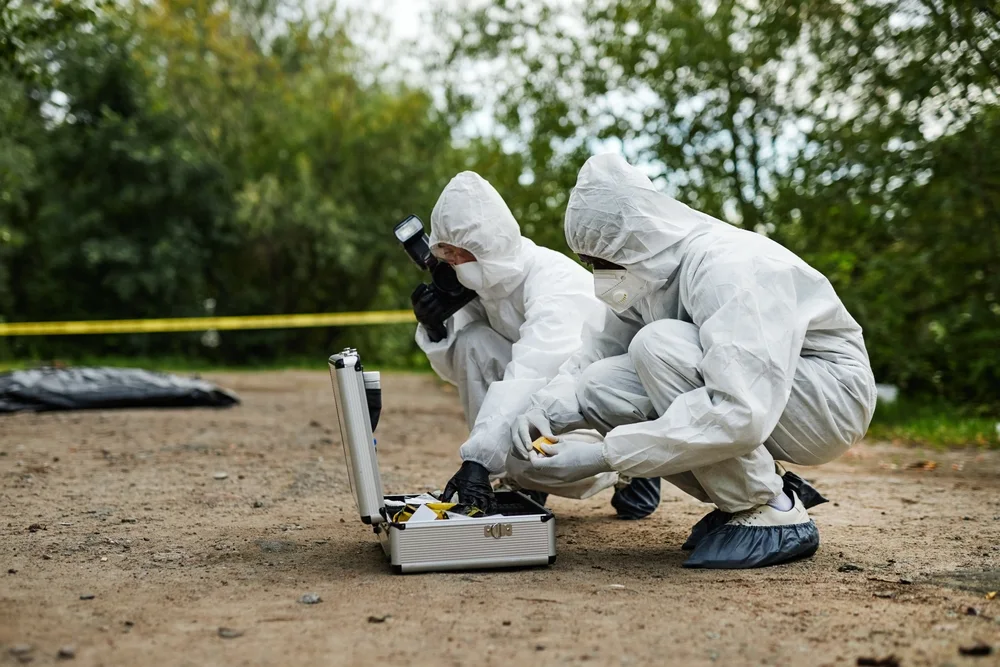
CSI and forensic science are not a single career path. In California, the terms cover field investigators who document crime scenes, laboratory scientists who analyze physical evidence, technicians who manage evidence, specialists who compare fingerprints or firearms, digital examiners, and professionals working in medicolegal death investigation.
The education required depends on the work. Some municipal crime scene positions accept high school graduation supplemented by specialized training, while others require an associate degree, professional experience, or both. California Department of Justice criminalists need bachelor’s-level preparation in a physical or biological science, including specified chemistry coursework. Careers such as forensic psychology, forensic anthropology, and forensic pathology require graduate or professional education far beyond a typical CSI degree.
Job titles also vary by agency. A crime scene investigator can be a civilian employee in one police department and a sworn officer assignment in another. Similarly, “forensic specialist” can describe scene processing, DNA analysis, computer forensics, or a combination of functions.
This guide separates the main career paths, explains California hiring patterns, and shows how to align education with the work rather than relying on a job title alone.
California forensic career paths compared
| Career path | Primary work | Common educational foundation | Typical setting | Main career-planning issue |
|---|---|---|---|---|
| Civilian crime scene investigator or forensic specialist | Photography, scene documentation, evidence recovery, fingerprints, impressions, presumptive testing | Requirements range from relevant coursework or training to an associate or bachelor’s degree plus experience | Police departments, sheriff’s offices, crime-scene units | Many jobs require prior technical or law-enforcement experience even when a bachelor’s degree is not mandatory |
| Sworn officer assigned to CSI | Law-enforcement duties plus specialized crime-scene response | Police-academy and peace-officer preparation, followed by agency training | Police and sheriff’s departments | This route begins as a law-enforcement career, not as direct civilian forensic employment |
| Criminalist or laboratory forensic scientist | Chemical, biological, microscopic, instrumental, or comparative evidence analysis | Bachelor’s degree in chemistry, biology, forensic science, or another qualifying natural science | State, county, city, or federal laboratories | Science coursework matters more than the word “forensic” in the degree title |
| Evidence or property technician | Evidence intake, chain of custody, storage, records, release, and disposal | Employer-specific education and administrative or evidence-handling experience | Police property rooms and evidence units | The work can support investigations without including full scene processing or laboratory analysis |
| Latent-print examiner | Fingerprint comparison, database searches, reports, scene response, and testimony | Agency-specific combinations of education, training, casework, and certification | Identification units and forensic laboratories | Developing prints at a scene is different from performing advanced comparison casework |
| Digital evidence examiner | Examination of computers, phones, networks, cloud data, video, and storage media | Computing, information technology, engineering, cybersecurity, or digital-forensics education | Police units, laboratories, prosecutor offices, and specialized investigative teams | A traditional CSI curriculum may not provide enough computing depth |
| Forensic toxicologist | Analysis and interpretation of alcohol, drugs, poisons, and metabolites | Life or physical science degree with chemistry, toxicology, and pharmacology preparation | Crime laboratories, medical examiner offices, and toxicology laboratories | This is a laboratory science pathway requiring strong chemistry and quality-control preparation |
| Forensic biologist or DNA analyst | Biological evidence examination, DNA analysis, statistical interpretation, and reporting | Bachelor’s degree in a qualifying science with relevant biology, genetics, biochemistry, and statistics | Public forensic laboratories | DNA positions can require specific courses beyond general degree completion |
| Firearms and toolmark examiner | Comparison of firearms, bullets, cartridge cases, and toolmarks | Science or forensic education followed by extensive discipline-specific training | Crime laboratories | Independent casework generally follows supervised specialty training |
| Medicolegal death investigator | Death-scene investigation, interviews, identification, records review, and autopsy coordination | County-specific education and experience requirements | Coroner or medical examiner offices | Investigators are not physicians and do not perform the forensic pathologist’s role |
| Forensic autopsy technician | Autopsy assistance, remains handling, facility preparation, and evidence procedures | Relevant college coursework or qualifying experience, depending on the county | Coroner and medical examiner facilities | This is a technical support route, not a pathologist position |
| Forensic pathologist | Autopsies, cause-and-manner determinations, medical reports, and expert testimony | Medical degree, physician licensure, and pathology training | Medical examiner and coroner systems | This is a physician specialty rather than an entry-level forensic science occupation |
| Forensic anthropologist | Skeletal analysis, human identification, excavation, and recovery consultation | Usually a PhD in anthropology with osteology, anatomy, and archaeological training | Universities, laboratories, consulting, and government agencies | Full-time positions are limited and highly competitive |
| Forensic psychologist | Psychological evaluation involving competency, responsibility, commitment, disability, custody, or related legal questions | Doctoral psychology education, supervised experience, examinations, and California licensure | Courts, hospitals, correctional settings, private practice, and government agencies | A forensic psychology degree alone does not authorize independent psychology practice |
Crime scene investigation: field evidence work
Crime scene investigators document conditions at a scene and identify, collect, preserve, and package evidence. Common duties include photography, sketching, measurements, fingerprint processing, biological evidence collection, impression casting, presumptive testing, report writing, and maintenance of chain-of-custody records. Investigators may also participate in reconstruction, attend autopsies, prepare exhibits, and testify about their methods.
The work is more procedural and documentation-intensive than television portrayals suggest. A scene must be processed in a way that preserves context and supports later laboratory examination. Poor packaging can contaminate biological material. Inadequate photographs can leave investigators without a reliable visual record. Incomplete notes can become a problem when a case reaches court months or years later.
California agencies organize these duties differently. Brea classifies its crime scene investigator as a non-sworn employee responsible for major-scene coordination, photography, latent prints, biological evidence, impressions, presumptive testing, and testimony. A Town of Los Gatos career structure, by contrast, lists crime scene investigation as an assignment available to sworn police officers. Neither model applies to every department.
Civilian entry requirements vary substantially. A 2026 City of Costa Mesa recruitment required high school graduation supplemented by college coursework in police science or a related field, with specialized forensic training preferred. Irvine’s 2026 Forensic Specialist I recruitment required an associate degree in criminal justice, criminology, or a related field with forensic coursework plus three years of paid law-enforcement experience, or an equivalent combination. A Redlands recruitment required high school graduation with relevant training and at least one year of forensic specialist or technician experience; an associate degree was highly desirable but not mandatory.
These examples show why a certificate or associate degree can support some municipal CSI routes. They also show why education alone may not be enough. Irvine required paid experience, Redlands required forensic work experience, and Brea described journey-level investigative and analytical responsibilities. An applicant with classroom knowledge but no photography, evidence-handling, fingerprint, or scene-processing practice can still fall short of an employer’s minimum qualifications.
The working conditions are demanding
Crime-scene units operate according to investigative need rather than a standard classroom schedule. California job specifications describe rotating hours, nights, weekends, holidays, overtime, on-call duty, and off-duty response. Personnel may work outside, enter unsafe or contaminated environments, and handle biological material.
The emotional demands are equally real. Crime-scene employees can encounter homicides, suicides, fatal collisions, decomposed remains, child victims, and autopsies. Redlands specifically warned applicants about violent scenes and deadline pressure. The job also requires sustained attention after leaving the scene because photographs, evidence logs, diagrams, and narrative reports must be accurate.
Courtroom credibility is part of the occupation. An investigator may need to explain collection methods, demonstrate that evidence remained secure, and respond to challenges about contamination or documentation. Clear writing and calm testimony are therefore job skills, not peripheral academic requirements.
Criminalists and laboratory forensic scientists
A criminalist applies natural science to physical evidence. Depending on the laboratory and assignment, the work can involve controlled substances, toxicology, DNA, trace materials, firearms, toolmarks, impression evidence, latent prints, gunshot residue, or clandestine laboratory investigations.
The California Department of Justice Bureau of Forensic Services operates 10 regional laboratories serving 46 of California’s 58 counties. Its services include biology, DNA, toxicology, controlled substances, firearms and toolmarks, fingerprints, impression evidence, trace evidence, crime-scene analysis, and related testimony. Other areas of California receive services through city, county, or federal laboratories.
California DOJ uses “Criminalist” as a defined state civil-service classification. Entry applicants must have the equivalent of college graduation with a major in a physical or biological science. Required coursework includes eight semester hours of general chemistry and three semester hours of quantitative analysis. The class serves as the entry, training, and subjourney level in the state series.
Those requirements explain why a general criminal justice degree is a poor fit for many laboratory careers. A program can include forensic terminology, crime-scene courses, and evidence law while providing too little chemistry for the DOJ Criminalist classification. A science-based forensic degree can work, but only if its underlying coursework satisfies the employer’s natural-science and chemistry requirements.
Laboratory scientists operate instruments, perform analytical procedures, evaluate controls, document findings, prepare technical reports, and testify when required. New employees typically complete supervised specialty training before handling independent casework. The degree establishes scientific preparation; it does not represent full professional competency in a laboratory discipline.
California DOJ’s laboratory system is accredited by the ANSI National Accreditation Board to ISO/IEC 17025 for activities within its accreditation scope. That means casework occurs within documented systems addressing methods, validation, competency, evidence handling, reporting, and quality assurance. The NIST Forensic Science Standards Program similarly supports standards and guidance intended to produce valid, reliable, and reproducible forensic results.
Applying for California DOJ criminalist work
State hiring has several stages. Candidates first complete the relevant civil-service examination. Successful candidates are placed on an eligibility list, which the researched Criminalist bulletin described as valid for 12 months. Candidates then apply for vacancies, interview, complete required screening, and serve a probationary period if appointed.
Passing the examination does not produce a job offer. It establishes eligibility to compete for appointments.
The DOJ Criminalist bulletin also required drug screening. Its knowledge and ability areas covered chemistry, toxicology, physiological-fluid testing, trace evidence, firearms and toolmarks, chromatography, scientific crime-scene methods, technical reporting, and testimony. Academic preparation in analytical chemistry, statistics, instrumental analysis, molecular biology, and technical writing can therefore have practical value beyond meeting the minimum course count.
Laboratory specialty careers
“Crime lab analyst” is not one uniform job. Each discipline has its own scientific foundation, methods, training sequence, and competency requirements.
Forensic biology and DNA analysis
Forensic biology personnel locate, identify, and examine biological material. DNA analysts develop and interpret genetic profiles, evaluate statistical results, document quality controls, and prepare reports. Casework can involve crime-scene samples, reference samples, missing-person investigations, and database functions.
A City of Glendale forensic classification separates forensic services, forensic biology, and computer forensics into different assignments. Its forensic-biology route requires a bachelor’s degree in a chemical, physical, biological, forensic, or related science and requires candidates to satisfy applicable DNA analyst educational standards. The specification identifies genetics, molecular biology, biochemistry, statistics, and population genetics as relevant preparation.
A biology degree without the required supporting courses can therefore be incomplete preparation for DNA work. Conversely, a forensic science degree with substantial molecular biology, genetics, biochemistry, and statistics can align well with the field. Course titles and credit hours matter because laboratories may review transcripts rather than accepting the degree title as sufficient evidence.
Forensic toxicology
Forensic toxicologists analyze alcohol, drugs, poisons, and metabolites in biological samples. The field includes postmortem toxicology, human-performance toxicology, and forensic drug testing. Duties can include extraction, instrumental analysis, quality-control review, interpretation, reporting, and testimony.
The American Academy of Forensic Sciences identifies a bachelor’s degree in a life or physical science as the initial educational foundation. Chemistry, pharmacology, and toxicology are especially relevant, and many practitioners hold graduate degrees.
This route favors a curriculum with general and organic chemistry, analytical or quantitative chemistry, biochemistry, physiology, statistics, and instrumental methods. A scene-processing certificate does not provide the laboratory depth expected for toxicology. Practical familiarity with chromatography, mass spectrometry, calibration, controls, and method validation can strengthen preparation, although employers provide their own method-specific training.
Firearms and toolmark examination
Firearms examiners compare bullets, cartridge cases, firearms, and toolmarks. Work can include operability testing, serial-number restoration, distance determination, microscopic comparison, and reconstruction-related analysis.
A Santa Ana class specification describes firearms examination as an advanced specialist role requiring prior firearms and toolmark casework and qualification as an expert witness. That is not an entry-level benchmark for every laboratory, but it illustrates the experience expected at an advanced career stage.
The normal preparation sequence includes relevant academic science, entry into a laboratory or training role, supervised discipline-specific instruction, competency assessment, and progressively independent casework. General firearms familiarity is not equivalent to professional comparison training.
Latent-print examination
Latent-print work can occur at two levels. Crime-scene personnel may develop and lift impressions using powders, chemicals, alternate light, or other methods. Dedicated examiners perform detailed comparisons, conduct automated database searches, prepare conclusions, and testify as experts.
Oakland maintains a nonsworn Latent Print Examiner classification involving independent comparisons, crime-scene response, reports, automated searches, and testimony. Its journey-level classification requires substantial casework experience and current International Association for Identification latent-print certification. This is an employer-specific advanced requirement, not a statewide mandate.
The distinction between print development and print comparison should shape training choices. A field CSI course may teach recovery techniques, while an examiner career requires deeper instruction in friction-ridge anatomy, comparison methodology, documentation, decision-making, and supervised casework.
Questioned-document examination
Questioned-document examiners evaluate handwriting, signatures, printing processes, inks, paper, alterations, impressions, and other document features. According to AAFS career guidance, standard preparation includes a bachelor’s degree or higher in forensic science, science, or a related field plus at least 24 months of structured supervised training.
This specialty illustrates the limits of classroom-only education. Academic work can build scientific reasoning and introduce document principles, but independent examination depends on extended training under qualified practitioners.
Evidence and property technician careers
Evidence technicians often work in the same agency as crime scene personnel, but their central responsibility may be evidence control rather than full scene processing. Duties can include receiving property, recording transfers, maintaining secure storage, preparing items for laboratory submission, returning property, arranging lawful disposal, and preserving the chain of custody.
A 2026 City of Lemoore Evidence Technician recruitment focused on evidence control, records, return or destruction of property, clerical support, and assistance with crime-scene investigations. The position supported CSI operations without being equivalent to a criminalist or full crime-scene investigator.
This route can be useful for gaining public-safety experience and learning evidence procedures. It also requires careful administrative work. An evidence room can contain biological material, controlled substances, firearms, currency, and property associated with ongoing litigation. Inventory accuracy, secure access, retention schedules, and documented disposition are central to the job.
Some agencies combine property-room and scene duties. Others place them in separate classifications. Candidates should read the duty statement closely because the title “evidence technician” does not reveal how much time is spent at scenes.
Digital forensics careers
Digital evidence examination has a different technical foundation from conventional CSI and wet-laboratory criminalistics. Examiners may analyze computers, phones, storage media, cloud systems, surveillance video, networks, images, audio, and application data. Their work can include acquisition, preservation, recovery, timeline analysis, reporting, and testimony.
AAFS describes a bachelor’s degree in computer science, information technology, engineering, or a related technical discipline as common preparation for a digital-forensics apprenticeship. California employers can use other combinations. Pasadena’s Computer Forensic Examiner classification lists an associate degree with relevant computing or digital-forensics coursework plus substantial technical experience as a typical route, with a bachelor’s degree able to substitute for part of the experience requirement.
Digital examiners must preserve evidentiary integrity while working with systems that change rapidly. Technical areas can include operating systems, file systems, networking, scripting, databases, mobile devices, cloud architecture, hashing, acquisition methods, and forensic software. Legal constraints also influence collection and analysis, particularly when work supports search warrants.
A traditional crime-scene program with one introductory computer-forensics course is usually too narrow for advanced digital examination. Computer science or information technology education with specialized evidence training provides a stronger technical base. Depending on the agency, digital work may be performed by civilian specialists, sworn investigators, laboratory employees, or personnel in hybrid technical roles.
Medicolegal death investigation
Death investigation includes several professions with separate authority and education requirements. A forensic pathologist, deputy coroner investigator, and autopsy technician may work on the same case, but they do not perform interchangeable jobs.
Deputy coroner investigator
Deputy coroner investigators respond to reportable deaths, document scenes, photograph conditions, interview witnesses, establish identity, review records, collect evidence or specimens, coordinate transportation, and work with pathologists and funeral-service personnel. They may also notify or communicate with grieving families and testify about investigative findings.
A Shasta County classification includes scene investigation, witness interviews, evidence collection, autopsy coordination, standby coverage, transportation of remains, and interaction with medical and law-enforcement personnel. Exact authority, sworn status, and entry requirements vary by county.
This work combines investigative skill with extensive communication. Medical terminology, anatomy, report writing, scene photography, evidence procedures, and an understanding of death investigation can be useful educational areas. The emotional demands are substantial because the role involves frequent contact with sudden death and bereaved families.
Forensic autopsy technician
Autopsy technicians assist forensic pathologists, prepare examination areas, handle and release remains, maintain instruments and facilities, and package or transport evidentiary material. San Luis Obispo County lists either two years of relevant college coursework or two years of qualifying experience handling human remains as example entry routes for its classification.
This is a nonphysician technical pathway into medicolegal services. It requires comfort with postmortem procedures, biological hazards, sanitation protocols, detailed documentation, and respectful remains handling. It does not grant authority to determine cause of death independently.
Forensic pathologist
Forensic pathologists are physicians who conduct autopsies, review medical history, determine cause and manner of death, issue reports, consult with investigators, and provide expert testimony. They may also respond to death scenes after regular hours.
The profession requires medical-school graduation, physician licensure, and pathology training. County classifications may also require specified forensic-pathology experience and professional credentials. An undergraduate forensic science degree can provide background knowledge, but it is not professional qualification for this physician specialty.
Advanced forensic professions outside conventional CSI
Several careers use forensic methods without being crime-scene or criminalistics positions. Their educational routes are much longer or more specialized than a general CSI pathway.
Forensic anthropology
Forensic anthropologists apply biological anthropology, human osteology, anatomy, archaeology, excavation, and mapping to human remains. They may assist with identification, biological profile development, trauma interpretation, recovery, and the distinction between human and nonhuman material.
AAFS reports that forensic anthropologists usually earn a PhD in anthropology with emphasis on osteology and anatomy. Many practitioners are university professors who consult on casework, and full-time positions are limited and highly competitive.
A bachelor’s degree in anthropology can begin the academic route but usually does not lead directly to professional forensic anthropologist employment. Students need advanced skeletal biology, anatomy, statistics, archaeological field methods, research, and graduate mentorship.
Forensic psychology
Forensic psychologists apply psychological expertise to legal questions involving competency, criminal responsibility, civil commitment, disability, custody, risk, and related matters. This is a regulated psychology pathway rather than a crime-scene career.
Independent practice as a psychologist in California requires a qualifying doctoral degree, 3,000 hours of supervised professional experience including 1,500 postdoctoral hours, passage of the Examination for Professional Practice in Psychology and the California Psychology Laws and Ethics Examination, required coursework, and fingerprinting.
A bachelor’s or master’s program labeled forensic psychology can provide academic preparation for further study, research, case management, or some support roles. It does not by itself authorize independent practice as a psychologist.
Psychiatry follows a medical route. A forensic psychiatrist completes medical education, physician training, general psychiatry residency, and often further forensic training.
Education choices by career goal
The most useful degree is the one that satisfies repeated requirements for the intended work.
For field CSI work
Prioritize coursework and applied training in:
- Crime-scene documentation
- Digital photography and image management
- Evidence recognition and recovery
- Fingerprint development
- Biological evidence handling
- Impression evidence
- Measurements, sketches, and diagrams
- Chain of custody
- Report writing
- Courtroom testimony
- Safety and bloodborne-pathogen procedures
Criminal justice education can be relevant when it includes substantial forensic practice. However, field positions frequently value demonstrated photography, scene, and evidence experience. An associate degree or certificate can qualify a candidate for some classifications, but other employers require a bachelor’s degree, several years of experience, or an equivalent combination.
For laboratory criminalistics
Prioritize natural science and mathematics:
- General chemistry
- Organic chemistry
- Quantitative or analytical chemistry
- Biology
- Molecular biology
- Genetics
- Biochemistry
- Physics
- Statistics
- Instrumental analysis
- Laboratory methods
- Scientific writing
California DOJ’s requirement for a physical or biological science major, eight semester hours of general chemistry, and three semester hours of quantitative analysis provides a concrete baseline for state criminalist planning. Other laboratories can impose different or more specialized requirements.
A generic criminal justice degree normally lacks the chemistry and laboratory sequence needed for criminalist hiring. Adding a forensic certificate later may not repair major science deficiencies efficiently. A natural science bachelor’s degree with forensic coursework preserves more laboratory options.
For digital evidence
Build technical depth in:
- Computer science or information technology
- Operating systems
- File systems
- Networking
- Scripting or programming
- Databases
- Cybersecurity
- Mobile systems
- Cloud computing
- Digital-evidence acquisition
- Technical reporting
Digital examiners need both computing competence and evidence discipline. Training on one commercial tool is less durable than broad knowledge of how systems store, transmit, and alter data.
For medicolegal work
Preparation depends on the role. Coroner investigation benefits from scene investigation, anatomy, medical terminology, interviewing, writing, and evidence procedures. Autopsy support calls for anatomy, safety, remains handling, and facility procedures. Forensic pathology requires the full physician pathway.
These routes should not be collapsed into a general recommendation to earn a forensic science degree.
Readers comparing educational options can use the broader California CSI degree and training resources on this site, while keeping the target occupation’s actual course requirements in view.
Accreditation, certification, and professional training
The Forensic Science Education Programs Accreditation Commission, or FEPAC, accredits qualifying bachelor’s and master’s programs in forensic science as well as certain natural or computer science programs with forensic concentrations. Accreditation applies to a specific academic program, not every program offered by the institution.
FEPAC review provides evidence that a program has been evaluated against forensic-science education standards. It is not individual licensure, and it is not a universal hiring requirement. FEPAC also acknowledges that non-accredited programs can provide suitable education. A non-FEPAC curriculum can still prepare graduates effectively when it includes the required science, mathematics, laboratory work, and forensic content.
FEPAC is most relevant to criminalistics and closely related forensic science education. It is not the appropriate measure for psychology, anthropology, pathology, or every criminal justice program.
The International Association for Identification administers certifications in crime-scene investigation, latent prints, tenprint identification, forensic photography, forensic video, footwear, forensic art, and bloodstain-pattern analysis. Its crime-scene credentials include Certified Crime Scene Investigator, Certified Crime Scene Analyst, and Certified Senior Crime Scene Analyst.
California employers use certification differently. Ventura lists IAI crime-scene, latent-print, or other professional certification as desired. Irvine’s higher forensic specialist level required proof of latent-print certification or completion of a comparison training program. Oakland requires current IAI latent-print certification for the journey-level examiner classification described in its specification.
Certification usually follows education, training, and qualifying experience. It does not replace an employer’s degree, background, casework, or competency requirements.
The California Criminalistics Institute provides specialized practitioner training in chemistry, firearms, impressions, biology, DNA, crime scenes, toxicology, trace evidence, safety, and professional development. Its students include criminalists, evidence technicians, detectives, and crime scene investigators. This training supports working professionals and agencies; it is not a substitute for the college science required for a criminalist appointment.
Salary and employment outlook
Salary data for CSI careers requires careful interpretation because national and state databases use the broad “forensic science technicians” occupation. That category covers or overlaps multiple field and laboratory jobs. It does not provide an exact salary for every civilian CSI, evidence technician, latent-print examiner, criminalist, or digital examiner.
The U.S. Bureau of Labor Statistics reported a national median wage of $67,440 in May 2024 for forensic science technicians. National employment is projected to grow 13 percent from 2024 through 2034, with about 2,900 openings per year on average.
California wages are higher in the statewide occupational data. The California Employment Development Department reported the following first-quarter 2026 hourly figures for forensic science technicians:
- 25th percentile: $39.94
- Median: $50.46
- Mean: $51.87
- 75th percentile: $65.64
The $50.46 hourly median equals approximately $104,957 over 2,080 paid hours. That annual figure is an arithmetic conversion, not a quoted EDD annual salary. It is also not an entry salary or a promise of earnings in a particular classification.
EDD projects California forensic science technician employment to rise from 2,200 positions in 2022 to 2,600 in 2032. That represents 18.2 percent growth, but only about 400 additional jobs over ten years. The favorable percentage should be read alongside the occupation’s small employment base.
Recent municipal salary schedules show how widely classifications can differ:
- Costa Mesa listed $79,980 to $107,172 for a 2026 Crime Scene Investigator recruitment.
- Irvine listed $68,411.20 to $122,803.20 across Forensic Specialist I and II levels in 2026.
- Redlands listed $76,979 to $95,964 for a July 2026 Forensic Specialist recruitment.
- Lemoore listed $43,961 to $56,107 for a 2026 Evidence Technician recruitment.
These are dated employer examples, not statewide averages or guaranteed current vacancies. The ranges can reflect steps, experience levels, bargaining agreements, or separate classification levels. Overtime and on-call compensation can further affect actual earnings.
Public-agency screening and hiring
California forensic hiring often extends beyond education and an interview. Depending on the agency and classification, the process can include:
- A detailed personal-history statement
- Fingerprinting
- Criminal and employment background investigation
- Driving-record review
- Drug screening
- Psychological examination
- Medical or physical requirements
- Reference checks
- Transcript review
- Practical, written, or oral examinations
- Probation after appointment
Irvine’s Forensic Specialist recruitment required a public-safety background process that included a psychological examination. California DOJ criminalist applicants face a civil-service examination and drug screening. Digital-forensics positions may also require extensive background review because employees can access sensitive data and criminal evidence.
A criminal record is not the only possible concern. Accuracy in application materials, honesty during the background process, financial or employment history where relevant, driving qualifications, and conduct involving controlled substances can affect public-safety hiring. Agencies need personnel whose documentation and credibility can withstand courtroom scrutiny.
Many field positions also require a California driver’s license or the ability to obtain one. Crime-scene personnel may drive department vehicles, respond after hours, and transport equipment or evidence.
How to build a practical route into the field
Begin with the work environment, not the broad label “forensics.”
-
Choose a primary track. Decide whether the goal is field investigation, natural-science laboratory analysis, digital evidence, identification work, medicolegal death investigation, or a regulated advanced profession.
-
Collect current job descriptions. Review five to ten classifications from agencies where employment is geographically realistic. Separate minimum requirements from desirable qualifications and note repeated courses, degrees, experience, licenses, and shift expectations.
-
Build the correct academic foundation. Field CSI preparation should include photography, documentation, evidence recovery, fingerprints, and reporting. Laboratory preparation should emphasize chemistry, biology, mathematics, and hands-on science. Digital work requires substantial computing education.
-
Develop applied experience. Useful experience can come from laboratory work, photography, evidence-room support, internships, research, law-enforcement employment, technical computing roles, or supervised scene exercises. The best type depends on the target position.
-
Keep detailed academic records. Laboratory employers may evaluate transcripts course by course. Save catalog descriptions and syllabi for classes such as quantitative analysis, genetics, molecular biology, statistics, and instrumental analysis.
-
Prepare for public-safety hiring. Complete applications carefully, maintain an accurate history of employment and residences, and expect an extensive background process.
-
Complete employer training. Entry into a laboratory or scene unit begins another stage of development. New employees learn agency procedures, validated methods, quality controls, reporting standards, safety practices, and testimony expectations before receiving full independent responsibility.
-
Pursue certification at the appropriate career stage. Professional credentials can support advancement or satisfy an employer-specific requirement after the necessary training and experience have been completed.
A short forensic certificate can be useful for adding scene-processing skills to an existing education or strengthening eligibility for a particular technician classification. It is not a universal bridge into criminalist, DNA analyst, toxicologist, psychologist, anthropologist, or pathologist work.
Choosing a direction
Field CSI work is the closest match for people interested in photography, evidence recovery, scene documentation, irregular response schedules, and courtroom testimony. A focused certificate or associate degree can support some municipal routes, although experience requirements can still be substantial.
Laboratory criminalistics is better aligned with strong preparation in chemistry, biology, mathematics, and scientific instrumentation. California DOJ’s criminalist requirements make the central issue clear: laboratory employers evaluate the underlying science, not merely the presence of “forensic” in a degree title.
Digital evidence favors computing education. Forensic biology and DNA require specific life-science courses. Toxicology requires chemistry and pharmacology-related preparation. Latent-print, firearms, and questioned-document careers develop through specialty training and supervised casework. Medicolegal death work divides into investigative, technical, and physician-level roles, each with a different educational route.
The most reliable planning method is to compare multiple California job descriptions and build toward the requirements that recur. That approach reveals whether an associate degree is sufficient for the intended field position, whether a bachelor’s degree needs more chemistry, whether experience can substitute for education, and whether the job is civilian, sworn, laboratory-based, or primarily evidence custody. It also prevents an appealing program title from steering a student toward coursework that does not qualify them for the career they actually want.