A forensic science degree can lead to several kinds of work in California: criminalist or forensic scientist positions, DNA and forensic biology analysis, drug chemistry, toxicology, trace evidence, firearms examination, crime-scene investigation, latent print work, evidence management, and laboratory support. Wildlife forensics is another specialized state pathway.
The degree title alone is rarely the deciding credential. California employers often evaluate the major, individual science courses, laboratory experience, technical skills, and prior training. A chemistry-heavy forensic science degree may support criminalist or toxicology work. A biology-heavy curriculum with genetics, molecular biology, biochemistry, and statistics is better aligned with DNA analysis. A field-oriented program emphasizing photography, fingerprints, evidence recovery, and scene documentation is more relevant to civilian crime-scene positions.
Digital forensics, questioned-document examination, medicolegal investigation, and autopsy work are more conditional options. Each requires specialized preparation beyond what many general forensic science programs provide.
This guide focuses primarily on documented California state, county, and municipal career pathways. Private laboratories and federal jobs based in California also employ forensic personnel, but they are not comprehensively inventoried here.
California forensic science careers at a glance
| Job or specialty | Primary work | Strongest academic preparation | Is a general forensic science bachelor’s usually enough? | Common additional requirements |
|---|---|---|---|---|
| Criminalist or forensic scientist | Analyze physical evidence and report scientific findings | Chemistry, biology, criminalistics, quantitative analysis, laboratory methods | Potentially, if the degree and transcript satisfy the science requirements | Civil-service examination, transcript review, background screening, drug screening, employer training |
| Forensic biology or DNA analyst | Analyze biological evidence and develop or interpret DNA profiles | Molecular biology, genetics, biochemistry, statistics or population genetics | Only if the curriculum includes the required DNA foundation courses | Documented laboratory training and casework competency |
| Drug chemistry analyst | Identify controlled substances using chemical methods and instruments | General chemistry, organic chemistry, analytical or quantitative chemistry, instrumentation | Often possible with a chemistry-intensive degree | Laboratory training, competency testing, quality-system documentation |
| Trace evidence analyst | Examine fibers, hair, glass, paint, debris, metals, or other small materials | Chemistry, microscopy, materials science, instrumental analysis | Possible when the degree includes substantial laboratory science | Specialty training and supervised casework |
| Firearms and toolmarks examiner | Examine firearms, ammunition, toolmarks, and comparison evidence | Physical science, forensic science, physics, microscopy | May support entry, but extensive specialty training is normal | Employer training, competency demonstrations, courtroom preparation |
| Forensic toxicologist | Test biological specimens for alcohol, drugs, poisons, or toxic substances | Toxicology, pharmacology, biochemistry, chemistry, quantitative analysis | Only when the transcript satisfies defined laboratory-science requirements | Some positions require post-hire forensic alcohol certification |
| Wildlife forensic specialist | Apply biology, genetics, chemistry, and forensic methods to wildlife evidence | Biological science, genetics, molecular biology, biochemistry, organic or quantitative chemistry | Only if the major and exact courses satisfy the state specification | California examination and laboratory training |
| Forensic laboratory technician | Prepare evidence, reagents, samples, and equipment under scientific supervision | Forensic science or a natural science with laboratory coursework | Frequently relevant, subject to chemistry or biology requirements | Agency training and work under criminalist supervision |
| Crime scene investigator or forensic specialist | Document scenes and recognize, collect, preserve, and package evidence | Crime-scene processing, photography, fingerprints, impression evidence, report writing | Often relevant; some jobs accept an associate degree or 60 units | Driver’s license, field availability, background investigation, practical training |
| Evidence or property technician | Maintain chain of custody, property records, storage, disposition, and sometimes scene response | Evidence procedures, criminal justice, forensic science, records systems | Often relevant, but requirements vary widely | Agency experience, driver’s license, physical handling duties |
| Latent print examiner or aide | Develop, document, compare, and search fingerprints | Fingerprint science, physical science, forensic technology | Can support aide or trainee entry; not enough for many journey-level roles | Comparison experience, competency development, sometimes professional certification |
| Digital forensic examiner | Recover and analyze evidence from computers, phones, storage devices, and cloud systems | Computer science, networking, operating systems, cybersecurity, digital forensics | Usually not without substantial computing preparation | Technical experience and sometimes industry certifications |
| Questioned-document examiner | Examine handwriting, signatures, paper, ink, and alterations | Physical science plus formal questioned-document training | Usually not as a direct entry credential | Extensive supervised training or prior casework |
| Coroner or medicolegal investigator | Investigate deaths, document circumstances, coordinate evidence, and prepare reports | Physical or health science plus investigative preparation | The degree can be relevant, but it is not the sole qualification | Agency-specific investigative, peace-officer, course, or certification requirements |
| Autopsy technician | Assist with autopsies, body preparation, morgue operations, and specimen handling | Biology, anatomy, forensic science, medical or mortuary coursework | Relevant academically, but experience is often also required | Autopsy, embalming, medical, morgue, or law-enforcement experience |
Why the transcript matters more than the degree title
Forensic science degrees are not standardized around a single curriculum. One program may resemble a chemistry degree with criminalistics courses. Another may concentrate on biology and DNA. A third may be closer to criminal justice, with courses in crime-scene photography, fingerprint development, evidence procedures, and investigations.
Those programs prepare graduates for different jobs.
The clearest California example is the California Department of Justice Criminalist examination. Its entry education standard requires the equivalent of graduation with a major in a physical or biological science, including eight semester hours of general chemistry and three semester hours of quantitative analysis. A candidate who lacks quantitative analysis may take the examination, but must complete the course requirement before appointment.
A forensic science graduate with crime-scene courses but little chemistry could therefore be poorly aligned with California DOJ criminalist eligibility. By contrast, a chemistry or biochemistry graduate who has never taken a course called “forensic science” may satisfy the academic standard and receive specialized forensic training after hiring.
Los Angeles County has used a similar science-centered approach. Its 2026 entry-level Criminalist recruitment accepted bachelor’s degrees specializing in criminalistics, chemistry, biology, biochemistry, or a closely related scientific field, with a stated general chemistry requirement. That recruitment closed in March 2026, so it is evidence of the county’s qualifications rather than a current vacancy.
Transcript review becomes even more specific in DNA work. The current FBI Quality Assurance Standards for Forensic DNA Testing Laboratories, effective July 1, 2025, require an analyst to hold at least a bachelor’s or advanced degree in a biology-, chemistry-, or forensic science-related area. Analysts also need at least nine credit hours of biology- or chemistry-related coursework that supplies a foundation for DNA analysis. Those qualified on or after July 1, 2020 need coursework covering statistics or population genetics.
Laboratory technical leaders review analysts’ education, including academic transcripts. The practical result is simple: molecular biology, genetics, biochemistry, and statistics have far more value for DNA eligibility than a broad collection of survey courses with forensic titles.
Keep official transcripts and detailed course descriptions. Course names do not always reveal whether a class covered quantitative analysis, molecular genetics, population genetics, instrumental analysis, or another required subject.
Direct laboratory career paths
Criminalist or forensic scientist
Criminalist and forensic scientist are among the most direct professional outcomes for graduates with strong natural-science preparation. California agencies do not use the titles consistently, but these positions usually involve the scientific examination of physical evidence.
The California DOJ describes Criminalist as an entry, training, and subjourney-level classification. Work may include laboratory analysis, crime-scene assistance, scientific investigations, report preparation, and testimony. The state’s listed knowledge areas cover biological fluids, explosives and flammable materials, toxicology, trace materials, firearms and toolmarks, questioned documents, photography, chromatography, and crime-scene methods.
A county laboratory may use one broad Criminalist classification and assign employees to different sections. Santa Clara County, for example, has listed assignments involving drug chemistry, trace evidence, firearms and toolmarks, forensic biology and DNA, latent print processing, toxicology, questioned documents, footwear impressions, friction-ridge examination, crime-scene analysis, and computer forensics.
Entry into a classification is followed by substantial training. The California DOJ describes specialized instruction as a normal part of crime-laboratory employment, and a 2026 Los Angeles County recruitment included mandatory classroom and hands-on in-service training. A bachelor’s degree supplies scientific foundations; it does not replace training on validated methods, instruments, quality systems, report review, evidence security, and courtroom testimony.
The strongest undergraduate preparation includes:
- General chemistry
- Organic chemistry
- Quantitative or analytical chemistry
- Biology and biochemistry
- Statistics
- Instrumental analysis
- Laboratory quality assurance
- Scientific writing
- Evidence handling and chain of custody
Crime-scene courses are useful because criminalists can be called to scenes, but field processing should not replace the chemistry and biology needed for laboratory eligibility.
Forensic scientist trainee
Some agencies create a defined training classification below independent forensic scientist work. Ventura County’s Forensic Scientist Trainee specification is one example. It accepts qualifying degrees in forensic science, biochemistry, chemistry, physics, biology, microbiology, and closely related fields, with at least eight semester units of general chemistry.
The trainee participates in an agency-sponsored program and must demonstrate competency before promotion to Forensic Scientist I. Duties can include evidence handling, instrument maintenance, report preparation, validation work, crime-scene attendance, and preparation for testimony.
DNA assignments add more exact academic requirements, including molecular biology, genetics, biochemistry, and population genetics or statistics. This is a useful model for understanding entry into the profession: an employer can hire a well-prepared science graduate into structured training, but progression depends on demonstrated laboratory competence.
A trainee classification is different from a laboratory technician position. The trainee is being developed toward professional casework. A technician generally supplies laboratory support under closer supervision. Neither title guarantees promotion, and agencies structure their classifications differently.
Forensic biology and DNA analyst
DNA analysts examine biological evidence, perform or oversee testing, interpret results, document conclusions, and work within tightly controlled quality systems. The position requires more than general familiarity with DNA.
Preparation should include:
- Molecular biology
- Genetics
- Biochemistry
- Cell biology
- Statistics or population genetics
- Laboratory methods
- Scientific documentation
- Quality assurance
The FBI standards also require documented laboratory training and appropriate forensic human DNA laboratory experience. New analysts therefore complete a supervised progression before independently handling casework.
A biology-focused forensic science degree can align well with this specialty when it includes the required foundation courses. A CSI-focused degree with anatomy, introductory biology, and evidence collection but no genetics, molecular biology, biochemistry, or statistics is too light for DNA analyst preparation.
DNA-related work can also appear under trainee or project classifications. Contra Costa County’s Forensic Analyst - Project classification has included supervised work and progressively responsible training in forensic biology and DNA. The position requires a bachelor’s degree in criminalistics, chemistry, biochemistry, or a closely related natural science. DNA casework carries the molecular biology, genetics, biochemistry, and statistics expectations associated with the FBI standards.
Because this is a project-funded classification supported by state or federal sources, it represents a possible pathway rather than a standard permanent route available at all times.
Controlled substances or drug chemistry analyst
Drug chemistry analysts identify suspected controlled substances using chemical tests, instrumental methods, comparison materials, and laboratory procedures. In many agencies, this is an assignment within the Criminalist or Forensic Scientist classification rather than a separately advertised entry-level job.
Chemistry is the central academic foundation. Useful courses include general chemistry, organic chemistry, analytical chemistry, quantitative analysis, and instrumental analysis. Statistics, quality assurance, and scientific report writing also support the work.
A program built mainly around criminal law, policing, scene photography, and evidence collection will not provide equivalent preparation. Drug chemistry requires the ability to understand chemical separation, measurement, instrument output, uncertainty, controls, contamination, and validated methods.
Graduates interested in this field should search both specialty terms and broad classifications. An agency may advertise “Criminalist” and assign the selected employee to controlled substances after hiring and training.
Trace evidence analyst
Trace evidence can include fibers, hair, glass, paint, metals, soil, debris, and other small materials transferred during an event. Analysts may use microscopy, spectroscopy, chromatography, physical comparisons, and other laboratory methods to evaluate those materials.
The best academic base is usually chemistry or another laboratory-intensive natural science. Microscopy, materials science, instrumental analysis, statistics, and trace evidence courses add direct relevance.
Entry is often through a broad criminalist classification. New employees then receive method-specific training and complete competency requirements before reporting independent conclusions. Because trace units vary in size and scope, standalone entry-level “trace evidence analyst” vacancies may be less common than general criminalist recruitments.
Firearms and toolmarks examiner
Firearms and toolmarks work can include examination of firearms, ammunition components, firing function, microscopic comparison marks, tool impressions, and related physical evidence. Examiners prepare reports and may provide expert testimony.
A forensic science or physical science degree can support entry, especially when it includes physics, microscopy, laboratory measurement, and evidence courses. The specialty still relies heavily on employer-supervised training and competency development. Graduation alone does not establish readiness to conduct independent comparisons.
Contra Costa County’s project forensic analyst classification illustrates one potential bridge. Its assignments may include firearms and toolmarks under supervision, with progressively responsible on-the-job training. Since the position is project-funded, it should be viewed as an example of how agencies build specialty capacity, not as a continuously open statewide occupation.
Forensic toxicologist
Forensic toxicologists analyze biological specimens and other materials for alcohol, drugs, poisons, and toxic substances. The work may support impaired-driving cases, postmortem investigations, or other legal matters, depending on the laboratory.
Contra Costa County’s Forensic Toxicologist I classification requires a bachelor’s degree in toxicology, pharmacology, biochemistry, or a closely related laboratory science. Its coursework requirement includes 12 semester or 18 quarter units of chemistry, including quantitative analysis. Employees must obtain the specified California forensic alcohol analyst certification within one year of employment.
This example shows why toxicology should not be treated as a broad option for every forensic science major. The better preparation is a laboratory-science curriculum with chemistry, biochemistry, pharmacology or toxicology, quantitative methods, and instrumental analysis.
Certification requirements also vary with the role. A forensic alcohol requirement attached to one county classification is not a universal credential for every California toxicology job.
Wildlife forensic specialist
California operates a distinct wildlife-forensics pathway through the Department of Fish and Wildlife. The state’s Wildlife Forensic Laboratory analyzes evidence for wildlife-law and public-safety investigations. Its documented work includes species identification, individual identification, wildlife-trafficking evidence, and incidents involving wildlife and public safety. The laboratory uses DNA-based methods, reports scientific findings, and provides testimony.
The Wildlife Forensic Specialist classification combines biological science, genetics, chemistry, and forensic methods. The state examination was accepting applications continuously as of September 25, 2026, with listed filing cutoffs in 2027.
Eligibility is narrow enough that a generic forensic science degree may not fit. The examination bulletin requires a biological-science degree and specified coursework involving chemistry, biochemistry, organic chemistry or quantitative analysis, and genetics or molecular biology. Graduates interested in this work need a transcript grounded in biology and molecular methods, not only conventional police-forensics courses.
Laboratory support and bridge roles
Forensic laboratory technician
A forensic laboratory technician supports criminalists or forensic scientists rather than independently performing the full scope of professional casework. Kern County’s Forensic Laboratory Technician I classification, for example, includes evidence processing, routine chemical or biological examinations, DNA-sample work, reagent preparation, and laboratory equipment duties under criminalist supervision.
The education standard accepts a bachelor’s degree in forensic science, physical or natural science, or a related laboratory science, subject to laboratory and chemistry or biology coursework requirements.
Technician work can provide relevant laboratory experience, familiarity with evidence procedures, and exposure to quality systems. It is still a separate classification. Advancement into criminalist work requires satisfying the professional classification’s education and selection standards, along with any examination, training, and competency requirements.
This route works better for a graduate who has relevant laboratory coursework but is not yet competitive for independent analytical work. It can also fit someone who prefers scientific support, sample coordination, equipment preparation, and controlled procedures.
The difference among technician, trainee, and criminalist
These labels are easy to confuse because agencies define them differently. A practical comparison is:
- Forensic laboratory technician: Performs support and routine laboratory functions under professional supervision.
- Forensic scientist trainee: Enters a structured development program intended to build competency for professional casework.
- Criminalist or forensic scientist: Conducts scientific examinations within an authorized scope, prepares findings, and may testify as an expert after completing required training.
The progression is not universal. Some laboratories hire directly into an entry-level Criminalist classification and provide training there. Others use trainee classifications. A technician position may remain a distinct support track rather than a formal promotion step.
Field, fingerprint, and evidence careers
Crime scene investigator or forensic specialist
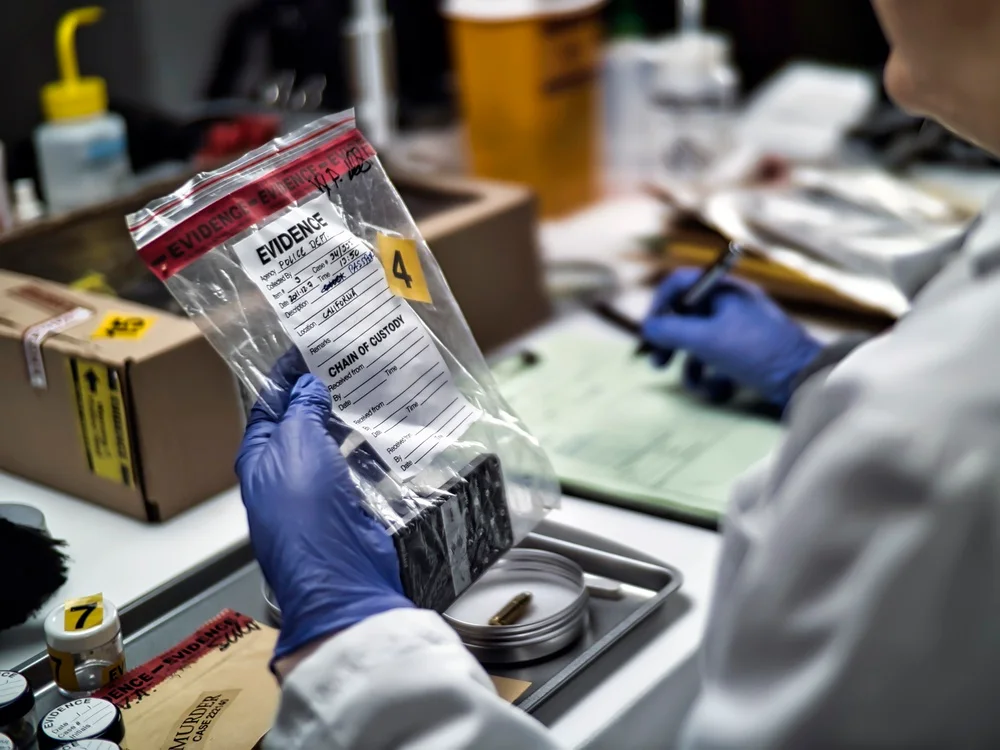
Crime-scene work emphasizes recognizing, documenting, collecting, preserving, and packaging physical evidence. Common duties include photography, sketches or diagrams, measurements, latent print processing, impression evidence, presumptive testing, report writing, chain of custody, and courtroom testimony.
California agencies structure these jobs in several ways. A crime scene investigator can be a civilian employee, a forensic specialist, a criminalist with scene responsibilities, or a sworn assignment. No single statewide education standard covers all of them.
The City of Beverly Hills Forensic Specialist specification provides a civilian example. Duties include scene investigation, photography, sketching, latent print development, impression evidence, presumptive blood and drug tests, reports, testimony, and property or evidence support. Its published minimum qualification allows an associate degree or 60 college units, or two years of full-time law-enforcement identification work.
This demonstrates that a bachelor’s degree is not required for every California field position. A bachelor’s can still strengthen preparation, particularly if the curriculum includes extensive practical work.
Useful CSI coursework includes:
- Crime-scene documentation
- Digital and low-light photography
- Evidence recognition and recovery
- Fingerprint development
- Impression evidence
- Bloodstain documentation
- Scene diagrams and measurements
- Chain of custody
- Report writing
- Courtroom testimony
A chemistry-intensive criminalistics degree may exceed the academic minimum for some CSI roles while providing less field practice than an applied forensic technology program. Career alignment depends on the work performed, not the prestige or level of the degree alone.
Field schedules can also differ from laboratory schedules. The U.S. Bureau of Labor Statistics reports that crime-scene technicians may work staggered shifts, overtime, or on-call schedules. Some criminalists also respond to scenes outside normal hours.
Evidence or property technician
Evidence technicians maintain the integrity, location, storage, release, and legal disposition of physical evidence and property. Depending on the agency, they may also photograph scenes, collect evidence, prepare diagrams, or process latent prints.
South Lake Tahoe’s entry-level Property/Evidence Technician classification combines property-room work with crime-scene investigation, photography, evidence collection, scene diagrams, and latent-print duties. A typical qualification includes 60 college units in forensic science, criminal justice, chemistry, biology, or a closely related field plus law-enforcement agency experience. A related bachelor’s degree may substitute for the experience requirement.
Other agencies may separate field processing from property-room operations. Some evidence jobs devote far more time to records, audits, packaging, storage conditions, legal releases, destruction orders, and chain-of-custody documentation.
Graduates attracted primarily to laboratory analysis should read the duties carefully. An evidence technician title can represent an operational records and property role rather than a bench-science position.
Latent print examiner or aide
Latent print work includes developing fingerprints on evidence, documenting impressions, comparing ridge detail, searching automated systems, maintaining examination records, and testifying about findings.
A forensic science degree can support entry into aide or trainee positions. A closed 2025 City of San Diego recruitment for Latent Print Examiner Aide accepted several education routes, including an associate degree or higher in forensic or physical science. The position normally required 100 hours of print-related experience, but a bachelor’s degree in forensic or physical science could substitute for that experience. The bulletin is useful evidence of an entry route, not a current opening.
Journey-level positions demand much more. Oakland’s Latent Print Examiner II specification includes independent comparisons, automated searches, evidence processing, crime-scene response, reports, mentoring, and expert testimony. Its typical qualification includes a bachelor’s degree with science coursework and three years of progressively responsible latent-print experience. It also requires International Association for Identification latent print examiner certification and continued recertification.
A bachelor’s degree therefore supports the beginning of the pathway. Independent examiner work is built through formal training, comparison experience, competency assessment, and, for some employers and career levels, certification.
Careers that require additional specialization
Digital forensic examiner
Digital forensic examiners preserve, recover, and analyze evidence from computers, phones, storage media, applications, networks, and cloud systems. Although the word “forensic” appears in the title, the technical foundation differs substantially from laboratory criminalistics.
Pasadena’s Computer Forensic Examiner specification combines college preparation in computer science, networking, digital forensics, or criminal justice with significant technical experience. A bachelor’s degree may replace part of the experience requirement, and computer or mobile forensic certifications may be considered or preferred.
Bakersfield has similarly emphasized college coursework in digital forensics, computer science, law enforcement, administration of justice, or a related field, along with experience in digital forensics, computer systems analysis, or computer repair and maintenance.
A conventional forensic science degree is too narrow for this pathway when it lacks:
- Computer architecture
- Operating systems
- Networking
- File systems
- Cybersecurity
- Scripting or programming
- Mobile-device analysis
- Cloud systems
- Digital forensic tools
- Technical troubleshooting
Some laboratories place digital evidence under a Criminalist classification, while other agencies treat it as a computing occupation. A forensic science major pursuing this field should add a substantial computer science, cybersecurity, or digital forensics concentration and build hands-on technical experience.
Questioned-document examiner
Questioned-document examiners analyze handwriting, signatures, ink, paper, printing processes, erasures, alterations, and other document features. Scientific observation and physical evidence principles are relevant, but the occupation normally requires extensive specialty training.
Riverside County’s Documents Examiner qualification routes emphasize four years of questioned-document examination experience, completion of a recognized full-time training program, or prior county forensic technician experience. The classification does not identify a forensic science bachelor’s as a direct entry credential by itself.
A science degree can provide useful foundations in microscopy, chemistry, measurement, photography, and evidence procedures. The professional pathway still depends on formal examiner training and supervised casework.
Coroner or medicolegal death investigator
Medicolegal death investigators document death scenes and circumstances, obtain information, coordinate evidence, communicate with families or agencies, and support coroner or medical examiner operations. Requirements vary sharply by jurisdiction.
A historical Los Angeles County Coroner Investigator bulletin listed a bachelor’s degree in administration of justice, health or physical sciences, or nursing as desirable, rather than as the sole qualifying route. The classification also carried peace-officer requirements and required an approved coroner death-investigator course after appointment. Certification through the American Board of Medicolegal Death Investigators was listed as desirable.
A forensic science degree can contribute relevant scientific and evidence knowledge, but this is an investigative occupation with separate agency standards. It should not be confused with forensic pathology, which requires medical education, physician licensure, and specialized pathology training.
Autopsy technician
Autopsy technicians assist with postmortem examinations, prepare bodies, maintain morgue areas, handle instruments and specimens, and support documentation or death-investigation functions.
A closed 2025 Shasta County recruitment required 30 college credits in biology, anatomy, forensic science, or a related field plus one year of relevant autopsy, embalming, medical, or law-enforcement experience. That combination shows the limits of academic preparation alone. Practical exposure to morgue, medical, mortuary, or investigative work can be a central qualification.
County requirements differ, so the Shasta example should not be applied statewide. It does, however, illustrate why autopsy technician belongs in an adjacent-career category rather than among direct bachelor’s-level forensic scientist outcomes.
Salary and employment outlook in California
The California Employment Development Department occupation profile reported a median hourly wage of $50.46 for forensic science technicians in the first quarter of 2026. The reported 25th-percentile wage was $39.94 per hour, and the 75th-percentile wage was $65.64.
These figures cover a broad occupational category. They are not an entry salary, a criminalist salary schedule, or a pay estimate for every career discussed above. Local government classifications can fall above or below the statewide median, and titles such as property technician, autopsy technician, digital examiner, and toxicologist do not always map neatly to the same occupational dataset.
California projected forensic science technician employment to rise from 2,200 positions in 2022 to 2,600 in 2032. That represents 400 additional positions and an 18.2 percent increase. The projection covers the occupation as a whole rather than each specialty or agency title.
Nationally, the Bureau of Labor Statistics reported a median annual wage of $72,060 in May 2025. It projected 13 percent employment growth from 2025 through 2035, with approximately 2,800 openings per year nationwide over that period.
Public agencies are major employers, which affects how applicants enter the field. Hiring may be tied to budget cycles, civil-service lists, retirements, grant or project funding, and the needs of particular laboratory sections. Occupational growth does not mean that every specialty will recruit continuously.
How California government forensic hiring works
A California government forensic application often involves several stages beyond submitting a resume.
For a state Criminalist position, the usual sequence is:
- Meet the classification’s minimum qualifications. Education and required courses are evaluated first.
- Complete the classification examination. California DOJ lists the Criminalist assessment as statewide, online, and continuously filed as of September 25, 2026.
- Obtain list eligibility. A passing result establishes eligibility to compete for appointments.
- Apply to an actual vacancy. Examination eligibility and an open job are separate.
- Submit required materials. These can include transcripts, a statement of qualifications, writing samples, and other documents named in the posting.
- Interview and complete selection steps.
- Pass applicable screening. Depending on the agency and job, this can include a background investigation, drug screening, driver’s-license review, medical assessment, or other suitability requirements.
- Complete laboratory training and competency requirements after hiring.
Passing the California DOJ Criminalist examination is not a job offer. It places the candidate in the pool used to fill vacancies throughout California.
County and city hiring systems use different procedures. Some maintain eligibility lists, while others recruit for an individual opening. Older GovernmentJobs bulletins frequently remain online after closing, so the posting date and filing deadline determine whether a recruitment is active.
The California DOJ application guidance and CalCareers are the appropriate starting points for state roles. Broader career planning materials are also available through this site’s forensic science and CSI resources.
Search by job function, not just “forensic science”
Job titles vary too much to rely on one search term. A graduate should use several titles, including:
- Criminalist
- Forensic scientist
- Forensic scientist trainee
- Forensic analyst
- Forensic laboratory technician
- Forensic specialist
- Crime scene investigator
- Crime scene technician
- Evidence technician
- Property and evidence technician
- Latent print examiner
- Latent print aide
- Forensic toxicologist
- Drug chemistry analyst
- Firearms examiner
- Toolmarks examiner
- DNA analyst
- Forensic biology analyst
- Wildlife forensic specialist
- Digital forensic examiner
- Computer forensic examiner
Read the duties and qualification sections before deciding whether the title fits. “Forensic specialist” can describe field CSI work in one city and laboratory work elsewhere. “Forensic technician” may mean a laboratory support employee, a scene processor, or a broad occupational category. “Criminalist” may cover one discipline or several.
Active vacancies should be separated from enduring class specifications. A class specification explains what a position can require, but it does not establish that the agency is currently hiring.
Internships and practical experience
Laboratory classes and internships can improve preparation, but internship availability is uneven. The California DOJ reports that internships with the California Criminalistics Institute, Forensic Library, and Bureau of Forensic Services are occasional and depend on staffing and available placements. They are not continuously available programs.
Where an internship is unavailable, useful preparation can come from:
- Upper-division chemistry or biology laboratories
- Undergraduate research
- Instrumental analysis projects
- Molecular biology or genetics laboratory work
- Quality-assurance documentation
- Evidence-processing laboratories
- Crime-scene practical exercises
- Photography portfolios based on controlled training scenarios
- Computer or cybersecurity laboratories for digital forensics
- Technical writing that requires defensible methods and conclusions
Practical experience should match the intended career. A crime-scene internship does not substitute for quantitative chemistry in a criminalist application. A research biology laboratory can be more relevant to DNA analysis than a general investigative internship. Technical support work in information technology can be more useful for digital evidence than wet-laboratory experience.
Work conditions beyond the science
Forensic work includes substantial documentation. Analysts follow written procedures, maintain evidence integrity, record instrument and test information, document controls, participate in quality systems, and write reports that can be reviewed by other scientists, attorneys, and courts.
Courtroom testimony is part of many professional classifications. Employees may need to explain methods, findings, limitations, and laboratory procedures under questioning. Clear scientific writing and oral communication are therefore job skills, not optional additions to technical preparation.
Field assignments can involve biohazards, chemicals, unpleasant scenes, outdoor conditions, protective equipment, physical activity, and irregular schedules. Crime-scene personnel may work nights, weekends, overtime, or on call. Laboratory positions often have more regular schedules, although scene response, urgent examinations, or court appearances can change that pattern.
Government agencies also apply conduct and suitability standards. The California DOJ Criminalist series requires drug screening, and DOJ states that drug-use standards also apply to internships in its forensic units. Police and sheriff’s departments commonly use background investigations. Driver’s licenses appear in several California field, laboratory, latent-print, and toxicology classifications.
Careers a forensic science degree does not directly qualify you for
A bachelor’s degree in forensic science is relevant to many evidence-related jobs, but it is not professional preparation for every occupation that uses the word “forensic.”
Forensic psychologist
Forensic psychologists are trained psychologists who work in legal or correctional contexts. Professional practice requires graduate education and applicable psychology licensing. Undergraduate forensic science is not a substitute for psychology training.
Forensic pathologist
A forensic pathologist is a physician specializing in pathology and death investigation. The route includes medical school, physician licensure, pathology residency, and forensic pathology fellowship training. An autopsy technician or medicolegal investigator works in the same broad system but has a different role and qualification path.
Attorney
Legal knowledge can benefit a forensic scientist, especially in evidence presentation and testimony. Practicing as an attorney requires legal education, bar admission, and separate professional qualifications.
Sworn detective
Some detectives handle crime scenes or work closely with forensic units, but sworn law-enforcement careers require agency selection and academy training. A forensic science degree can be an educational asset without replacing those requirements.
Forensic anthropologist
A general forensic science bachelor’s provides only an undergraduate starting point for forensic anthropology. Professional work in skeletal analysis normally requires advanced training in anthropology and extensive specialized experience.
Crime analyst
Crime analysts often work with intelligence, patterns, databases, mapping, and statistical information rather than examining physical evidence. The title sounds similar to criminalist, but the occupations are different. Data analysis, geographic information systems, criminology, or intelligence analysis may be more relevant than laboratory science.
Matching your degree to a California career
The most productive job search begins with the transcript.
A graduate with general chemistry, organic chemistry, quantitative analysis, instrumental analysis, and extensive laboratory work can target criminalist, drug chemistry, toxicology, trace evidence, and related scientific classifications. Quantitative analysis deserves special attention because it appears explicitly in California DOJ and toxicology requirements.
A biology-heavy graduate with molecular biology, genetics, biochemistry, cell biology, and statistics or population genetics is better positioned for forensic biology and DNA work. The current FBI standards provide a clear framework for evaluating that preparation.
A degree centered on crime-scene documentation, evidence recovery, photography, fingerprints, impressions, report writing, and chain of custody aligns more directly with CSI, forensic specialist, latent print aide, and evidence technician positions. Such a curriculum can be effective for field work even if it is too light in chemistry for criminalist classifications.
Graduates interested in wildlife forensics need a biological-science foundation with the exact genetics, molecular biology, chemistry, biochemistry, organic chemistry, or quantitative coursework required by the state classification.
Digital evidence requires a separate technical plan. Add computer science, networking, operating systems, cybersecurity, scripting, and substantial hands-on practice. The word “forensic” in a degree title cannot replace computing competence.
Applicants who are close to meeting a classification but lack one or two required courses can address the academic gap directly. Completing quantitative analysis, statistics, population genetics, molecular biology, or another missing prerequisite is more useful than adding a generic forensic survey course.
Finally, search broadly across state, county, and municipal employers. Use both general classifications and specialty terms, distinguish open recruitments from archived bulletins, and compare every qualification against the actual courses on the transcript. Chemistry-heavy graduates can pursue laboratory criminalistics and toxicology, biology-heavy graduates can build toward DNA and wildlife analysis, field-trained graduates can target crime-scene and evidence roles, and computing specialists can pursue digital evidence. That career-to-curriculum match is the strongest basis for deciding which California forensic jobs to pursue.