
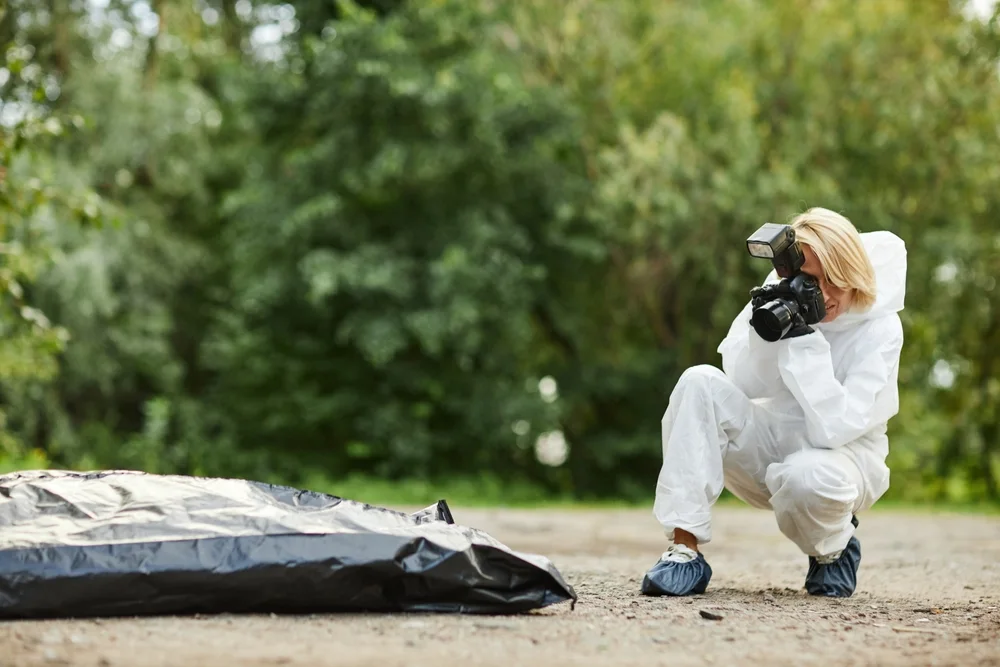
Forensic photography in California is usually a job function rather than a standalone entry-level occupation. Agencies assign evidentiary photography to crime scene specialists, forensic technicians, identification specialists, medical examiner staff, criminalists, sworn officers, and other trained personnel. A vacancy advertised simply as “forensic photographer” is comparatively uncommon.
The practical route into this work is to qualify for a broader forensic or crime scene position, develop advanced technical photography skills, and learn the evidence procedures needed to preserve image integrity, support authentication, and produce photographs useful in investigations and court. Following proper procedures does not guarantee that a photograph will be admitted as evidence. Admissibility depends on the applicable evidence rules, the foundation presented, and the court’s determination.
Depending on the agency, preparation may involve an associate degree, a bachelor’s degree, a forensic technology certificate, specified college courses, relevant experience, or a combination of education and training.
Job seekers should search beyond the exact title. Job titles, assignments, and useful search terms used by some California agencies include:
- Forensic specialist
- Crime scene specialist
- Forensic identification specialist
- Forensic technician
- Evidence technician
- Crime scene investigator
- Identification technician
- Police photographer
- Photo-laboratory technician
- Medical examiner’s photographic assistant
- Autopsy technician-photographer
- Forensic pathology technician
- Coroner technician
- Criminalist, when the applicant satisfies the required science prerequisites
Some entries in this list are formal classifications used by particular public employers. Others are occupational labels or search terms that vary by agency. California does not have one statewide education standard or occupational license for this career. The right pathway depends mainly on whether the intended work involves crime scenes, police photographic laboratories, autopsies, collision investigations, clinical injury documentation, or laboratory criminalistics.
What forensic photographers actually do
Forensic photography is evidentiary documentation. Its purpose is to create an accurate, organized, reproducible visual record of a scene, object, injury, specimen, or investigative process. Artistic ability can help with composition and lighting, but investigative value and procedural integrity take priority over visual style.
According to the National Institute of Justice crime scene investigation guide, photography is one part of a larger process that includes securing a scene, documenting its condition, recognizing and preserving evidence, recording investigative activity, and submitting evidence. A photographer working at a scene must understand that entire sequence.
Typical responsibilities can include:
- Photographing a scene before evidence is moved
- Producing overall, midrange, and close-up photographs
- Photographing evidence both with and without a measurement scale
- Documenting fingerprints, footwear impressions, tire marks, bloodstain patterns, injuries, weapons, vehicles, and damaged property
- Using flash, macro equipment, tripods, alternate light sources, and low-light techniques
- Recording case numbers, dates, locations, image sequences, and photographer information
- Preserving original image files and associated metadata
- Uploading and organizing files according to agency procedures
- Preparing enlargements, comparison images, or courtroom exhibits
- Writing reports that explain photographic activity
- Testifying about equipment, procedures, image integrity, and scene conditions
- Maintaining cameras, lenses, flashes, scales, batteries, storage media, and related equipment
The NIST-hosted Standard Guide for Crime Scene Photography describes a typical progression from overall photographs to midrange and close-up documentation. Overall views establish the location and general condition of the scene. Midrange views connect an item of evidence to its surroundings. Close-ups record fine detail, often first without a scale and then with a scale placed in the same plane as the evidence.
This sequence is very different from taking a collection of visually effective pictures. Investigators, attorneys, experts, judges, and jurors may need to understand where an object was located, how it related to another object, and what condition it was in before collection. A technically sharp close-up has limited evidentiary value when no wider image establishes where the photographed item was found.
California law also separates authentication from the final admissibility decision. Under California Evidence Code Section 1401, a writing generally must be authenticated before it may be received into evidence. Photographs also must satisfy other applicable evidence rules, including relevance requirements. Proper image handling, accurate logs, preserved originals, and reliable testimony help establish foundation and authenticity, but they do not predetermine how a court will rule.
Major forensic photography pathways in California
The term “forensic photographer” covers several specialties. Choosing a specialty first helps determine the appropriate education and experience.
Crime scene and evidence photography
Crime scene photography is the most familiar route. California agencies often combine it with evidence recognition, collection, preservation, fingerprint processing, scene measurement, diagrams, report writing, and testimony.
Orange County’s forensic specialist classification, for example, covers crime scene investigation, latent-print work, and photo-laboratory assignments. Duties can include photographing scenes, processing images, preparing court exhibits, maintaining equipment, writing reports, and testifying.
San Diego’s advanced crime scene specialist classification requires education that includes crime scene investigation, fingerprint development, and forensic photography. It also requires prior law-enforcement crime scene experience involving photography and physical evidence. Photography skill by itself is therefore insufficient for that advanced classification.
Other California examples follow the same pattern. Hayward’s crime scene specialist work combines photography with evidence recognition, preservation, diagrams, reports, and courtroom testimony. Riverside County forensic technicians may photograph evidence while also collecting it, processing fingerprints, attending autopsies, maintaining records, and presenting testimony.
This route works better for applicants prepared to become broad scene processors rather than narrowly focused camera operators.
Law-enforcement photographic laboratory work
Some agencies operate photo or imaging units that manage evidentiary photographs, prepare exhibits, process digital files, or maintain photographic archives. These assignments can involve less field response than crime scene work, but they still require strict control of evidence and case information.
Los Angeles County maintains a Medical Examiner’s Photographic Assistant classification responsible for day-to-day photographic-laboratory operations. Its duties include safeguarding photographic evidence, maintaining image inventories, processing photographic and radiographic materials, and potentially photographing gross specimens. The classification was formerly titled Coroner’s Photographic Assistant; the county changed the title effective September 26, 2023. The former name may still appear in archived records and older job-search results.
The class specification retains duties involving film, physical negatives, slides, chemicals, and traditional processing. That reflects the specific classification and does not establish that every contemporary California forensic unit runs a traditional darkroom. Modern agencies may rely primarily on digital systems while maintaining older records and media.
Photo-laboratory positions are among the closest California examples to a dedicated forensic photography occupation. Vacancies may be infrequent, however, and the exact classification is not used statewide.
Autopsy and medical examiner photography
Autopsy photography is a separate medicolegal specialty. It can include photographs of decedents, identifying features, injuries, organs, specimens, medical devices, clothing, and evidence recovered during examination.
Los Angeles County’s Autopsy Technician-Photographer classification combines photography with assistance during autopsies. The work requires camera and lighting knowledge, photographic quality control, file maintenance, and familiarity with laboratory procedures. Its minimum preparation includes autopsy-assisting or embalming-assistant experience plus camera training.
A separate Los Angeles County forensic technician pathway requires prior forensic technician experience and a photography assignment or documented experience photographing decedents or forensic evidence. These requirements illustrate why a general photography background is rarely enough for morgue work. Staff must also understand decedent handling, anatomy, infection control, medicolegal evidence, autopsy procedures, and chain of custody.
This environment involves direct exposure to death, traumatic injury, decomposition, odors, biological hazards, and emotionally difficult material. Applicants need a realistic understanding of those conditions before pursuing the specialty.
Collision and crash-investigation photography
Photographs are central to many traffic collision investigations. They can document roadway evidence, vehicle damage, final resting positions, sight lines, lighting, traffic controls, debris, tire marks, and environmental conditions.
The California Highway Patrol identifies photography as one specialized skill that personnel may contribute to Multidisciplinary Accident Investigation Team cases. Photography expertise alone, however, does not authorize someone to perform crash reconstruction. CHP restricts reconstruction methods to personnel who meet its Traffic Crash Reconstruction Specialist requirements.
Advanced collision documentation is therefore commonly reached through law-enforcement, traffic investigation, engineering, or reconstruction assignments. It is not evidence of a large standalone market for civilian “collision photographers.”
Clinical forensic-medical photography
Healthcare professionals and forensic medical examiners may photograph injuries associated with sexual assault, child abuse, domestic violence, or other interpersonal violence. The California Clinical Forensic Medical Training Center publishes photography and imaging resources for healthcare providers, forensic examiners, and multidisciplinary professionals.
Clinical forensic photography normally exists inside a healthcare or forensic-examination role. It requires knowledge of consent, patient care, trauma-informed practice, medical documentation, privacy, injury interpretation, and the policies governing sensitive medical records. A photographer without the relevant clinical qualifications would not ordinarily enter the field solely through camera training.
Laboratory criminalistics
Criminalists may photograph scenes or evidence, but criminalistics is a separate science pathway. California criminalist positions generally require a four-year degree in a physical or biological science and relevant science coursework. Laboratory assignments may involve chemistry, toxicology, controlled substances, DNA, firearms, trace evidence, or other analytical disciplines.
A photography degree plus a few forensic courses is not equivalent to the science preparation expected for criminalist work. Applicants targeting a crime laboratory should prioritize chemistry, biology, physics, statistics, laboratory methods, and the specific prerequisites listed by the hiring agency. Photography can supplement that preparation, but it does not replace it.
A practical path into forensic photography
There is no single sequence that applies to every California agency. The following route addresses the requirements that appear repeatedly across verified classifications.
1. Choose the work setting before choosing a degree
Start by deciding which type of evidence you want to document.
Crime scene personnel need broad preparation in evidence recognition, fingerprints, scene safety, collection procedures, diagrams, reports, and testimony. Autopsy photographers need morgue and medicolegal experience. Photo-laboratory staff need image management, quality control, and evidence-security skills. Collision specialists often enter through law enforcement or crash investigation. Criminalists need substantial natural science education.
A degree selected without that career target can leave major gaps. A technically strong photographer may lack evidence-processing skills, while a forensic studies graduate may have little experience controlling flash, depth of field, reflections, distortion, or macro focus.
2. Complete relevant college education
California employer requirements vary considerably. Verified pathways include high school completion plus specialized experience, specified college coursework, an associate degree, a forensic technology certificate, a photography degree, and a relevant bachelor’s degree.
Three education strategies are especially practical.
Photography degree plus forensic coursework
A photography degree can provide strong instruction in camera systems, exposure, lighting, lenses, color, digital workflow, and image production. Orange County’s forensic specialist specification recognizes a photography degree with digital-imaging training as one possible qualifying route.
The missing material must be supplied through forensic coursework or experience. Useful subjects include:
- Crime scene investigation
- Evidence collection and preservation
- Fingerprint development
- Chain of custody
- Criminal law and procedure
- Report writing
- Courtroom testimony
- Biology or anatomy
- Chemistry
- Occupational safety
- Digital evidence and image integrity
This route is well aligned with photo-laboratory or imaging-heavy work when paired with enough crime scene education. It is less direct for positions requiring substantial evidence processing or natural science.
Forensic science, CSI, or forensic technology education plus photography training
An associate degree, bachelor’s degree, or certificate focused on crime scene investigation can cover evidence handling, fingerprints, scene processing, documentation, and legal procedure. To prepare for photography assignments, the curriculum also needs meaningful camera and lighting instruction.
A single introductory photography course is limited preparation for low-light scenes, reflective evidence, latent prints, impressions, close-up work, alternate light sources, and courtroom image production. Effective preparation includes manual control of exposure, flash, depth of field, focal length, perspective, color balance, macro technique, and file management.
Los Angeles County has used an associate-degree route that includes criminalistics, police science, or a related field plus at least eight semester units in subjects such as photography, crime scene investigation, fingerprinting, or criminalistics. Orange County has also identified a criminal justice associate degree with at least eight photography units as one pathway.
Natural science degree plus crime scene photography training
A biology, chemistry, biochemistry, forensic science, or related physical science degree is the more suitable foundation for criminalist-oriented work. It can also support evidence positions involving biological material or laboratory coordination.
Science education alone does not produce an advanced forensic photographer. Camera operation, lighting, evidentiary image procedures, scene coverage, and practical documentation still require separate training.
The California Department of Justice’s California Criminalistics Institute explains that crime scene photography may be performed by criminalists, crime scene technicians, investigators, or specially trained police officers. It also distinguishes criminalists, who generally need a physical or biological science degree, from technician positions centered more heavily on scenes and evidence.
3. Build both technical and forensic competence
A capable forensic photographer needs more than exposure fundamentals. The work combines camera control with evidence rules, scene logic, documentation, and quality assurance.
Technical subjects should include:
- Manual exposure
- Aperture, shutter speed, and ISO
- Depth of field
- Lens selection and perspective
- Electronic flash
- Off-camera lighting
- Low-light and nighttime photography
- Macro and close-up photography
- Tripod and remote-release use
- Scale placement
- Reflective and transparent objects
- Alternate light sources
- Painting with light
- Impression and latent-print photography
- Image file formats and compression
- Metadata
- Color management
- Storage and backup procedures
- Controlled image processing
- Courtroom exhibit preparation
Forensic subjects should include:
- Overall, midrange, and close-up sequences
- Scene orientation
- Evidence recognition
- Contamination control
- Biological and chemical hazards
- Fingerprint processing
- Evidence packaging
- Chain of custody
- Case identifiers and photographic logs
- Scene sketches and measurements
- Report writing
- Legal discovery
- Courtroom testimony
- Agency policy compliance
The California Criminalistics Institute’s forensic photography course description covers camera operation, light, exposure, ISO, shutter speed, aperture, depth of field, file formats, storage, digital noise, scenes, and physical evidence. The listed schedule on that page is old, so it supports the description of course content but not current class availability.
California POST also recognizes crime scene and forensic photography courses, including advanced training. Access can depend on agency employment, prerequisites, presenter rules, and reimbursement eligibility. These courses often function as in-service professional development rather than open-entry replacements for college education.
4. Create a lawful, non-case portfolio
A portfolio can help demonstrate technical readiness, but it must use staged scenes, classroom exercises, or other authorized non-case material. Actual case images may be confidential, legally restricted, or owned by an employing agency. They should never be copied into a personal portfolio without explicit authorization.
A useful practice portfolio can include:
- A staged room photographed in overall, midrange, and close-up sequence
- An object photographed first without a scale and then with a scale
- Footwear or tire impressions
- Reflective metal, glass, and glossy surfaces
- Simulated injury documentation using makeup or training models
- Low-light exterior scenes
- A vehicle interior and exterior
- Small items photographed with macro equipment
- Fingerprint training targets
- Evidence under alternate lighting
- Night scenes using flash and painting-with-light techniques
- A complete photographic log connected to numbered images
The portfolio should demonstrate consistency, not dramatic editing. Include the exposure method, lens choice, scale use, lighting approach, and image sequence where appropriate. Preserve original files and maintain a repeatable file-naming and storage process.
5. Gain supervised forensic experience
Entry-level applicants often need to qualify for a broader position before specializing in photography. Relevant experience can come from:
- Crime scene or forensic technician work
- Evidence or property-room assignments
- Police or sheriff’s identification units
- Coroner or medical examiner operations
- Autopsy or morgue assistance
- Law-enforcement support work
- Laboratory internships
- Approved academic practicums
- Fingerprint or evidence-processing assignments
- Sworn law-enforcement service with crime scene duties
Internships and directly relevant academic projects can improve preparation, according to the California Department of Justice. New forensic science technicians also commonly receive supervised on-the-job training before independent casework.
Supervision is necessary because classroom competence does not establish readiness to manage an uncontrolled scene. Real cases introduce scene security issues, contamination risks, weather, crowds, distressed people, time pressure, legal restrictions, and coordination with investigators, pathologists, attorneys, or emergency personnel.
6. Apply under broader job titles
Waiting only for a job titled “forensic photographer” will sharply narrow the search. Use city, county, state, university police, district attorney, sheriff, coroner, and medical examiner employment sites.
Read the duties as closely as the title. “Forensic technician” may involve extensive scene photography in one agency and mostly laboratory or evidence work in another. “Crime scene investigator” can describe a civilian employee at one department and a sworn assignment at another.
Formal California classifications verified among individual city and county employers include Forensic Specialist, Forensic Identification Specialist, Evidence Technician, Coroner Technician, and Medical Examiner’s Photographic Assistant. Those titles are not universal. Searches should also include occupational labels such as crime scene specialist, identification technician, autopsy technician, forensic pathology technician, photo-laboratory technician, and police photographer.
The broader California forensic careers guide can help place photography alongside other crime scene, evidence, laboratory, and investigative occupations.
7. Complete agency screening and in-service training
Public-safety hiring commonly includes a detailed background investigation. Some positions also use polygraph examinations, medical evaluations, drug screening, driving-record checks, or other agency-specific assessments.
A California driver’s license appears frequently in forensic and crime scene classifications because employees travel to scenes, laboratories, courts, hospitals, morgues, and other facilities. Candidates also need a record of careful judgment. The job provides access to confidential records, sensitive images, private property, and evidence connected to criminal cases.
After hiring, training may cover agency cameras, evidence-management systems, report formats, image-storage procedures, safety, courtroom preparation, and local investigative protocols. Specialized POST or CCI education may follow once the employee is eligible.
Why evidence-image integrity is central to the job
Ordinary photography workflows often encourage deleting weak images, selecting only the best frames, applying broad edits, and discarding unused files. Evidentiary photography operates under stricter controls.
Current crime scene photography guidance says original images should not be deleted, including unintended or poor-quality frames. Photographs should remain in the case file, and evidentiary files should be maintained and backed up. A case identifier should connect the images to the organization, case or laboratory number, photographer, location, and date.
The reason is accountability. A photographer may later need to explain the sequence of images, the condition of the scene, camera settings, file handling, and any processing performed. Deleting frames can create questions about whether unfavorable or relevant information was removed. Uncontrolled editing can obscure what appeared in the original file or alter the apparent condition of evidence.
Processing is not categorically forbidden. Agencies may authorize carefully documented adjustments or the preparation of derivative images for analysis and presentation. The original must remain preserved, and the workflow must follow written policy. Competence with metadata, file formats, compression, image-editing software, and audit trails is therefore part of forensic photography rather than an unrelated computer skill.
These practices support authentication and reliable testimony. They also help attorneys and courts evaluate the photograph’s origin, accuracy, and handling history. They do not guarantee admission. Under the California Evidence Code, a court may separately evaluate authentication, relevance, prejudice, confusion, and other grounds for admission or exclusion.
Certification and professional development
California does not issue a forensic photographer occupational license. The International Association for Identification offers a voluntary Forensic Photography & Imaging Certification, but it is intended for experienced practitioners rather than new graduates.
Current IAI requirements include:
- Two years of qualifying professional experience
- 80 hours of photography training
- At least 40 of those hours in forensic photography
- Recommendations and professional references
- A written examination
- Practical assignments
The examination process includes a 100-question written test and practical work involving a crime scene, footwear impressions, a night scene, an injury, latent prints, and a vehicle. Competencies cover exposure, lighting theory, depth of field, metadata, image categories, compression, image-editing software, evidence-processing photography, and related topics.
Certification is best approached after entering the field and accumulating documented case-related experience. It can demonstrate professional competency, but it is neither a California license nor a universal hiring prerequisite.
Hiring requirements illustrated by California agencies
California classifications show how much requirements can differ even when the jobs share photography duties.
Orange County’s forensic specialist classification has recognized several qualifying routes, including related experience, a criminal justice associate degree with photography coursework, a photography degree with digital-imaging education, or a relevant bachelor’s degree. The work may expose employees to biological hazards, chemicals, offensive odors, firearms, confined areas, uneven terrain, and lifting demands.
San Diego’s advanced crime scene specialist classification requires qualifying forensic education that includes fingerprint development, crime scene investigation, and forensic photography. It also requires three years of law-enforcement crime scene experience involving photography and physical evidence.
A Los Angeles County forensic identification specialist recruitment used an associate-degree pathway with related coursework or an experience-based alternative. Desirable preparation included crime scene photography, friction-ridge examination, scene sketching, measurement, and testimony. The assignment involved nights, holidays, on-call response, and a law-enforcement background investigation.
A 2026 Redlands forensic specialist recruitment included advanced photography, evidence work, autopsy photography, court photographs, and testimony. The minimum education was a high school diploma supplemented by police science, photography, or related training, while an associate degree was highly desirable. At least one year of forensic specialist or technician experience was required.
Hayward’s 2026 crime scene specialist II recruitment used high school completion plus qualifying experience as its typical baseline, with associate-level education in forensic science, natural science, or a related field described as highly desirable. It also required a POST-certified Crime Scene Investigations course certificate and later advanced training.
Riverside County’s forensic technician recruitment required either specified college units in criminology, criminal justice, police science, or a related field, or a qualifying experience substitution. Photography was combined with evidence preservation, fingerprint work, reports, testimony, and autopsy attendance.
These examples show why neither “every forensic photographer needs a bachelor’s degree” nor “a photography certificate is enough” accurately describes the California market. Employers hire for the entire assignment.
Sworn and civilian routes
Some California agencies employ civilian crime scene and forensic staff. Others assign scene photography to sworn police officers or deputies. The title alone may not establish which structure applies.
A civilian position can still involve callouts, violent crime scenes, courtroom testimony, evidence handling, background screening, and work alongside detectives. It simply does not require the employee to exercise the same law-enforcement authority as a sworn officer.
The sworn route normally requires academy completion and the broader qualifications for peace officer employment. Photography may then become a specialized assignment after patrol or investigative experience. This path is appropriate for someone who wants the full duties and authority of law enforcement, not solely access to a camera-based specialty.
The civilian route is more direct for a person focused on evidence documentation and technical work. Competition can be substantial, and agencies may favor applicants with prior crime scene, fingerprint, evidence, laboratory, or morgue experience.
Working conditions and personal demands
Forensic photography can involve much more difficult conditions than studio, commercial, or event photography. Crime scene staff may encounter homicide, suicide, abuse, serious collisions, fires, decomposition, blood, bodily fluids, hazardous chemicals, firearms, insects, odors, and grieving relatives.
Scenes may be outdoors in heat, rain, darkness, traffic, or rough terrain. Employees can spend long periods standing, kneeling, bending, carrying equipment, or wearing protective gear. Some classifications require lifting equipment or evidence weighing up to 50 pounds.
Work schedules may include nights, weekends, holidays, overtime, staggered shifts, and on-call response. A photographer may be called back to court months or years after completing a case. Careful records and clear reports are necessary because memory alone will not support detailed testimony after a long delay.
Emotional resilience also matters. Professional detachment does not mean indifference, but the photographer must document disturbing material accurately while maintaining dignity, privacy, and procedural discipline.
Salary and employment outlook in California
There is no dedicated federal or California wage category for forensic photographers. Two broader occupations provide context, but neither gives an exact salary for this specialty.
The California Employment Development Department’s forensic science technician occupation profile includes evidence collection, classification, analysis, specialization, and testimony. It covers many workers who are not primarily photographers. For the first quarter of 2026, EDD reported:
- Mean wage: $51.87 per hour
- Median wage: $50.46 per hour
- 25th percentile wage: $39.94 per hour
- 75th percentile wage: $65.64 per hour
California projects employment in that broad occupation to rise from 2,200 jobs in 2022 to 2,600 in 2032, an increase of 18.2 percent. EDD describes an associate degree as the education level California employers usually seek for the category.
Nationally, the Bureau of Labor Statistics reports that forensic science technicians had a median annual wage of $67,440 in May 2024. Employment is projected to grow 13 percent from 2024 through 2034, with about 2,900 openings per year. BLS identifies a bachelor’s degree as the typical national entry education, while noting that an associate degree may be sufficient for some positions.
The difference between EDD’s education description and the BLS national baseline reflects the breadth of the occupation and variation among employers. California recruitments demonstrate that technician-level requirements can range from coursework and experience to associate or bachelor’s degrees.
EDD’s California photographer occupation profile offers a second point of comparison. In the first quarter of 2026, California photographers had a mean wage of $34.61 per hour and a median of $23.64. That category includes commercial, portrait, scientific, aerial, news, and other photographers. It is not a reliable estimate for government forensic personnel.
Recent agency recruitments illustrate the range more concretely:
- Redlands forensic specialist: $76,979 to $95,964 annually in a 2026 posting
- Hayward crime scene specialist II: $102,772.80 to $122,948.80 annually in a 2026 posting
- Riverside County forensic technician I/II: approximately $64,314 to $108,243 annually, depending on level, in a 2026 posting
These are dated examples from different classifications, experience levels, and public employers. They are not statewide starting salaries. Actual compensation can also include overtime, shift differentials, on-call pay, retirement benefits, or other public-sector benefits that vary by agency and bargaining unit.
How to prepare for a competitive application
A focused application should demonstrate that the candidate understands both photography and evidence work.
Academic transcripts can be especially useful when a classification requires a certain number of semester or quarter units. Keep course descriptions for subjects such as forensic photography, crime scene investigation, fingerprints, criminalistics, biology, chemistry, and digital imaging. A course title may not fully communicate its laboratory or practical content.
The application and résumé should describe specific competencies rather than relying on broad statements such as “experienced photographer.” More useful details include:
- Manual camera operation
- Electronic flash and off-camera lighting
- Macro evidence photography
- Low-light scene documentation
- Scaled impression photography
- Image logging and file preservation
- Fingerprint or evidence-processing training
- Scene sketches and measurements
- Report writing
- Chain-of-custody procedures
- Courtroom or mock-trial testimony
- Hazardous-material or bloodborne-pathogen training
- Work in an on-call or public-safety environment
Interview preparation should cover scenario-based questions. An agency may ask how the applicant would document a scene systematically, respond to an equipment failure, preserve original files, photograph reflective evidence, maintain a secure image archive, or explain an error in court.
Accuracy and candor are essential. A technically imperfect photograph preserved and documented according to procedure can be explained. Concealing an error, deleting an image, or misrepresenting a file-handling step can damage a case and the employee’s credibility.
Choosing the right route
The most efficient educational path depends on the intended assignment:
- Crime scene photography: Prioritize crime scene investigation, evidence recognition, fingerprints, documentation, chain of custody, report writing, testimony, and substantial practical photography.
- Police or medical examiner photo-laboratory work: Emphasize digital imaging, metadata, file preservation, quality control, exhibit preparation, archive management, and evidentiary security.
- Autopsy photography: Combine camera and lighting skill with morgue, anatomy, pathology, decedent-care, safety, and medicolegal evidence training.
- Collision documentation: Build photography skill within traffic investigation, law enforcement, engineering, or crash-reconstruction preparation.
- Clinical injury photography: Enter through an appropriate healthcare or forensic-examiner profession and add specialized imaging education.
- Laboratory criminalistics: Complete the required physical or biological science degree and laboratory coursework, then add scene and evidence photography.
A general photography degree is most useful when paired with forensic coursework and supervised evidence experience. A CSI or forensic technology program is more useful when it includes serious camera, lighting, and image-integrity training. A natural science degree is the proper foundation for criminalist work, but it must be supplemented with photography if scene documentation is part of the intended role.
The strongest early-career strategy is to prepare for a complete forensic technician or crime scene assignment rather than a camera-only job. Develop manual photography skill, learn evidence procedure, create a staged non-case portfolio, gain supervised experience, and search across the broader titles and assignments used by California agencies. Professional certification can follow after the required experience and training have been earned.