
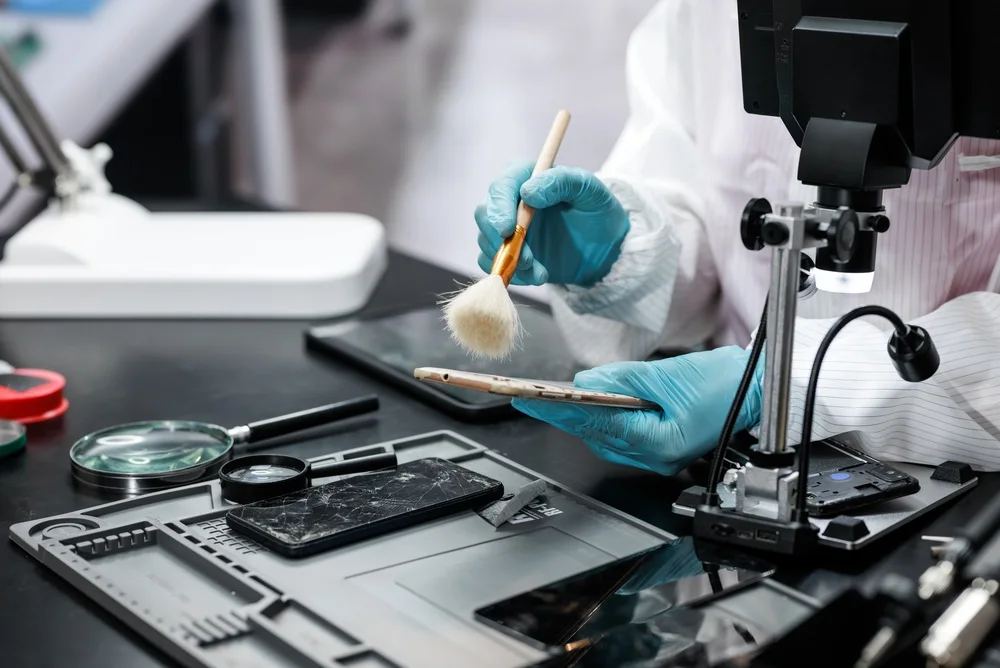
California does not impose one statewide degree, training, or licensing requirement for latent print examiners. Each state or local agency establishes its own qualifications. One employer may accept a relevant bachelor’s degree without prior professional experience, while another requires fingerprint-specific coursework, an internship, formal training hours, or several years of comparison work.
The practical route into this career is therefore employer-focused:
- Learn how latent print examination differs from crime-scene processing, tenprint work, and laboratory criminalistics.
- Identify the California agencies and job titles that match the work you want.
- Complete education that satisfies several target employers rather than only one narrow classification.
- Gain documented experience in latent print development, friction-ridge comparison, evidence handling, or related identification work.
- Pass the employer’s background investigation and technical selection process.
- Complete supervised agency training and competency testing before performing independent casework.
- Pursue professional certification after meeting the required experience and training standards.
A bachelor’s degree in forensic science, biology, chemistry, physical science, or another accepted field provides access to some California entry routes. It is not the only route. Associate degrees, forensic technology certificates, approved fingerprint courses, internships, examiner-aide jobs, and prior identification experience also appear in public-employer specifications.
The occupation rewards precise visual analysis, disciplined documentation, scientific reasoning, and the ability to explain conclusions in court. Academic study is useful, but independent casework requires extensive applied training beyond the degree.
What a latent print examiner actually does
A latent print is a friction-ridge impression that is not always visible without development or enhancement. It may come from fingers, palms, or feet and can be deposited on many surfaces. Examiners work with these impressions to determine whether they are suitable for comparison and whether their features support a conclusion under the laboratory’s procedures.
The work can include:
- Selecting optical, physical, or chemical development methods
- Applying powders, cyanoacrylate fuming, amino-acid reagents, fluorescence, or other techniques
- Photographing and preserving developed impressions
- Documenting where and how evidence was processed
- Examining ridge flow, ridge paths, and finer morphological details
- Comparing unknown impressions with known exemplars
- Searching automated fingerprint databases
- Reviewing candidate lists generated by automated systems
- Preparing technical notes, reports, diagrams, and court exhibits
- Participating in verification and technical review
- Testifying as an expert witness
- Collecting known prints from living or deceased people
- Training investigators or other agency personnel
- Occasionally responding to crime scenes
The NIJ Fingerprint Sourcebook covers friction-ridge anatomy, known exemplars, classification, automated fingerprint identification systems, development methods, preservation, examination, documentation, quality assurance, legal issues, and research. Its scope illustrates why the job requires more than recognizing loops, whorls, and arches.
Latent print development and latent print comparison are related but distinct activities. Development involves locating and visualizing impressions on evidence. Comparison involves examining ridge detail and evaluating an unknown impression against a known source. Some California jobs combine both functions. Others place evidence processing, database work, and comparison in separate assignments.
The work also involves judgment. Automated systems can identify possible candidates, but the examiner evaluates the friction-ridge detail. The examination process may follow an ACE-V framework: analysis, comparison, evaluation, and verification. ACE-V is not a mechanical formula or a guarantee against error. Competency testing, documentation, technical review, verification, quality systems, continuing training, and attention to human factors remain part of professional practice.
Latent print examiner is not a universal job title
California agencies use several titles for overlapping forms of fingerprint work. Relevant searches include:
- Latent print examiner
- Latent fingerprint examiner
- Latent print analyst
- Latent print specialist
- Fingerprint examiner
- Fingerprint identification expert
- Forensic identification specialist
- Forensic specialist
- Identification technician
- Latent print examiner aide
Titles alone can be misleading. A fingerprint position may concentrate on tenprint records, booking fingerprints, identity verification, or automated database processing rather than latent impressions recovered from evidence. A forensic specialist position may involve crime-scene photography and evidence collection, or it may be assigned primarily to latent print comparison.
Los Angeles, for example, has recruited under the title Fingerprint Identification Expert. The published duties included classifying and comparing fingerprints, conducting fingerprint-system searches, processing booking records, and testifying. The role therefore covered work beyond latent impressions alone.
Orange County illustrates a different classification model. Its Lead Forensic Specialist classification can be assigned exclusively to crime-scene investigation or to latent print specialist work. The latent print assignment includes comparison, evidence processing, automated system entry, training, and expert testimony. A listing for “forensic specialist” therefore needs to be read at the assignment level. The CSI and latent print tracks do not necessarily involve the same daily work.
A latent print examiner also is not automatically a criminalist. California criminalists commonly perform laboratory analysis in disciplines such as controlled substances, toxicology, trace evidence, firearms, forensic biology, or DNA. Those paths can demand substantial chemistry, biology, quantitative analysis, and instrumental laboratory preparation. Latent print work is grounded in friction-ridge examination, print development, imaging, comparison, documentation, and identification systems.
Nor is every examiner a crime scene investigator. Some positions include scene response, while others are based mainly in a crime laboratory or fingerprint bureau. Several reviewed California classifications are civilian and non-sworn, including positions in Oakland and San Diego County. Other agencies may assign related tasks to sworn personnel.
Readers comparing this occupation with other options can explore the broader collection of California forensic career paths.
Education routes used by California employers
There is no approved statewide list of latent print examiner degrees. The strongest education plan is one that satisfies multiple agency specifications and includes hands-on fingerprint training.
Two routes appear repeatedly in California public-employer requirements.
Route 1: A bachelor’s degree followed by an internship or entry-level appointment
A bachelor’s degree in forensic science, physical science, biology, chemistry, or another accepted related discipline can qualify a candidate for certain entry-level classifications. The degree offers broader science preparation and can preserve access to adjacent forensic occupations.
Oakland’s published Latent Print Examiner I specification provides a clear example. Its standard education route calls for a bachelor’s degree in a related field with some college science coursework and no required experience, although examiner experience is desirable. The position includes print development, comparison, automated fingerprint-system use, documentation, testimony, crime-scene response, and taking prints from living and deceased people.
San Jose’s flexibly staffed examiner series provides another degree-based entry model. One qualification route for Latent Print Examiner I accepts a relevant bachelor’s degree without prior experience. An associate-degree route requires at least a three-month law-enforcement internship. Higher levels add fingerprint training, qualifying experience, and certification expectations.
A degree alone does not mean a new employee is ready for independent comparisons. These classifications can use pattern-recognition tests, interviews, practical exercises, background investigations, supervised training, and competency evaluations to assess candidates beyond their academic credentials.
San Diego County uses a degree-plus-experience model. One route into its Latent Print Examiner classification requires a bachelor’s degree in a specified related field plus a one-year internship involving latent print development or friction-ridge comparison. The county identifies 24 semester hours of STEM coursework as highly desired, although not mandatory in the published specification.
This route is most useful when the degree contains applied forensic work and the student obtains an internship with substantive fingerprint duties. An internship devoted only to observation or general crime-scene support may not satisfy a classification that explicitly requires development or comparison experience.
Route 2: Targeted fingerprint education followed by aide or identification work
A four-year degree is not universal across California. Some employers accept a specialized fingerprint course, an associate degree, a forensic technology certificate, formal training hours, or qualifying technical experience.
The City of San Diego’s 2025 Latent Print Examiner Aide recruitment accepted several forms of education:
- 80 hours of recognized formal training
- An associate degree or higher in forensic or physical science
- A forensic technology certificate containing basic and advanced fingerprint coursework
The aide recruitment also required 100 hours of latent processing, tenprint, or latent examination experience. A bachelor’s degree in forensic or physical science could substitute for that experience. Documented volunteer or internship experience at a recognized law-enforcement agency or laboratory could count.
That combination shows how a shorter academic route can work when paired with documented applied experience. The aide position performed routine latent print analysis, automated searches, evidence processing, record maintenance, and administrative duties. It offered more direct occupational preparation than an unrelated office role, even though it was below the journey level.
Los Angeles has used another targeted route. Its Fingerprint Identification Expert recruitment allowed applicants to qualify through an accredited fingerprint-identification course or six months of paid technical fingerprint-identification experience in a law-enforcement fingerprint bureau. The selection process tested fingerprint patterns, print quality and usability, attention to detail, and related abilities.
Riverside County’s Fingerprint Examiner II specification shows the limits of relying only on a degree title. One route combines approved fingerprint-science training with a year of comparable latent print experience. Another calls for a bachelor’s degree containing specified latent print or fingerprint coursework, or 120 hours of fingerprint-science training, plus six months of comparable experience. Because this is a journey-level classification, the degree route still includes experience.
A targeted associate or certificate route can reduce time in school, but it is narrower. It works best when the curriculum contains basic and advanced fingerprint examination, evidence processing, photography, and laboratory practice, and when the student can obtain an agency internship or aide position. A generic criminal justice curriculum without friction-ridge training provides weaker preparation for technical testing and supervised comparison work.
Coursework that supports the career
Program names are less informative than course content. A useful curriculum for latent print work should address both evidence development and friction-ridge examination.
Strong subject areas include:
- Friction-ridge anatomy, formation, persistence, and morphology
- Fingerprint pattern recognition and classification
- Latent print development methods
- Sequential processing of porous and nonporous surfaces
- Known-print recording and exemplar quality
- Finger, palm, and foot impression comparison
- Photography and digital imaging
- Evidence recognition, collection, packaging, and preservation
- Chain of custody
- Automated fingerprint identification systems
- Technical note-taking and report writing
- Courtroom testimony and evidence presentation
- Quality assurance and technical review
- Statistics, research literacy, and scientific reasoning
- Laboratory safety and hazardous-material handling
Biology and chemistry are useful even where an employer does not mandate a science degree. Biology helps with skin structure, friction-ridge formation, biological evidence, and contamination issues. Chemistry helps explain why development reagents interact differently with residues and substrates. Laboratory courses also reinforce safety, documentation, controlled procedures, and the handling of chemicals.
Photography deserves specific attention. Examiners need to preserve impressions accurately, control scale and orientation, use appropriate lighting, and produce images suitable for examination and court presentation. General photography can help, but forensic imaging practice is more directly aligned with the occupation.
Writing-intensive courses have practical value as well. Examination notes and reports must allow another qualified person to understand what was done and how a conclusion was reached. Court testimony then requires the examiner to explain methods, limitations, and conclusions in language that judges and jurors can follow.
An online degree can cover theory, anatomy, legal principles, research, and report writing. It cannot replace repeated comparison exercises, chemical processing, supervised evidence handling, competency tests, and documented casework. A distance program is most useful when paired with an accessible laboratory component, internship, or agency training placement.
Practical experience is the bridge to independent casework
Academic preparation can establish eligibility, but agencies train examiners within their own procedures and quality systems. The NIST OSAC record for ANSI/ASB Standard 014-24 identifies a formal standard for friction-ridge examination training programs. Structured competency training is separate from earning a degree.
Training commonly develops proficiency in:
- Evidence examination and processing
- Friction-ridge visualization
- Suitability decisions
- Side-by-side comparison
- Automated database searches
- Documentation and reporting
- Verification procedures
- Quality-control practices
- Mock or supervised testimony
- Practical competency examinations
- Agency-specific policies and legal requirements
The exact training period varies by employer and by the employee’s previous experience. Early casework is commonly reviewed or supervised. Progression to independent work depends on demonstrated competence, not merely time in the position.
Useful pre-employment experience can come from internships, volunteer laboratory work, latent print aide positions, identification units, evidence assignments, or jobs that include print processing and comparison. Sacramento County’s entry qualifications for a Forensic Identification Specialist have allowed either one year of paid law-enforcement agency experience or 30 semester units, including 12 units in criminal justice, forensic science, chemistry, biology, or a related field. Its recruitment evaluated preparation in fingerprinting, evidence collection, latent processing, report writing, chemicals, laser technology, photography, and laboratory equipment.
Quality matters more than an impressive-sounding internship title. Relevant experience should produce a record of what the candidate actually did. Strong placements may include supervised processing, known-print collection, comparison exercises, database exposure, evidence documentation, report preparation, or formal training. General observation can help with career exploration but provides less evidence of technical preparation.
Preserve detailed records of:
- College transcripts
- Course descriptions and syllabi
- Laboratory hours
- Fingerprint training certificates
- Internship dates and total hours
- Volunteer assignments
- Supervisor contact information
- Types of evidence processed
- Comparison exercises completed
- Competency or proficiency records
- Courtroom or mock-testimony training
- Continuing education
Public agencies often screen applications closely. A transcript that lists “forensic methods” may not show whether the course covered latent prints. A syllabus or official course description can document fingerprint-specific content. Training records become especially useful where a specification requires a defined number of hours.
Entry-level does not always mean no experience
California job seekers need to distinguish an employer’s first classification level from a true trainee position.
The California Department of Justice calls Latent Print Analyst I the entry and first working level in its series. However, the external qualification pattern in the 2026 examination bulletin required three years of technical criminal-identification experience, including one year in latent print analysis, plus education equivalent to high school completion. Relevant experience could include latent comparisons, automated searches, testimony, crime-scene evidence collection, print processing, photography, measurements, and documentation.
California DOJ’s Latent Print Analyst II is the full journey level. Its external route required four years of technical criminal-identification work in a governmental law-enforcement agency, including one year of latent print analysis involving field investigation or automated fingerprint systems and court testimony.
These are not realistic first jobs for most new graduates applying from outside state service. A new graduate interested in DOJ work may need to begin in an aide, evidence, identification, crime-scene, or local-agency role that develops the required experience.
Oakland and San Jose demonstrate a different model. Their published specifications contain bachelor’s-level entry routes without prior professional examiner experience. San Diego County requires a relevant bachelor’s degree plus a one-year internship under one route. The City of San Diego has used an aide classification with lower education and experience thresholds than its journey-level examiner role.
The fastest minimum qualification is not necessarily the strongest preparation. Los Angeles has accepted a fingerprint course as one route, but applicants still faced technical testing. Oakland’s no-experience degree route included a pattern-recognition examination and a thorough background investigation. Agencies can receive applications from candidates whose qualifications exceed the stated minimum.
What to expect during hiring
Latent print hiring often evaluates technical aptitude directly. A college degree may pass the initial education screen, but it does not replace the selection process.
Verified California procedures have included:
- Pattern-recognition tests
- Side-by-side fingerprint comparison exercises
- Print-quality and usability questions
- Written knowledge tests
- Qualification appraisal panels
- Structured interviews
- Practical latent print examinations
- Background investigations
- Fingerprinting and criminal-record checks
- Employment and education verification
- Psychological or truth-verification testing in some agencies
California DOJ’s 2026 examinations included practical exercises in pattern recognition and side-by-side comparison, followed by qualification appraisal panels. Oakland’s specification calls for a pattern-recognition examination. Los Angeles has tested fingerprint patterns, print quality, usability, and attention to detail.
Applicants preparing for these processes need more than memorized vocabulary. They should be able to examine impressions methodically, distinguish reliable detail from distortion, document observations, and explain their reasoning within the limits of their training.
Background investigations are common because examiners handle controlled evidence, confidential records, law-enforcement databases, and testimony that can affect criminal cases. Reviewed specifications also show that a California driver’s license is required for some jobs, including San Diego and Los Angeles classifications. Neither a driver’s license nor a particular background procedure has been established as universal across every California employer.
IAI certification and California licensing
California does not have a statewide occupational license specifically for latent print examiners. The International Association for Identification offers the best-known professional certification in the discipline, but it is a voluntary credential rather than a state license.
The IAI Latent Print Certification is administered through the organization’s Forensic Certification Management Board. Its scope includes evidence processing, friction-ridge visualization, examination and comparison, and expert testimony.
Under the 2026 IAI requirements, initial latent print certification calls for:
- Two years of relevant experience
- 176 hours of discipline-specific training
- 16 hours of qualified-testimony training completed within the preceding five years
- Required recommendations and application documentation
- A written examination
- A practical comparison examination
Certification therefore is normally a post-entry milestone, not something a student earns immediately after graduation. Recertification requires professional-development credits and another examination.
Some California employers incorporate IAI certification into advancement or qualification rules. Oakland requires employees to obtain certification within one year after they become eligible under IAI requirements. San Diego County allows certification to substitute for up to one year of specified comparison experience. San Jose requires Certified Latent Print Examiner status within two years of eligibility at Level II and requires it for Level III under the published series specification.
IAI certification can support advancement because it documents a defined combination of experience, training, knowledge, and practical testing. It does not override an agency’s hiring requirements, background process, internal authorization, or competency program.
California POST also maintains law-enforcement training resources, course listings, and a learning portal. POST is not a universal licensing body for civilian latent print examiners. Access to some POST resources is tied to employment or affiliation with a participating agency, although an agency administrator can add civilian support employees. This is one reason specialized training can become more accessible after an internship or agency appointment.
Working conditions and occupational demands
Latent print examination combines desk-based visual analysis with laboratory and, in some positions, field duties. The work can be physically and mentally demanding despite not fitting the image of a traditional field occupation.
San Diego County identifies extensive visual examination as a feature of the job. Examiners may spend long periods studying small details through digital imaging systems, magnification tools, or comparison interfaces. Sustained concentration and careful documentation are essential.
Evidence processing can expose employees to powders, chemical reagents, fumes, biological material, and contaminated objects. Sacramento County’s forensic identification work may include hazardous materials, biological evidence, and fingerprinting deceased people. Oakland’s duties also include rolling prints from living and deceased individuals. Proper personal protective equipment, ventilation, laboratory controls, and safety procedures are integral to the work.
Some positions involve evening, weekend, standby, or irregular schedules. Crime-scene participation may add travel, outdoor conditions, or work around disturbing evidence. Other examiners spend most of their time in controlled laboratory or bureau settings.
Court testimony creates another demand. An examiner must describe qualifications, methods, observations, quality procedures, and conclusions under direct and cross-examination. Technical competence must be accompanied by professional communication and composure.
Salary for latent print examiners in California
California does not publish a statewide wage series solely for latent print examiners. The clearest salary evidence comes from individual employer classifications, but those figures vary by agency, location, bargaining agreement, and career level.
Published examples include:
- City of San Diego Latent Print Examiner Aide: $56,538 to $68,256 annually in a 2025 recruitment
- City of Los Angeles Fingerprint Identification Expert: salary ranges from $61,616 to $101,247 in a 2024 recruitment, depending on grade
- California DOJ Latent Print Analyst I: $5,869 to $7,897 per month in the 2026 examination bulletin
- City of Oakland Latent Print Examiner I: $89,193 to $109,473 annually on the accessible classification page
- San Diego County Latent Print Examiner: $89,585.60 to $115,502.40 annually on the accessible specification
- City of San Diego Latent Print Examiner II: $95,908.80 to $115,876.80 annually on the accessible specification
These figures illustrate the difference between aide, entry, and journey-level classifications. They are not active-vacancy guarantees. Some source recruitments have closed, and pay schedules can change through negotiated increases or classification updates.
The California Employment Development Department occupation profile groups fingerprint specialists within the broader forensic science technician occupation. For the first quarter of 2026, EDD reported:
- Mean wage: $51.87 per hour
- Median wage: $50.46 per hour
- 25th-percentile wage: $39.94 per hour
- 75th-percentile wage: $65.64 per hour
Those numbers include forensic science technicians in other specialties. They are useful as broad labor-market context, not as a precise latent print examiner salary estimate.
Employment outlook
California EDD projects employment for forensic science technicians to increase from 2,200 positions in 2022 to 2,600 in 2032. That is a projected increase of 400 positions, or 18.2 percent.
Nationally, the Bureau of Labor Statistics projects forensic science technician employment to grow from approximately 20,100 in 2024 to 22,800 in 2034, a 13.3 percent increase. BLS identifies a bachelor’s degree as the typical entry education and moderate-term on-the-job training for the broad occupation.
Neither projection isolates latent print examiners. The totals also include other forensic disciplines, so they do not reveal how many openings will involve friction-ridge work. Latent print units are often relatively small, and vacancies may arise through turnover, retirement, agency expansion, or movement into senior and supervisory positions.
Geographic flexibility can improve the job search. California’s qualification models vary enough that a candidate screened out by one agency may qualify for another. Searches limited to the exact phrase “latent print examiner” will also miss openings under fingerprint, identification, and forensic specialist titles.
Advancement after entry
A new examiner commonly progresses through supervised training before receiving authorization for independent casework. Later advancement can lead to:
- Journey-level latent print examiner
- Senior or lead examiner
- Technical reviewer
- Trainer or competency-program instructor
- AFIS or automated-system specialist
- Quality-assurance specialist
- Unit supervisor
- Laboratory management
- Crime-scene or forensic identification leadership
Journey-level work can include difficult comparisons, database searches, report review, preparation of court exhibits, expert testimony, and training other personnel. California DOJ’s Latent Print Analyst II classification includes these functions. Senior and lead positions may add technical oversight, policy work, case review, training, and quality responsibilities.
Continuing education remains relevant throughout the career. Development methods, imaging tools, database capabilities, standards, research, and courtroom expectations change. IAI recertification also requires continuing professional development and examination.
A practical California preparation plan
A candidate starting without relevant education or experience can use the following sequence.
1. Choose the target function
Decide whether the goal is primarily friction-ridge comparison, evidence processing, crime-scene response, tenprint identification, or a blended forensic identification role. Review actual duty statements rather than relying on titles.
Someone who wants laboratory comparison work should prioritize friction-ridge anatomy, comparison methodology, AFIS, documentation, and verification. Someone seeking a combined CSI and latent role also needs photography, scene documentation, evidence recovery, biological evidence procedures, and irregular-shift readiness.
2. Build an employer list before selecting a degree
Compare specifications from several agencies. A useful list might include a state employer, a county crime laboratory, a large municipal police department, and smaller regional agencies.
Record each employer’s accepted fields of study, required units, internship provisions, training hours, experience substitutions, certification rules, driver-license terms, and technical tests. The differences will reveal whether a bachelor’s degree, associate degree, certificate, or targeted course route gives the broadest eligibility for your goals.
3. Select applied coursework
Prioritize fingerprint-specific classes and laboratory work. Add chemistry, biology, photography, technical writing, evidence procedures, and research or statistics where available.
A criminal justice degree can provide legal and investigative context, but it is weaker preparation when it omits science laboratories and friction-ridge examination. A forensic science degree is more aligned only when its curriculum actually includes the relevant courses. The word “forensic” in the degree title is not proof of latent print preparation.
4. Obtain documented hands-on experience
Seek internships or volunteer placements in law-enforcement laboratories, identification units, evidence sections, or forensic service providers. Focus on assignments involving actual processing, comparison exercises, known prints, database exposure, or technical documentation.
The San Diego aide pathway demonstrates that documented internship or volunteer hours can satisfy experience requirements. San Diego County’s bachelor’s route specifically calls for a year-long internship involving latent development or friction-ridge comparison.
5. Apply across related entry classifications
Do not wait only for a position titled Latent Print Examiner I. Search aide, technician, identification, evidence, forensic specialist, and fingerprint roles. Read the duties carefully to determine whether the job develops relevant experience.
California DOJ’s first analyst level requires substantial prior experience from external applicants. An aide or identification role can provide a more realistic starting point and create the casework history needed for later applications.
6. Prepare for technical screening
Practice disciplined visual comparison using legitimate training materials and under qualified instruction. Develop accurate note-taking habits. Review friction-ridge anatomy, distortion, pattern areas, print quality, development methods, and evidence procedures.
Employers may assess pattern recognition and side-by-side comparison before appointment. Technical preparation therefore affects selection even where the minimum qualification lists no professional experience.
7. Complete agency training and pursue certification later
Once hired, treat the employer’s structured training program as the route to independent practice. Maintain records of training hours, competency tests, supervised cases, testimony education, and continuing professional development.
After meeting IAI’s experience and training requirements, certification can support advancement and satisfy employer expectations in agencies that incorporate it into their career ladder.
Choosing between the main routes
A bachelor’s route provides the widest academic foundation and fits verified entry models in Oakland and San Jose. It also aligns with the typical education reported by BLS for the broader forensic science technician occupation. The tradeoff is greater time and cost, especially if the program lacks fingerprint laboratories or internship access.
An associate degree or forensic technology certificate can lead to aide and technical roles more quickly. The City of San Diego has accepted these credentials when paired with fingerprint coursework and experience. This route depends heavily on the quality of the specialized curriculum and the availability of practical placements.
A fingerprint-course route can satisfy some classifications, including the qualification pattern used by Los Angeles. It is the narrowest academic option and may provide less flexibility for employers that require a degree or substantial science coursework.
Experience-based routes remain available in several specifications, but they create a practical question: how does a newcomer obtain the first relevant position? Aide jobs, internships, volunteer placements, evidence work, and broader identification assignments provide the clearest bridge.
The most resilient plan combines three elements: accepted education, fingerprint-specific training, and documented applied experience. That combination addresses the widest range of California qualification models and prepares the candidate for the technical tests that frequently follow the initial application screen.
California agencies do not hire latent print examiners under one formula. A well-prepared applicant can still approach the field systematically. Build the education plan around several employer specifications, obtain real processing or comparison exposure, retain detailed proof of every course and training hour, and target classifications that match the current level of experience. The path then progresses from eligibility to supervised competency, independent casework, expert testimony, and professional certification.