
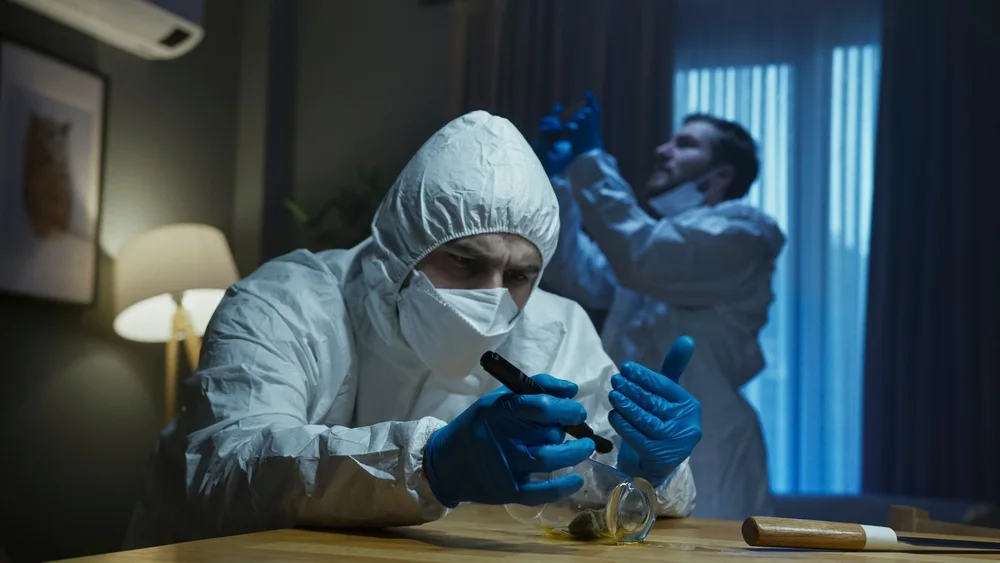
Forensic science and criminal justice degrees overlap around crime and legal investigations, but they prepare graduates for different kinds of work. Forensic science applies chemistry, biology, physics, computer science, and specialized evidence methods to legal questions. Criminal justice examines policing, courts, corrections, criminal law, public administration, policy, and the social causes and consequences of crime.
The clearest California example is the criminalist career path. California’s state Criminalist classification requires a physical or biological science major, eight semester hours of general chemistry, and three semester hours of quantitative analysis. A conventional criminal justice curriculum usually does not include that science sequence. A criminal justice graduate may qualify for certain civilian crime-scene positions, law enforcement roles, probation, corrections, or justice administration, but the degree alone is generally not preparation for laboratory criminalistics.
Degree titles can also mislead. A forensic science program might concentrate on chemistry, biology, digital evidence, or crime-scene investigation. Those concentrations do not lead to identical jobs. A program called forensic behavioral science can focus on psychology and criminology rather than laboratory evidence. The right choice therefore depends less on whether a degree contains the word “forensic” and more on the coursework, laboratories, practical training, and hiring requirements connected to a specific occupation.
Forensic science and criminal justice at a glance
| Comparison point | Forensic science degree | Criminal justice degree |
|---|---|---|
| Primary academic foundation | Natural science, computer science, evidence examination, or crime-scene methods, depending on concentration | Social science, law, policy, administration, criminology, and justice institutions |
| Common subjects | Chemistry, biology, DNA, toxicology, instrumentation, trace evidence, digital evidence, fingerprints, photography, or scene processing | Policing, courts, corrections, criminal law, constitutional procedure, research methods, administration, and crime policy |
| Laboratory requirements | Often substantial in chemistry, biology, DNA, or criminalistics tracks | Usually limited unless science courses are added separately |
| Field-oriented training | May include scene photography, evidence recovery, fingerprints, documentation, reconstruction, and internships | May include investigation, interviewing, physical evidence, policing, internships, or agency-based learning |
| Online feasibility | Laboratory tracks usually need in-person laboratories, equipment, or research; CSI tracks may require practical exercises | More readily offered fully online, especially as a degree-completion program |
| Typical career alignment | Criminalist, forensic scientist, crime-lab analyst, forensic biologist, forensic chemist, digital evidence specialist, or CSI, depending on curriculum | Law enforcement, probation, parole, corrections, courts, public-safety administration, policy, and some civilian investigative roles |
| FEPAC relevance | Relevant to eligible forensic science, natural science, computer science, and certain CSI programs | Not a general accreditation framework for criminal justice degrees |
| California hiring implication | Science-heavy study is usually the better route to laboratory criminalist classifications | Can align with justice-system careers and some civilian CSI classifications, but normally lacks the science required for criminalist work |
Neither degree is universally better. Forensic science is the more direct academic route when the target job involves chemical, biological, microscopic, or instrumental examination of evidence. Criminal justice is more directly connected to policing institutions, courts, corrections, legal procedure, administration, and policy. Civilian crime-scene work occupies the middle ground because employers may accept forensic science, criminal justice, chemistry, biology, or another related field.
Start with the job, not the degree title
California employers use forensic and investigative job titles inconsistently. Criminalist, forensic scientist, forensic science technician, forensic investigator, crime-scene investigator, evidence technician, latent print examiner, and property and evidence technician can refer to different duties at different agencies.
A criminalist is generally a laboratory scientist. According to the California Department of Justice’s California Criminalistics Institute, criminalists examine physical evidence and may specialize in DNA and biology, firearms, trace evidence, controlled substances, alcohol, or toxicology. They can also respond to scenes, but crime-scene duties may instead be handled by technicians, investigators, or specially trained police officers.
A crime-scene investigator may spend much more time documenting scenes, taking photographs, collecting evidence, developing latent prints, preparing diagrams, maintaining chain of custody, and writing reports. Some California agencies employ civilian investigators for that work. Others assign it to sworn officers or divide the duties among several classifications.
A detective is usually a sworn law enforcement officer conducting interviews, pursuing leads, obtaining warrants, and assembling cases. That work is not the same as performing a chemical analysis in a crime laboratory, even though detectives and criminalists may contribute to the same investigation.
Digital evidence is another separate path. It can involve computer systems, mobile devices, network artifacts, forensic imaging, data recovery, technical reporting, and legal controls on electronic searches. A digital evidence concentration should be evaluated through its computing and technical content rather than grouped automatically with wet-laboratory chemistry or biology.
Before choosing a major, define the intended function:
- Analyze evidence scientifically in a laboratory.
- Process scenes and document physical evidence.
- Become a sworn police officer or investigator.
- Work in courts, corrections, probation, parole, or public administration.
- Examine computers and digital devices.
- Apply psychology or behavioral science to legal and criminal justice settings.
Those goals call for different coursework and, in some cases, different hiring processes.
Choose forensic science for laboratory criminalist work
A student targeting criminalist, forensic chemist, forensic biologist, DNA analyst, toxicology analyst, or related crime-laboratory work should prioritize natural science. California’s public-sector requirements make this more than a general recommendation.
The California state Criminalist examination bulletin requires the equivalent of graduation with a major in a physical or biological science. It also requires eight semester hours of general chemistry and three semester hours of quantitative analysis before appointment. The examination questionnaire separately assesses education in chemistry, biology, genetics, molecular biology, statistics, physics, forensic science, toxicology, and instrumental analysis.
Los Angeles County uses a similarly scientific model. Its entry-level Criminalist classification requires a bachelor’s degree specializing in criminalistics, chemistry, biology, biochemistry, or a closely related scientific field, along with at least eight semester units of general chemistry. The county’s Medical Examiner specialty adds a quantitative analysis requirement.
These requirements explain why a criminal justice degree with one physical-evidence elective is not equivalent to a chemistry, biology, or science-intensive forensic science degree. Criminal justice courses can provide useful context about constitutional procedure, investigations, evidence law, and public agencies, but they do not replace organic chemistry laboratories, analytical chemistry, molecular biology, genetics, statistics, or instrumental methods.
Science courses that matter
A laboratory-oriented undergraduate plan should be evaluated course by course. Useful preparation commonly includes:
- General chemistry with laboratories
- Organic chemistry with laboratories
- Quantitative or analytical chemistry
- Biology with laboratories
- Genetics or molecular biology
- Biochemistry
- Physics
- Calculus or another required level of mathematics
- Statistics
- Instrumental analysis
- Microscopy
- Forensic biology or DNA analysis
- Toxicology
- Quality assurance and laboratory documentation
- Upper-division laboratory courses
- Scientific report writing
- Research or a substantial capstone project
Not every laboratory specialty requires the same mix. DNA and forensic biology place greater weight on molecular biology, genetics, statistics, and biological laboratory methods. Drug chemistry, toxicology, and trace analysis require stronger chemistry and instrumentation. Firearms and pattern evidence may use a different combination of physics, microscopy, documentation, and comparative methods.
The safest undergraduate routes for a California criminalist goal are usually chemistry, biology, biochemistry, molecular biology, or a forensic science degree built around one of those sciences. The transcript must still contain the courses required by the intended employer. A forensic science title alone is not proof of eligibility.
California program examples
San Jose State University’s BS in Forensic Science demonstrates how much variation can exist inside one degree. It offers concentrations in biology, chemistry, digital evidence, and crime-scene investigation. The biology and chemistry options are closer to laboratory criminalistics, while digital evidence and CSI lead toward different technical functions.
San Jose State describes hands-on crime-laboratory and crime-scene training and requires forensic science majors to complete a three-unit internship course. Its listed subjects include biology and DNA, organic and inorganic chemistry, instrumentation, toxicology, physical evidence, photography, firearms, toolmarks, arson, and explosives. The university says each concentration meets FEPAC educational standards. That wording is not the same as current FEPAC accreditation, and San Jose State is not listed in the current FEPAC-accredited program directory.
Graduate admissions provide another useful test of undergraduate preparation. The UC Davis MS in Forensic Science expects an undergraduate degree in physical or natural science, engineering, or a closely related field. Prerequisites include general chemistry, organic chemistry, physics, calculus, and statistics. Its DNA Analysis and Criminalistics tracks include laboratory work, research, analytical methods, law, quality assurance, and testimony.
A standard criminal justice bachelor’s program would not ordinarily contain all those prerequisites. A criminal justice graduate seeking admission could need a substantial sequence of additional science and mathematics courses, not merely one introductory forensic science class.
Cal State LA draws the line even more explicitly. Its MS in Criminalistics requires an undergraduate degree in a natural or physical science. The university identifies criminal justice, psychology, and anthropology as unrelated disciplines for admission to this program. Required background includes biology, biostatistics, general and organic chemistry with laboratories, physics, and quantitative analysis. The graduate program culminates in a research project, and internships with public or private laboratories are encouraged.
Cal State LA separately describes its undergraduate criminal justice major as preparation for criminal justice administration rather than criminalistics or forensic science. Readers planning laboratory careers are directed toward chemistry, biology, biochemistry, natural sciences, or physics. That is a direct institutional example of why the two degree fields should not be treated as substitutes.
Choose criminal justice for justice-system and administration careers
Criminal justice is better aligned with careers centered on institutions, legal processes, public policy, supervision, administration, and human behavior within the justice system. Common destinations include law enforcement, probation, parole, corrections, court administration, public-safety administration, crime analysis, victim services, and related government or nonprofit work.
The Sacramento State BS in Criminal Justice illustrates the field’s academic structure. Its required upper-division courses address research methods, crime and punishment, courts, constitutional search and seizure, corrections, police and society, public-safety administration, and contemporary justice issues. Electives can include advanced criminal investigation and physical evidence, and an internship is available as an elective.
That curriculum provides broad exposure to the agencies, laws, policies, and procedures that shape public safety. It does not require the extensive chemistry, biology, quantitative analysis, or instrumentation sequence associated with criminalist preparation.
Criminal justice also lends itself more readily to online study. Sacramento State operates a separate online bachelor’s degree-completion pathway for transfer-ready students. The remaining upper-division work covers law, policy, institutions, administration, research, and investigation-related subjects that can be taught without a specialized chemistry or biology laboratory.
Criminal justice and sworn law enforcement
A bachelor’s degree in criminal justice is not a statewide requirement for becoming a California peace officer. The California Commission on Peace Officer Standards and Training sets a minimum education standard based on high school graduation, an approved GED, or another approved equivalent. An accredited college degree can also satisfy the education standard.
Applicants must meet other selection requirements involving age, background, fingerprints, medical suitability, psychological suitability, and agency screening. The Regular Basic Course is the minimum entry-level training requirement for city police officers, sheriff’s deputies, and most other peace officer categories.
Individual departments can impose requirements beyond the state minimum. A criminal justice degree can support a policing career by providing knowledge of law, institutions, procedure, and administration, but it does not replace academy training or the hiring process. A forensic science degree also does not replace those steps. Someone who wants to become a sworn investigator can major in either field, provided the person meets the employing agency’s standards, but criminal justice usually offers more direct academic coverage of policing and the justice system.
Courts, corrections, probation, and policy
Criminal justice has a clearer advantage for work focused on:
- Correctional institutions
- Probation and parole systems
- Court operations
- Public-safety management
- Crime policy
- Justice research
- Community supervision
- Police administration
- Legal processes
- Rehabilitation and reentry
- Program evaluation
A chemistry-intensive forensic science degree may include little study of corrections, court administration, organizational management, or justice policy. It can still be a valid bachelor’s degree for positions that accept any major, but its subject matter is less directly connected to those functions.
Either degree can support some civilian CSI careers
Civilian crime-scene investigation does not fit neatly on only one side of the comparison. Scene work combines evidence procedure, technical documentation, photography, pattern recognition, legal awareness, careful report writing, and practical skill. Some positions accept criminal justice education, while others prefer forensic science or a natural science.
Sacramento’s Forensic Investigator I classification is a useful California example. It is a civilian entry-level crime-scene and evidence-processing position. Duties include photography, video, evidence evaluation and collection, diagramming, and latent-print work. The education requirement accepts 60 college units with major work in forensic science, criminal justice, chemistry, biology, or a closely related field. A relevant bachelor’s degree can substitute for specified experience.
That specification shows that a criminal justice degree can qualify as relevant education for some California CSI work. It does not establish a statewide standard. Other agencies can require a bachelor’s degree, particular science classes, prior scene experience, sworn status, or different combinations of education and experience.
What a CSI curriculum should contain
A field-oriented program should provide more than a survey course about forensic disciplines. Look for applied instruction in:
- Scene safety and initial assessment
- Evidence recognition
- Photography and video
- Sketching, measurements, and diagrams
- Notes and scene documentation
- Search methods
- Evidence collection and packaging
- Chain of custody
- Latent print development and comparison fundamentals
- Biological evidence handling
- Trace evidence protection
- Impression evidence
- Bloodstain or pattern-evidence fundamentals
- Report writing
- Legal procedure
- Courtroom testimony
- Practical exercises, internships, or field experience
Chemistry and biology remain useful because investigators must understand contamination, preservation, biological hazards, and the limits of testing. A field CSI curriculum does not need to reproduce an entire chemistry major, however. Its emphasis is usually on recognizing, documenting, preserving, and collecting evidence so that qualified examiners can analyze it.
Southwestern College’s AS in Forensic Studies represents this mixed approach. The 36-unit career-technical major combines administration of justice, criminal law, investigation, legal evidence, evidence technology, latent fingerprints, digital forensic photography, biology with laboratory work, and introductory general chemistry.
The program is oriented toward field evidence technician, evidence processing, forensic photography, fingerprint, and technical support functions. Its introductory science requirements are useful for those goals, but they are not equivalent to an upper-division chemistry or biology major. The college also states that practical experience is commonly needed before obtaining paid employment.
An associate degree can therefore be a reasonable entry or transfer route for scene and evidence work. It is a weaker endpoint for jobs that explicitly require a bachelor’s degree or advanced natural science. Transfer planning should preserve general education, mathematics, and laboratory science courses rather than focusing only on vocational units.
A forensic degree title can conceal very different curricula
The word “forensic” means that a discipline is being applied to legal questions. It does not identify a single occupation or guarantee laboratory preparation.
Forensic behavioral science
Fresno State’s BS in Forensic Behavioral Sciences applies psychology, anthropology, linguistics, criminology, and other behavioral sciences to criminal justice. Required subjects include criminal law, statistics, psychology of crime, forensic neuroscience, behavioral science and law, clinical forensic practice, and research methods. Electives include interviewing and interrogation, violence-risk assessment, victimology, corrections, policing, forensic anthropology, psychology, and an internship.
Fresno State explicitly states that this degree does not prepare graduates for crime-laboratory or crime-scene investigator work. The university recommends biology or chemistry for those goals.
This degree belongs on the behavioral and criminal justice side of the comparison, even though “forensic” appears in the title. It may align with behavioral science applications, victim services, corrections, justice research, or preparation for relevant graduate study. It is not a substitute for chemistry, molecular biology, analytical methods, or crime-scene practice.
Criminalistics versus investigation
National University’s Master of Forensic Sciences illustrates another internal division. The 36-credit program offers Criminalistics and Investigation specializations.
The Criminalistics option requires an undergraduate laboratory-science or physical-science degree, or program-director approval. Its specialized subjects include trace evidence, toxicology, serology, and DNA. The Investigation option does not specify an undergraduate major and emphasizes field and death-investigation subjects. Both share a forensic sciences core that includes crime-scene investigation and supervised research.
Those tracks should not be described as interchangeable. One has an explicit science-entry expectation and greater laboratory alignment. The other is designed around investigative work.
National University advertises online, in-person, and hybrid delivery, but the format varies by specialization. Some Criminalistics courses may require in-person laboratory participation. The university’s current tuition table lists an estimated $25,830 in tuition and listed fees for the 36-credit degree. That figure is not a complete cost of attendance because it does not represent all living, travel, equipment, or personal expenses.
Digital evidence needs its own evaluation
Digital evidence is forensic work, but its academic foundation differs from both criminal justice and traditional laboratory criminalistics. A strong digital evidence program should include computing depth rather than relying mainly on general criminal justice courses.
Relevant subjects can include:
- Computer hardware and operating systems
- File systems
- Networking
- Cybersecurity fundamentals
- Scripting or programming
- Forensic imaging
- Mobile-device examination
- Data recovery
- Log and artifact analysis
- Evidence integrity and hashing
- Technical documentation
- Search-and-seizure law for electronic evidence
- Laboratory validation and quality procedures
San Jose State places digital evidence alongside its biology, chemistry, and CSI concentrations, which helps illustrate the broader scope of modern forensic education. It should still be treated as a separate technical pathway. Organic chemistry is central to some criminalistics specialties but generally less relevant to computer forensics than operating systems, networking, data structures, and validated forensic tools.
A criminal justice degree with a cybercrime elective is unlikely to provide the same technical depth as computer science, cybersecurity, information systems, or a well-designed digital evidence concentration. Conversely, a technically strong computing graduate may need additional education in evidence handling, legal authority, forensic reporting, and testimony.
Online versus campus study
Criminal justice is generally easier to complete fully online because much of the curriculum uses reading, research, writing, legal analysis, policy analysis, and social-science methods. Online degree-completion programs can be practical for working adults, transfer students, public employees, and people who cannot attend a campus on a conventional schedule.
Laboratory forensic science has physical requirements that online lectures cannot replace. Students need supervised experience with chemicals, biological materials, microscopes, analytical instruments, quality-control procedures, contamination prevention, and laboratory documentation. Graduate criminalistics may also require research using specialized equipment.
A credible online or hybrid laboratory program therefore needs a clear way to deliver its practical components. That can mean scheduled campus laboratories, approved local laboratory work, intensive sessions, or a hybrid structure. In-person requirements add travel and scheduling obligations even when lecture courses are online.
CSI education presents a related problem. Photography, scene searches, measurements, evidence packaging, fingerprint processing, and mock-scene documentation improve through supervised practice. An online theory course can explain those procedures, but practical exercises and internships provide a different level of preparation.
Program format should follow the intended occupation:
- Criminal justice administration, policy, or theory: Fully online study can cover the central academic content effectively.
- Laboratory criminalistics: Prioritize supervised laboratories, instrumentation, and research access.
- Crime-scene investigation: Look for practical scene exercises, photography, evidence processing, and internships.
- Digital evidence: Online delivery can work for some technical subjects, but students still need appropriate software, hardware, forensic workflows, and applied exercises.
- Sworn law enforcement: An online degree can satisfy academic goals, but academy and agency selection requirements remain separate.
How FEPAC accreditation fits the comparison
The Forensic Science Education Programs Accreditation Commission accredits qualifying bachelor’s and master’s programs in forensic science, as well as eligible natural science or computer science programs with forensic concentrations. Its 2026 scope also includes qualifying undergraduate CSI programs.
FEPAC evaluates areas such as forensic coursework, discipline-specific science, professional practice, capstone experiences, and laboratory or practical preparation. It does not serve as a general accreditor for criminal justice programs, nor should it be used to judge unrelated behavioral specialties as though they were crime-laboratory degrees.
Programmatic FEPAC accreditation is also different from institutional accreditation. A university may hold recognized institutional accreditation without its forensic program being FEPAC-accredited.
According to the current AAFS directory, the UC Davis MS in Forensic Science is the California entry with full FEPAC accreditation, effective March 1, 2026, through March 1, 2031. Its DNA Analysis and Criminalistics tracks reflect FEPAC’s laboratory-science scope.
San Jose State says its forensic science curricula meet FEPAC educational standards, but it is not listed as currently FEPAC-accredited. The accurate description is that the university states its curricula meet the standards. The two claims are not interchangeable.
FEPAC status can be a useful quality indicator for an eligible forensic science program, but it is not the sole measure of career fit. A chemistry degree with the right laboratories and forensic electives may provide excellent criminalist preparation even though it is not called forensic science. A field-oriented CSI program may be useful for evidence work without resembling a graduate criminalistics degree. Employer requirements and transcript content remain decisive.
Transfer and prerequisite planning
Transfer students can lose time by selecting courses based on degree labels rather than upper-division prerequisites. The problem is especially common when moving from a criminal justice associate degree into a science-intensive forensic bachelor’s program.
A criminal justice transfer curriculum may cover introductory criminal justice, criminal law, investigations, corrections, and general education. A forensic chemistry or biology concentration may instead require multi-course sequences in chemistry, biology, calculus, physics, and statistics before upper-division study begins. Missing one prerequisite can delay several later courses because laboratory sciences are often sequential.
Readers planning laboratory careers should map lower-division study around:
- General chemistry sequence with laboratories
- Biology sequence with laboratories
- Organic chemistry with laboratories
- Required mathematics
- Statistics
- Physics
- Transferable general education
- Any programming or computer requirements connected to the intended concentration
A field CSI plan may allow a different balance. Investigation, evidence technology, photography, fingerprints, report writing, and criminal law can take priority, supported by introductory chemistry and biology. The resulting preparation can be appropriate for evidence technician work but will not usually meet upper-division criminalistics or state criminalist requirements without substantial additional science.
A criminal justice major who later decides on laboratory work faces several possible routes: change to a natural science major, add a second major, complete a structured set of post-baccalaureate prerequisites, or enter a forensic science program with sufficient science depth. A minor or a few forensic electives often leaves major gaps in chemistry and biology.
Comparing likely career outcomes
Degree choice should be tied to actual occupational functions rather than broad salary claims.
Laboratory criminalist or forensic scientist
Prioritize chemistry, biology, biochemistry, molecular biology, or a science-intensive forensic science concentration. The curriculum should include upper-division laboratories, statistics, analytical methods, and instrumentation. California state and Los Angeles County criminalist requirements strongly support this route.
Civilian crime-scene investigator
Either forensic science or criminal justice can be relevant. Applied coursework in photography, scene processing, fingerprints, evidence recovery, chain of custody, diagrams, reports, and courtroom testimony deserves greater weight than the major title. Internship or field practice is highly useful because some employers expect practical experience.
Sworn police officer or detective
Criminal justice aligns more directly with policing, constitutional procedure, institutions, and administration. California POST does not require a bachelor’s degree statewide, and neither major substitutes for academy training, background investigation, medical review, psychological screening, or agency selection.
Evidence or property technician
Criminal justice, forensic studies, evidence technology, or CSI-focused education can fit these roles. Work may emphasize intake, documentation, packaging, storage, chain of custody, release, and evidence-room procedures rather than scientific analysis.
Latent print examiner or forensic photographer
An applied forensic studies or CSI curriculum can provide relevant preparation if it includes substantial fingerprint or photography training. Hiring standards vary, and some positions combine these functions with broader scene duties.
Digital evidence specialist
Prioritize computer science, cybersecurity, information systems, or a technically substantial digital evidence concentration. General criminal justice can supply legal and investigative context but normally needs additional computing depth.
Probation, corrections, courts, and public-safety administration
Criminal justice is usually the more direct academic match. Its curriculum addresses justice institutions, policy, research, law, rehabilitation, policing, corrections, and administration.
Forensic behavioral work
Behavioral science, psychology, criminology, anthropology, or a program such as Fresno State’s Forensic Behavioral Sciences degree can support this direction. These fields should not be confused with laboratory criminalistics or scene processing.
Salary data needs occupational context
The U.S. Bureau of Labor Statistics groups scene and laboratory workers under the broad forensic science technician category. The Occupational Outlook Handbook reports a national median annual wage of $72,060 as of May 2025 and projects 13 percent employment growth from 2025 through 2035.
California’s Employment Development Department reported a statewide median hourly wage of $50.46 for forensic science technicians in the first quarter of 2026. That figure covers a broad occupational category and is not a guaranteed wage for every criminalist, CSI, latent print examiner, or evidence technician.
Criminal justice graduates enter an even wider range of occupations, including policing, corrections, probation, administration, research, and private-sector work. Comparing average earnings by degree title would obscure differences in job classification, public-agency pay schedules, sworn status, experience, location, overtime, education, and specialty.
Use salary information only after identifying the intended occupation and likely employer type. A civilian evidence technician, sworn detective, state criminalist, and forensic DNA analyst can have very different compensation structures even though all contribute to criminal investigations.
A practical degree-selection framework
Use the following process before applying to a California program.
1. Select a precise target role
“Work in forensics” is too broad for degree planning. Choose a working target such as DNA analyst, criminalist, civilian CSI, digital evidence examiner, evidence technician, police officer, probation officer, or behavioral researcher.
2. Compare several current California job specifications
Read the education and coursework requirements, not only the job summary. Record whether each employer requires:
- A particular degree level
- A physical or biological science major
- General chemistry units
- Quantitative or analytical chemistry
- Biology or molecular biology
- Statistics
- Prior scene or laboratory experience
- Peace officer status
- A driver’s license
- Background screening
- Drug screening
- Specialized certification
Several specifications provide a more realistic picture than one agency’s rules because California employers organize forensic work differently.
3. Audit the curriculum by course
For laboratory work, count actual chemistry, biology, mathematics, instrumentation, and laboratory courses. For CSI, identify applied photography, evidence recovery, fingerprints, scene documentation, report writing, and field practice. For digital evidence, inspect the computing sequence. For criminal justice careers, examine law, institutions, policy, research, corrections, policing, and administration.
4. Review practical training
An internship, research project, supervised laboratory, or mock-scene sequence can strengthen preparation. The form should match the job. A policy internship does not replace analytical chemistry, and a chemistry research project does not teach every scene-photography skill.
5. Evaluate format honestly
Fully online criminal justice study can be academically appropriate. Laboratory forensic education needs a credible practical structure. Hybrid programs can provide flexibility, but required laboratories still affect travel, scheduling, and cost.
6. Use accreditation in the correct context
FEPAC is relevant to qualifying forensic science and CSI programs, not general criminal justice education. Current accreditation, a claim that a curriculum meets educational standards, and institutional accreditation are three different statements.
7. Plan beyond the first degree
An associate program may be an efficient start for evidence technology or transfer, provided its courses fit the next degree. A criminal justice bachelor’s can lead directly toward justice-system work but may require substantial science prerequisites before graduate criminalistics. A natural science bachelor’s can preserve laboratory options while forensic electives and internships add legal and applied context.
Additional California education and career comparisons are available in the site’s broader CSI and forensic science resources.
Final guidance
Choose forensic science, chemistry, biology, biochemistry, or another relevant natural science when the intended work involves laboratory analysis of physical evidence. California criminalist requirements make science depth, chemistry units, quantitative analysis, and laboratory preparation central to that route.
Choose criminal justice when the goal centers on policing institutions, courts, corrections, probation, parole, policy, or public-safety administration. It can also support some civilian CSI positions, especially when paired with applied coursework in evidence, photography, fingerprints, investigation, and report writing.
For field CSI work, compare practical content more closely than the degree label. A program with scene exercises, evidence processing, photography, chain of custody, and an internship is better aligned than a broad degree containing only one forensic survey course.
For digital evidence, prioritize technical computing preparation. For behavioral applications, treat forensic psychology, forensic behavioral science, and criminology as distinct from laboratory criminalistics.
The most reliable decision is built from three items: a defined job target, several current California employer specifications, and a course-level audit of the degree. That approach reveals whether a program provides the science, investigative practice, computing depth, or justice-system knowledge the career actually requires.