
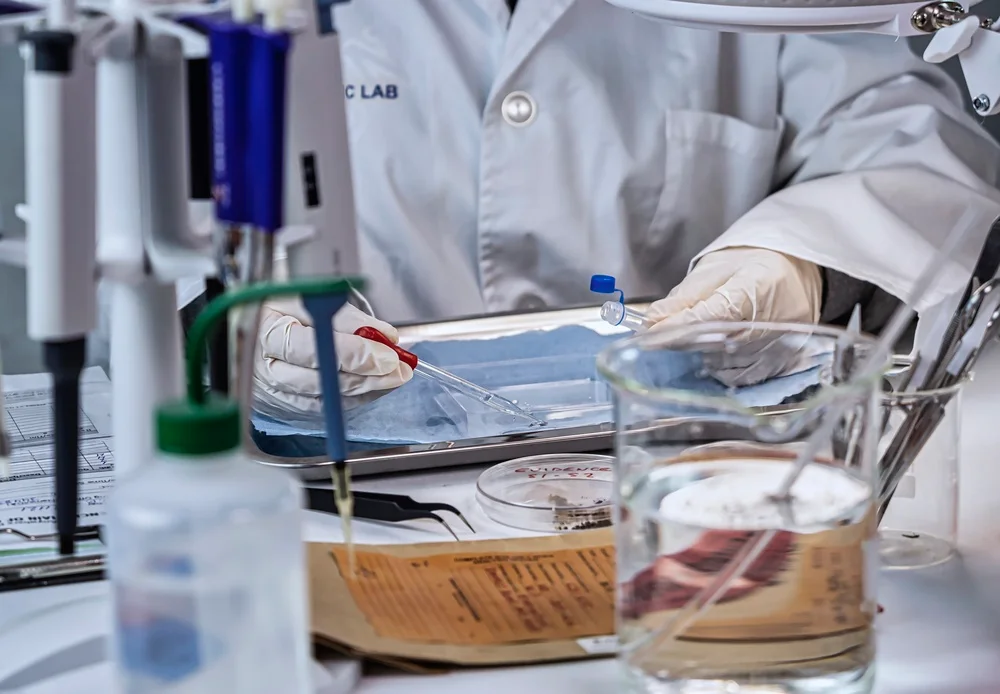
Forensic biology applies biological science to evidence used in legal investigations. The work can include identifying and interpreting DNA, blood and other body fluids, hair, tissue, microorganisms, and related biological material. Laboratory methods, statistical interpretation, documentation, quality assurance, and courtroom communication are central to the field.
That focus separates forensic biology from crime scene investigation. A crime scene investigator documents scenes, recognizes evidence, takes photographs, collects material, and maintains chain of custody. A forensic biologist or DNA analyst examines biological evidence in a laboratory, evaluates results, and reports scientific conclusions. Some education programs address both areas, but their science depth varies substantially.
California has relatively few programs explicitly named forensic biology. The verified options include two bachelor’s concentrations, a graduate forensic DNA track, and a community college certificate. Several broader graduate programs also include DNA, serology, or biological-evidence analysis. A field-focused criminal justice concentration appears later because it serves a different career direction.
Readers comparing this specialty with other forensic education can also review the broader guide to CSI and forensic degree options in California.
California forensic biology programs at a glance
| School | Credential | Program focus | Format | Main career alignment |
|---|---|---|---|---|
| San José State University | BS in Forensic Science, Biology Concentration | Biology, chemistry, DNA analysis, physical evidence, instrumentation, and crime-scene training | Primarily campus-based | Forensic biology, crime-laboratory support, criminalist preparation, and related forensic work |
| California State University, East Bay | BS in Biological Sciences, Forensic Science Concentration | Biology-first curriculum with molecular methods, quantitative analysis, chemistry, PCR, sequencing, and instrumentation | Campus-based | Biological evidence, laboratory criminalistics, molecular methods, and science-based graduate study |
| University of California, Davis | MS in Forensic Science, Forensic DNA Track | Advanced DNA methods, population genetics, interpretation, laboratory work, and thesis research | In person, full time or part time | Forensic DNA analysis, research, laboratory leadership preparation, and advanced criminalistics |
| Victor Valley College | Forensic Science, Biology Concentration Certificate of Achievement | Introductory forensic biology, pathology, microbiology, physiology, and biological research | Hands-on certificate; fully online completion was not verified | Entry-level technical education, professional development, or preparation for transfer |
These four pathways are not interchangeable. The SJSU and CSU East Bay programs are full bachelor’s degrees with substantial science coursework. UC Davis is an advanced program for applicants who already hold a natural- or physical-science bachelor’s degree. Victor Valley College offers a 25-unit certificate rather than a degree and explicitly notes that advanced forensic positions commonly require a bachelor’s or graduate degree in a natural or physical science.
Broader California graduate choices include criminalistics degrees at Cal State LA and National University, plus Alliant International University’s forensic science program. Their curricula contain relevant biological-evidence material, but none is formally titled forensic biology. Stanislaus State also has a field-oriented forensics concentration within criminal justice, which is better aligned with crime scene work than laboratory biology.
San José State University BS in Forensic Science, Biology Concentration
San José State University offers a Bachelor of Science in Forensic Science with concentrations in Biology, Chemistry, Digital Evidence, and Crime Scene Investigation. The Biology concentration is currently active, and the Department of Justice Studies welcomes applications to it.
The degree’s identity is broad forensic science rather than biology alone. Students study the natural sciences needed to understand biological evidence while also learning about physical evidence, crime scenes, forensic procedures, and the legal setting in which scientific results are used. That combination can be useful for someone who wants laboratory preparation without losing exposure to evidence collection and investigative work.
Curriculum and scientific preparation
SJSU’s published Biology concentration plan includes:
- General chemistry
- General biology
- Organic chemistry
- Physics
- Calculus
- Statistics
- Biochemistry
- Upper-division biology
- Forensic biology and DNA analysis
- Physical evidence
- Other forensic science courses
Current department materials also identify cellular biology and genetics, toxicology, instrumentation, photography, and crime-scene investigation among the program’s subject areas. This is substantially more scientific preparation than a typical criminal justice curriculum with a few forensic electives.
The accessible detailed major form is labeled Fall 2022, so individual course numbers or sequencing could have changed since its publication. The degree itself is current. The older plan remains useful for understanding the program’s established structure, particularly its combination of chemistry, biology, quantitative work, and applied forensic science.
SJSU describes hands-on crime-laboratory and crime-scene training. The curriculum also includes a practical requirement that may be completed through an internship, individual study, directed reading, or another approved option. The department identifies faculty laboratories and community partners such as the Santa Clara County District Attorney Crime Lab, the county Coroner’s Office, and local law-enforcement agencies as examples of practical settings.
This balance supports more than one direction. The biology and chemistry sequence is relevant to biological evidence and criminalist preparation, while photography, physical evidence, and scene training add context for how evidence reaches the laboratory. Someone committed exclusively to molecular laboratory science may prefer the biology-first structure at CSU East Bay, but SJSU provides a broader forensic science identity.
Admission to the impacted major
The Forensic Science major is impacted, which means space is limited and admission is competitive. Current SJSU students applying to change into the Biology concentration need at least a 3.0 overall GPA. Required preparatory work includes FS 11, statistics, and either CHEM 1A or BIOL 30, with grades of C or better.
Applicants are ranked by GPA, and satisfying the minimum requirements does not guarantee a place. Students hoping to enter SJSU in another major and later switch to forensic science face both course prerequisites and limited program capacity. Completing the preparatory courses successfully is only part of the process because capacity also affects admission.
Transfer students need to pay close attention to science sequencing. General chemistry, biology, organic chemistry, physics, calculus, and upper-division requirements build on one another. A missing prerequisite can delay several later courses, even when many general education units transfer successfully.
Accreditation language
SJSU states that each forensic science concentration meets the educational standards of the American Academy of Forensic Sciences’ Forensic Science Education Programs Accreditation Commission. The current FEPAC program directory does not list SJSU as an accredited program.
The accurate description is that SJSU says its curriculum meets FEPAC educational standards. It is not accurate to label the degree FEPAC-accredited. Curriculum alignment can still be informative, but it is different from a current specialized accreditation decision.
Published cost
For Fall 2026, SJSU lists full-time undergraduate tuition of $3,419. Mandatory registration fees bring the semester charge to $4,776.50. The published part-time total for 1.0 to 6.0 units is $3,338.50.
Non-California residents pay an additional $471 per unit. Housing, food, books, laboratory materials, transportation, and personal expenses are separate from the tuition and mandatory-fee figure.
Who is this program aligned with?
SJSU is the clearest undergraduate option in California for someone seeking a degree explicitly titled Forensic Science with a Biology concentration. Its mix of laboratory science and forensic application can support preparation for biological-evidence work, general criminalistics, graduate education, and some crime-scene functions.
Actual hiring standards still turn on the completed transcript. California crime laboratories can specify particular totals in chemistry, biology, biochemistry, molecular biology, statistics, or quantitative analysis. The program title alone is not the measure of eligibility.
California State University, East Bay BS in Biological Sciences, Forensic Science Concentration
California State University, East Bay takes a different approach. It awards a Bachelor of Science in Biological Sciences with a Forensic Science concentration. The university lists a 2026-2027 roadmap, establishing the concentration as a current option.
This is a biology degree first. Forensic science and criminal-investigation courses are incorporated into a foundation built around molecular biology, chemistry, physics, mathematics, and laboratory methods. That structure aligns closely with the academic preparation commonly sought for laboratory criminalist and biological-evidence positions.
A molecular and analytical curriculum
The 120-semester-unit roadmap includes:
- Cell and molecular biology
- Genetics
- Evolutionary biology
- General chemistry
- Two semesters of organic chemistry
- Physics
- Calculus
- Quantitative analysis
- PCR and sequencing fragment analysis
- Bioanalytical and forensic instrumentation
- Advanced molecular and cellular biology
- Criminal Identification
- Survey of Forensic Science
- Advanced Criminal Investigation
BIOL 415 addresses PCR and sequencing, while CHEM 320 covers bioanalytical and forensic instrumentation. BIOL 426 serves as an advanced molecular and cellular biology capstone. Laboratory practice is embedded across the degree through chemistry, physics, molecular biology, quantitative analysis, sequencing, and instrumentation courses.
The inclusion of quantitative analysis is especially relevant in California. The California Department of Justice describes general chemistry and quantitative analysis as usual components of criminalist preparation. CSU East Bay also requires organic chemistry and provides direct exposure to molecular techniques used in biological analysis.
The criminal justice courses give scientific work an investigative context. Criminal Identification, forensic science, and advanced investigation help connect laboratory results with evidence handling and casework. They do not replace the science core, which remains the defining feature of the degree.
Career alignment
This curriculum is well matched to students planning for laboratory criminalistics, forensic biology, molecular evidence work, or graduate study in forensic DNA. It is also a defensible option for someone who wants a conventional biological sciences degree with a named forensic concentration.
The biology-first title can be useful outside forensic science as well. Graduates have a foundation in cell biology, genetics, chemistry, physics, and molecular methods rather than relying primarily on occupation-specific coursework. That broader scientific base can support laboratory employment or additional education even if career plans change.
CSU East Bay maintains a forensics internship program, although the available concentration materials do not establish an internship as a universal graduation requirement. Practical scientific training is nonetheless built into required laboratory courses. PCR, sequencing, analytical chemistry, organic chemistry, physics, and instrumentation cannot be completed as purely conceptual survey work.
Cost
For Fall 2026, CSU East Bay lists tuition and mandatory campus fees of $4,208.50 for undergraduates taking more than six units. The charge for 0.1 to 6.0 units is $2,770.50. Nonresidents pay another $471 per unit.
Housing, meal plans, books, individual course fees, laboratory supplies, and other expenses are not included in those figures.
How it compares with SJSU
SJSU and CSU East Bay are both credible undergraduate routes, but their academic emphasis differs.
SJSU awards a forensic science degree and integrates biological science with a wider range of forensic topics, including crime scenes, photography, physical evidence, and practical placements. It offers a direct forensic professional identity and a defined Biology concentration within a multi-concentration forensic science program.
CSU East Bay awards a biological sciences degree. Its concentration places greater visible emphasis on molecular biology, quantitative analysis, PCR, sequencing, and bioanalytical instrumentation. A student targeting DNA analysis or laboratory criminalistics will find several courses that map directly to molecular and analytical work.
Neither curriculum should be reduced to “CSI” education. Both include enough natural science to merit close review for laboratory careers. CSU East Bay has the more explicitly biology-centered structure, while SJSU blends laboratory science with broader forensic practice. The better route depends on whether the intended work is primarily molecular and analytical or spans laboratory, evidence, and scene functions.
UC Davis MS in Forensic Science, Forensic DNA Track
The University of California, Davis offers an in-person Master of Science in Forensic Science with Forensic DNA and Forensic Criminalistics tracks. The program is research-focused, requires 54 quarter units, and permits full-time or part-time attendance.
UC Davis is the only California program identified in the current AAFS FEPAC directory. Its accreditation term runs from March 1, 2026, through March 1, 2031. FEPAC accreditation is specialized programmatic accreditation for qualifying forensic science programs. It is useful evidence of external curriculum review, although California employers do not universally require graduation from a FEPAC-accredited program.
Graduate-level DNA training
The Forensic DNA track concentrates on DNA methods, applications, and interpretation. Required study includes:
- Forensic Science Fundamentals
- Homicide Crime Scene Investigation
- Forensic Case Reports
- Molecular Techniques
- Forensic DNA Analysis
- Population Genetics
- Principles and Practices of DNA Typing
- Electives
- Thesis research
The coursework reaches beyond an introductory DNA survey. FOR 280 covers DNA extraction, quantitation, short tandem repeat amplification, capillary electrophoresis, data analysis, legal issues, and quality assurance. FOR 281 includes laboratory work in the extraction, quantification, and typing of human DNA. Population genetics is addressed as an applied forensic subject.
The wider core includes forensic biology, microscopy, materials analysis, ethics, case reporting, quality assurance, crime-scene investigation, and courtroom-related subjects. This provides context for how DNA testing operates within an accredited forensic laboratory system, not merely how genetic techniques work in a research setting.
Thesis research is a major part of the degree. UC Davis publishes examples involving touch DNA, mitochondrial DNA, probabilistic genotyping, microbial DNA, and body-fluid evidence. The program’s official pages differ on the exact number of research units, but they consistently describe a thesis-based 54-unit degree.
Admissions preparation
UC Davis is not an entry point for someone beginning college science. Applicants need a bachelor’s degree in a natural or physical science from an accredited institution. Required prerequisite work includes:
- General chemistry with laboratory
- Organic chemistry with laboratory
- Physics with laboratory
- Calculus
- Statistics
- Biology for DNA-track applicants
The minimum published overall GPA is 3.0, and the prerequisite-course GPA must also be at least 3.0. UC Davis indicates that, with program approval, some missing prerequisites can be completed during the first quarter.
These requirements show why an undergraduate biology or chemistry foundation matters. The master’s program begins with the expectation that students already understand core scientific concepts and laboratory practices. It then adds specialized DNA analysis, forensic interpretation, quality systems, and research.
Tuition and additional expenses
UC Davis lists tuition of $903 per quarter unit for students entering in fall 2025 or later. At 54 units, the published per-unit rate produces $48,762 in program tuition. Health insurance, books, supplies, laboratory materials, housing, transportation, and other living costs are separate.
The same stated program fee applies to California residents, nonresidents, and international students. The MS is self-supporting, which limits access to state-funded graduate financial support.
Appropriate career stage
The UC Davis DNA track is the most specialized California graduate pathway in this article. It is suited to applicants who already possess substantial science preparation and want advanced forensic DNA coursework, laboratory experience, population genetics, quality assurance, and thesis research.
A master’s degree can strengthen scientific depth and research capability, but it does not replace missing undergraduate prerequisites. DNA laboratories commonly evaluate the full transcript, including foundational biology, chemistry, molecular biology, genetics, biochemistry, and statistics.
Victor Valley College Forensic Science, Biology Concentration Certificate
Victor Valley College offers a 25-unit Certificate of Achievement in Forensic Science, Biology Concentration. The 2026-2027 catalog gives an expected completion time of 24 months.
Required courses include:
- Forensic Pathology
- Principles of Forensic Biology
- General Microbiology
- Human Physiology
- Biological Research II
Students also choose additional coursework in heredity, advanced biological research, forensic anthropology, or crime-scene investigation. Every certificate course must be completed with a grade of C or better.
The college describes education in biological evidence, DNA and serology, bloodstain analysis, forensic pathology, trace evidence, and concepts related to time since death. Laboratory science and biological research are part of the curriculum. Collaboration with local law-enforcement agencies adds an applied dimension, although a fully online completion route was not identified.
Where a certificate fits
This certificate can serve three practical purposes. It can introduce the specialty before a student commits to a four-year degree, add forensic context to prior science education, or provide lower-division preparation for transfer.
It is not equivalent to a bachelor’s degree in forensic science or biological sciences. Victor Valley College itself cautions that advanced forensic science positions commonly require a bachelor’s or graduate degree in a natural or physical science. California DOJ guidance similarly describes a four-year science degree as the usual educational foundation for criminalists.
A transfer-oriented student should preserve the broader science sequence alongside certificate requirements. General chemistry, organic chemistry, calculus, statistics, physics, genetics, molecular biology, and quantitative analysis often determine progress after transfer and eventual eligibility for laboratory positions. Completing only the 25-unit certificate would leave many of those requirements unfinished.
Cost
California residents pay $46 per unit at Victor Valley College. At that enrollment rate, 25 units of base enrollment fees equal $1,150. Student fees, books, laboratory supplies, transportation, housing, food, and other costs are separate.
The 2026-2027 catalog lists federal financial-aid approval for this certificate as pending. That status affects the certificate program’s aid eligibility, not the college’s general eligibility to participate in financial-aid programs.
FEPAC accreditation is not applicable to this certificate. FEPAC’s published scope covers qualifying bachelor’s and master’s programs, not community college certificates.
Broader California graduate programs with forensic biology content
A program does not need “forensic biology” in its title to include DNA or serology. California has at least three additional graduate programs with relevant content. They belong in a broader category because each covers criminalistics or forensic technology beyond biological evidence.
Cal State LA MS in Criminalistics
California State University, Los Angeles offers a campus-based Master of Science in Criminalistics. The program operates in the Hertzberg-Davis Forensic Science Center, a facility shared with public crime laboratories.
Applicants must have a bachelor’s degree in a natural or physical science. Listed preparation includes biology, biostatistics, general chemistry, organic chemistry with laboratories, quantitative analysis, and physics. The program publishes a 3.0 GPA threshold for consideration and currently admits for fall entry.
Official university materials describe instruction in serology, DNA extraction and analysis, microscopy, spectrophotometry, chromatography, toxicology, quality assurance, ethics, crime-scene reconstruction, and courtroom testimony. Biological evidence is therefore a meaningful component, but the degree also addresses trace, chemical, physical, and interpretive areas of criminalistics.
A research project serves as the capstone. Internships are encouraged rather than documented as a universal requirement. The location in a working forensic science center gives the program a direct connection to professional laboratory settings.
Cal State LA previously held FEPAC accreditation from 2011 through 2016. Current FEPAC accreditation was not established, and the program does not appear in the present directory. Its scientific entrance requirements and laboratory-oriented curriculum remain relevant independent of that historical accreditation.
This degree is suited to a natural-science graduate seeking broad criminalistics training with serology and DNA content. It is less specialized in DNA than UC Davis because it covers multiple forms of evidence and analytical technique.
National University Master of Forensic Sciences, Criminalistics Specialization
National University offers a 36-semester-credit Master of Forensic Sciences with a Criminalistics specialization. The specialization requires an undergraduate degree in a laboratory or physical science, which places it in the post-baccalaureate science category rather than the conversion-degree category.
Coursework includes advanced forensic serology and DNA, trace evidence, advanced forensic toxicology, and additional forensic science subjects. A supervised graduate research project is also part of the curriculum.
National University advertises online, in-person, and hybrid study, but delivery varies by specialization. Some Criminalistics courses can require in-person laboratory participation. The program therefore offers more scheduling flexibility than a conventional campus degree without eliminating the physical laboratory demands of criminalistics.
The official tuition page listed an estimated program cost of $25,830 when researched. That estimate is based on 36 credits, a $683 base rate per credit, and listed course-material fees. It is not a complete cost-of-attendance figure, and expenses associated with laboratory participation or travel may fall outside the estimate.
Current FEPAC accreditation was not verified. National University’s institutional accreditation is a separate matter from specialized forensic science program accreditation.
This route is relevant to forensic biology because of the advanced serology and DNA coursework. Its scope remains broader than a dedicated DNA track, with toxicology and trace evidence included alongside biological analysis.
Alliant International University MS in Forensic Science, Investigation, & Technology
Alliant International University offers a 33-unit Master of Science in Forensic Science, Investigation, & Technology. The Criminalistics and Technology concentration addresses the collection, preservation, and analysis of DNA, trace and physical evidence, toxicological or pharmacological evidence, and identification evidence.
The degree is delivered online and includes a research thesis. The main program page states that two on-site weekend residencies are required. Another official school page describes virtual weekend residencies, so the university’s published residency information is inconsistent. The current main degree page supports planning for two in-person weekends, including related travel costs.
The program uses simulations and laboratories, but available materials do not establish wet-laboratory depth comparable to the molecular laboratory sequence published by UC Davis or the science-heavy undergraduate curriculum at CSU East Bay. Its entrance materials also do not establish a laboratory-science bachelor’s prerequisite comparable to Cal State LA or National University’s Criminalistics specialization.
That difference affects career alignment. DNA analysts need more than general exposure to DNA evidence. Hiring standards can require specific academic work in biochemistry, genetics, molecular biology, statistics, and population genetics. Alliant’s program addresses DNA within a broader forensic technology curriculum, so its value for a particular laboratory role rests on how the graduate and undergraduate transcripts combine.
Current FEPAC accreditation was not verified.
An adjacent field route: Stanislaus State BA in Criminal Justice, Forensics Concentration
California State University, Stanislaus offers a Forensics concentration within its Bachelor of Arts in Criminal Justice. Preparatory coursework includes chemistry, statistics, human genetics, and psychology.
The university describes this pathway as broad-based and oriented toward field work such as crime scene investigation. It is campus-based rather than fully online. Its emphasis places it closer to evidence recognition, collection, scene processing, and investigative support than to laboratory DNA analysis.
Stanislaus State directly advises students seeking crime-laboratory criminalist work to major in biology or chemistry and add the Forensics minor. That advice accurately captures the curricular divide. A criminal justice degree with scientific prerequisites can support field investigation, but laboratory criminalistics generally requires deeper and more continuous work in chemistry, molecular biology, analytical methods, and instrumentation.
This option belongs in a forensic education comparison because some applicants use “forensic biology” to mean any work involving biological evidence. It should not be grouped with the SJSU and CSU East Bay science degrees as equivalent laboratory preparation.
Why chemistry matters in a biology specialty
The California Department of Justice’s California Criminalistics Institute states that criminalists usually hold a four-year degree in chemistry, physics, biology, biochemistry, molecular biology, or another physical or biological science. Its guidance also identifies a chemistry minor, or at least eight units of general chemistry and three units of quantitative analysis, as a usual requirement.
Forensic biology relies on chemistry throughout the analytical process. DNA extraction and purification involve chemical properties and reactions. Instrumental analysis requires an understanding of calibration, controls, sensitivity, interference, and measurement. Serological testing involves biochemical reactions. Toxicological or trace evidence encountered in broader criminalistics introduces still more analytical chemistry.
A degree with “forensic” in its title can still be too light in science for a particular criminalist position. Conversely, a biology, molecular biology, biochemistry, or chemistry degree can provide excellent preparation even when the diploma does not mention forensic science.
The transcript should show progression rather than scattered introductory courses. Strong preparation for laboratory biological evidence commonly includes:
- General biology
- Cell and molecular biology
- Genetics
- General chemistry with laboratories
- Organic chemistry with laboratories
- Biochemistry
- Statistics
- Calculus
- Quantitative or analytical chemistry
- Microbiology
- Population genetics
- Instrumentation
- Laboratory quality assurance
- Scientific writing and research
Not every job requires every subject in the same quantity. DNA analysis, toxicology, controlled-substance analysis, trace evidence, and general criminalistics have different educational standards. The practical lesson is to choose the scientific sequence around the intended laboratory discipline, not merely around a forensic program label.
Forensic biology, criminalistics, and CSI are different paths
California agencies use job titles inconsistently. One department may employ civilian crime scene investigators, while another assigns scene work to sworn officers. Evidence technician and property technician positions can also vary in their technical expectations.
Curriculum provides a clearer comparison than titles.
Forensic biology and DNA analysis
This path emphasizes:
- Molecular biology and genetics
- DNA extraction and quantitation
- PCR and STR analysis
- Capillary electrophoresis
- Serology and body-fluid testing
- Population genetics
- Statistical interpretation
- Contamination prevention
- Validation and quality assurance
- Technical reporting and testimony
UC Davis has the most specialized graduate curriculum in this group. CSU East Bay provides an especially direct undergraduate foundation through PCR, sequencing, genetics, quantitative analysis, and instrumentation. SJSU combines biological and chemical science with a wider forensic science curriculum.
General criminalistics
Criminalists can work across multiple evidence categories, depending on the laboratory and assignment. Preparation may include biological evidence, controlled substances, toxicology, trace materials, microscopy, chemistry, firearms-related evidence, or instrumentation.
Cal State LA and National University fit this broader model. Both require prior laboratory or natural science preparation and include biological evidence within a wider criminalistics curriculum.
Crime scene investigation
CSI education emphasizes:
- Evidence recognition and recovery
- Scene documentation
- Photography
- Fingerprints
- Measurements and diagrams
- Reconstruction
- Packaging and preservation
- Chain of custody
- Report writing
- Courtroom communication
Stanislaus State’s field-oriented concentration aligns more closely with this work. SJSU also includes meaningful scene and evidence instruction, but its Biology concentration retains a substantial laboratory science foundation.
A person can work with biological evidence at a scene without being the analyst who tests it. Collecting a bloodstain and interpreting its DNA profile are separate functions that require different forms of training.
Online study and laboratory requirements
No fully online California degree directly matching forensic biology was verified. That is consistent with the subject’s practical demands. Students need experience using laboratory equipment, handling samples, preventing contamination, following protocols, documenting work, and interpreting instrumental or molecular results.
National University offers online and hybrid flexibility, but some Criminalistics courses can require in-person laboratory participation. Alliant delivers its program online but publishes a two-weekend residency requirement on its main degree page. SJSU, CSU East Bay, UC Davis, Cal State LA, and the Stanislaus State pathway are campus-based.
An online lecture can effectively teach ethics, legal procedure, quality systems, statistics, or parts of DNA theory. It cannot fully reproduce repeated supervised practice with extraction, pipetting, quantitation, amplification, electrophoresis, microscopy, chromatography, or evidence handling.
Convenience therefore needs to be evaluated together with laboratory access. A program that reduces weekly commuting but requires residencies or lab sessions can still be workable, although travel, lodging, and time away from work become part of the real cost.
FEPAC accreditation in context
FEPAC accredits qualifying bachelor’s and master’s programs in forensic science, as well as natural-science programs with forensic science concentrations. Its scope does not cover the Victor Valley College certificate.
UC Davis is the only California option in this article with verified current FEPAC accreditation. SJSU says its concentrations meet FEPAC educational standards but is not listed as accredited. No current FEPAC status was verified for CSU East Bay, Cal State LA, National University, Alliant, or Stanislaus State.
Specialized accreditation can help identify a program that has undergone external review against forensic science education standards. It is not the only indicator of academic suitability. Employers also evaluate institutional accreditation, degree field, completed science courses, laboratory experience, grades, and the requirements attached to a specific discipline.
A biology degree with organic chemistry, quantitative analysis, genetics, molecular methods, statistics, and instrumentation can be more useful for a laboratory opening than a forensic degree with limited science. FEPAC status should be read alongside the actual curriculum rather than used as a substitute for curriculum review.
Transfer planning for California community college students
A transfer student targeting forensic biology should prioritize prerequisite chains early. Chemistry and mathematics often control the pace of the degree because upper-division biology and analytical courses require them.
A practical lower-division sequence usually includes:
- General biology with laboratory
- General chemistry with laboratory
- Calculus
- Statistics
- Organic chemistry with laboratory
- Physics with laboratory
- Additional transferable biology, where articulated
Completing general education without beginning chemistry can add substantial time after transfer. Organic chemistry may require a full general chemistry sequence, and biochemistry often follows organic chemistry. Physics and calculus can create similar dependencies.
The Victor Valley certificate can add useful forensic context, but transfer preparation should not sacrifice foundational science courses needed at SJSU, CSU East Bay, or another four-year institution. A student who completes pathology and forensic survey classes but lacks transferable chemistry may arrive interested in forensic biology without being ready for the major’s upper-division work.
CSU East Bay publishes transfer-roadmap resources for its concentration. SJSU’s major is impacted, which adds a capacity constraint beyond ordinary transfer eligibility. Course articulation, grades, and the order of science completion all affect the realistic timeline.
The unresolved Sacramento State concentration
Search results may still lead readers to references to a Sacramento State BS in Biological Science with a Forensic Biology concentration. Current official evidence is conflicting.
An official program document states that the concentration was suspended beginning around the 2020-2021 catalog period, with students already enrolled allowed to finish. The current 2026-2027 biological sciences catalog lists several concentrations but does not include Forensic Biology. Some newer overview and transfer-oriented university pages continue to mention it.
Sacramento State still offers relevant upper-division courses. BIO 150, Forensic Biology, covers serology, hair comparison, DNA profiling, evidence preservation, biological statistics, crime laboratories, and the criminalist’s courtroom role. BIO 151, Advanced Laboratory Techniques in Forensic Biology, addresses forensic serology, DNA typing, mixture interpretation, low-copy-number interpretation, advanced laboratory methods, and testimony.
Those courses demonstrate continuing forensic biology instruction, but they do not establish that the former named concentration is open to new students. For that reason, Sacramento State is not included in the active program table.
Choosing a California forensic biology pathway
The decision becomes clearer when organized by educational stage and career target.
A first-time undergraduate seeking a named forensic science degree can begin with SJSU. Its Biology concentration combines chemistry and biology with physical evidence, crime-scene work, instrumentation, and practical experience. Admission constraints deserve attention because the major is impacted.
An undergraduate who wants the degree anchored more firmly in biological science can focus on CSU East Bay. The required work in genetics, molecular biology, quantitative analysis, PCR, sequencing, organic chemistry, and forensic instrumentation provides a strong laboratory-oriented sequence.
A science graduate seeking advanced DNA specialization has the clearest direct route at UC Davis. The program requires substantial prior preparation and then advances into DNA typing, population genetics, interpretation, quality assurance, and thesis research.
Someone beginning at a community college can use Victor Valley College’s certificate to explore the field or add technical coursework, but a bachelor’s transfer plan remains the appropriate route toward advanced laboratory roles.
Cal State LA and National University are broader graduate criminalistics options. Their biological-evidence content sits alongside trace, toxicological, chemical, and physical evidence. Alliant offers online delivery with residencies and a broad technology concentration, but its published science-entry structure and wet-laboratory depth are less explicit.
Field investigation calls for a different emphasis. Stanislaus State’s Criminal Justice Forensics concentration is aligned with crime scene work, and the university itself directs prospective laboratory criminalists toward biology or chemistry instead.
For laboratory careers, prioritize the completed science sequence: chemistry, quantitative analysis, molecular biology, genetics, statistics, instrumentation, and sustained laboratory practice. For CSI work, prioritize evidence recognition, photography, documentation, collection, preservation, reconstruction, and chain of custody. California’s available programs serve both directions, but only a few provide the molecular and analytical depth associated with forensic biology.