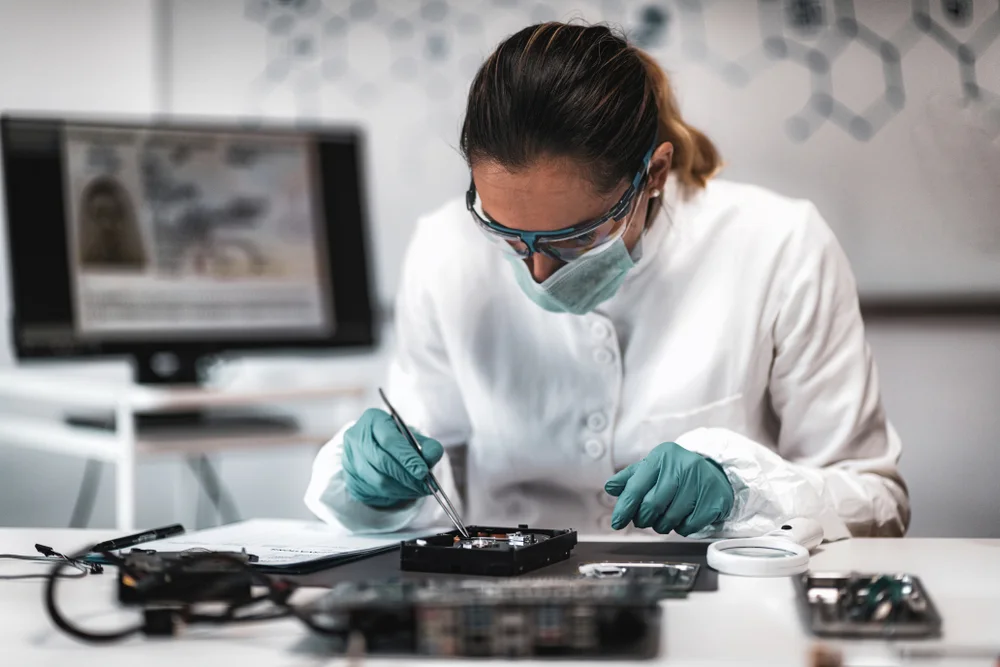
Digital forensics analysts recover, preserve, examine, and explain evidence found on computers, phones, cloud accounts, networks, removable media, and other electronic systems. California employers use several titles for this work, including digital forensic examiner, computer forensics analyst, digital forensic investigator, digital forensic specialist, cyber defense forensics analyst, and digital forensics technician.
Those titles overlap, but they are not interchangeable. A police department examiner may process devices seized under a search warrant and later testify in court. A corporate incident-response analyst may reconstruct a network intrusion, identify compromised accounts, and document the scope of a data breach. A state employee may perform both investigative and cybersecurity work under an Information Technology Specialist classification. Some California crime laboratories even place computer forensics within a broader criminalist classification.
There is no single statewide degree, license, or certification that qualifies someone for every digital-forensics position in California. A bachelor’s degree is common, especially at the analyst level, but recent public-sector requirements also show routes based on an associate degree, college coursework, technical experience, or combinations of education and experience.
A practical route into the occupation is to:
- Build a strong foundation in computers, operating systems, file systems, networking, and cybersecurity.
- Complete relevant college education or develop equivalent qualifying experience.
- Learn lawful evidence acquisition, preservation, analysis, documentation, and reporting.
- Gain practical experience through laboratories, IT support, security operations, incident response, evidence work, or supervised forensic assignments.
- Add a certification aligned with the positions you plan to pursue.
- Search under multiple job titles and document your education and experience in the detail required by government hiring systems.
- Prepare for extensive screening if you are applying to a police department, prosecutor’s office, crime laboratory, or other law-enforcement organization.
What a digital forensics analyst actually does
The O*NET profile for Digital Forensics Analysts describes an occupation focused on investigating computer-based crimes and security incidents, preserving digital evidence, analyzing operating systems and file systems, and presenting findings in reports or legal proceedings.
The work normally follows a controlled process:
- Identify potential sources of digital evidence.
- Obtain legal or organizational authority for the examination.
- Collect a device or acquire data from a remote system.
- Preserve the original evidence.
- Create a forensic image or other working copy.
- Confirm integrity through hashing or comparable controls.
- Examine file systems, logs, applications, communications, and user activity.
- Recover deleted or hidden information when technically possible.
- Correlate findings across devices, accounts, networks, or timelines.
- Document the methods, tools, results, and limitations.
- Prepare a technical report.
- Explain the findings to investigators, attorneys, managers, or a court.
The National Institute of Standards and Technology defines Digital Evidence Analysis as identifying, collecting, examining, and preserving digital evidence through controlled and documented analytical and investigative techniques. NIST treats this as a work role rather than a fixed occupation. One California position might combine digital evidence analysis with cybercrime investigation, incident response, mobile-device analysis, or network forensics.
An examiner cannot simply run a commercial tool and report whatever appears on the screen. The analyst must understand how the tool reached its result, what data it could have missed, whether the method was repeatable, and how the evidence was protected from alteration. That requires technical knowledge, disciplined documentation, and the ability to defend a conclusion under review.
Two major California career tracks
California digital-forensics employment broadly divides into criminal or litigation evidence work and cybersecurity or incident-response work. Some positions combine both.
Law-enforcement and litigation evidence
Police departments, sheriff’s offices, district attorney offices, state agencies, crime laboratories, and federal task forces examine evidence connected to criminal, civil, regulatory, or administrative matters.
Typical assignments include:
- Acquiring computers and phones during authorized searches
- Extracting mobile-device data
- Examining hard drives and removable storage
- Recovering deleted files
- Preserving social media or cloud evidence
- Preparing evidence for attorneys and investigators
- Supporting search-warrant applications
- Maintaining chain-of-custody records
- Writing examination reports
- Giving testimony about methods and findings
This track places heavy emphasis on search authority, evidence integrity, documentation, confidentiality, report writing, and courtroom communication. Hiring may also include a detailed background investigation, fingerprinting, psychological or medical evaluation, drug screening, and a polygraph or voice-stress examination.
Many of these jobs are civilian positions. The California Department of Justice, for example, recruited a non-sworn Digital Forensic Investigator under the Information Technology Specialist series in 2026. Civilian examiners may work closely with sworn officers without holding peace-officer status.
A separate route exists for sworn officers who gain digital-evidence expertise after entering law enforcement. The California Commission on Peace Officer Standards and Training lists courses in computer-crime investigation, mobile-device forensics, computer digital-evidence recovery, advanced PC forensics, and specialized investigative tools. POST training supports agency personnel, but it is not a general credential required of every civilian analyst.
Cybersecurity and incident-response forensics
Corporate security teams, government IT departments, consulting firms, managed security providers, and regulated organizations use forensic techniques to investigate cyber incidents.
Assignments may involve:
- Analyzing endpoint and server logs
- Reconstructing unauthorized access
- Tracing malicious activity across a network
- Examining compromised user accounts
- Collecting volatile system information
- Identifying persistence mechanisms
- Determining which files or records were accessed
- Supporting malware or ransomware investigations
- Preserving evidence for legal, insurance, regulatory, or disciplinary purposes
- Coordinating with incident responders and legal teams
This track often favors knowledge of operating systems, enterprise networks, cloud platforms, identity systems, security monitoring, scripting, and incident response. Court testimony may be less frequent than in police work, although reports can still face scrutiny in litigation, regulatory proceedings, or internal investigations.
California’s state IT classification mapping places functional titles such as Digital Forensics Analyst, Cyber Defense Forensics Analyst, Cyber Crime Investigator, and Law Enforcement/Counterintelligence Forensics Analyst within the Information Security Engineering domain. These functions can map to Information Technology Specialist I, II, or III classifications. Digital forensics in state service is therefore not confined to a traditional crime laboratory.
Education requirements in California
A bachelor’s degree is a common route, but California employers do not use one universal education standard.
O*NET respondent data indicate that 56 percent of new hires in this occupation needed a bachelor’s degree. Another 22 percent needed an associate degree, while 15 percent needed some college education without a completed degree. These national responses describe common preparation patterns rather than California law.
Recent California public-sector examples show how much requirements can vary:
- A 2026 Chula Vista Digital Forensics Technician I recruitment accepted a typical combination of relevant college coursework and either six months of digital-device examination experience or one year of computer hardware and software support experience. A bachelor’s degree was not listed as a universal requirement.
- Tulare County’s Digital Forensic Analyst I specification listed a bachelor’s degree in computer science or criminal justice plus one year of relevant experience. It also provided an alternative based on an associate degree plus three years of experience.
- A 2026 Clovis Digital Forensic Analyst recruitment typically required a bachelor’s degree in criminal justice, computer and digital forensics, computer information technology, or a closely related field, plus two years of relevant experience or two years of relevant graduate study.
- California’s Information Technology Specialist I classification permits several combinations of college education and IT experience. One route uses 120 semester units, including at least 15 semester units of IT or closely related coursework. Other routes rely more heavily on qualifying work experience.
- Information Technology Specialist II generally requires higher-level experience. A bachelor’s degree can substitute for four years of general IT experience, provided the qualifying education includes at least 15 semester units of IT or closely related study.
An associate-degree route is realistic, but it usually requires more experience before reaching a full analyst position. Coursework-only or support-experience routes are more common at the technician or trainee level. Advanced investigator and specialist positions generally expect several years of directly related work.
Choosing a major
Relevant undergraduate fields include:
- Computer science
- Cybersecurity
- Information technology
- Information systems
- Computer or digital forensics
- Software engineering
- Network administration
- Digital investigations
- A related technical discipline
A digital-forensics degree can provide direct exposure to evidence handling, forensic tools, legal procedure, and investigative reporting. A computer science, cybersecurity, or IT degree may offer a broader technical base, especially in programming, networks, operating systems, and enterprise infrastructure. Pairing that broader major with forensic laboratories, security coursework, or a digital-forensics certificate can prepare a graduate for both evidence examination and incident-response work.
Some California law-enforcement employers accept criminal justice as a relevant major. The degree title alone is not sufficient technical preparation for most examinations. A criminal justice curriculum that contains little computing, networking, scripting, or laboratory work leaves major gaps. Someone following that route needs substantial technical coursework and hands-on experience with operating systems, storage media, forensic acquisition, and analytical methods.
A specific employer can impose unusual prerequisites. The City of San Diego’s 2026 Criminalist II recruitment included computer and digital forensics as qualifying experience, but the broader criminalist classification also required defined general chemistry and organic chemistry or biochemistry coursework. Those science prerequisites belonged to that classification. They are not a general California requirement for digital-forensics analysts.
Courses that provide useful preparation
Program names reveal less than the actual curriculum. Strong preparation covers the systems being examined, the investigative process, and the communication needed to support a defensible conclusion.
Computer systems and programming
Useful subjects include:
- Windows, Linux, and macOS administration
- Computer architecture
- File systems
- Data storage
- Scripting with Python or PowerShell
- Databases and SQL
- Virtualization
- Cloud computing
- Mobile operating systems
- Software fundamentals
File-system knowledge is especially valuable. An examiner may need to explain where an artifact was stored, how an application generated it, whether a timestamp reflects creation or modification, and why deleted information remained recoverable.
Scripting can reduce repetitive work, parse large data sets, correlate records, and create repeatable analytical procedures. Analysts do not need to begin as advanced software developers, but they should be able to understand and safely modify basic scripts.
Networks and cybersecurity
For cybersecurity-oriented work, prioritize:
- TCP/IP networking
- Network security
- System and application logs
- Identity and access management
- Security operations
- Incident response
- Malware fundamentals
- Network traffic analysis
- Cloud security
- Endpoint detection
- Vulnerability management
Network knowledge also helps criminal examiners. Evidence increasingly spans phones, routers, cloud services, social media platforms, remote storage, and Internet of Things devices rather than remaining on one isolated computer.
Forensic methods and legal process
A useful forensic curriculum should include:
- Forensic imaging
- Write protection
- Hashing
- Data recovery
- Deleted-file analysis
- Windows artifacts
- Browser and email analysis
- Mobile-device examination
- Chain of custody
- Search authority and scope
- Documentation
- Report writing
- Expert testimony
- Tool validation
- Quality assurance
Legal education should be practical rather than superficial. Analysts need to understand how the scope of a warrant, consent, organizational authorization, or court order affects what they are permitted to collect and examine. Their role is technical, but technical decisions must remain within the authorized search.
Statistics and communication
Digital-forensics work is evidence-based, but it is also communication-intensive. Technical writing, research methods, statistics, and public speaking can be highly useful.
A report must distinguish observed facts from interpretation. It should explain what was examined, which procedures were used, what was found, and what limitations affected the analysis. Reports may be reviewed by senior examiners, investigators, attorneys, opposing experts, judges, or juries.
Evidence integrity and defensible methods
Digital evidence can be altered easily, sometimes merely by turning on a device or opening a file through its original operating system. Evidence handling therefore begins before analysis.
NIST’s digital-evidence preservation guidance emphasizes documentation of the original source, controlled transfers, integrity verification, authentication, access controls, logging, secure storage, and backups. Hash values and digital signatures can support later verification that data remained unchanged.
A sound workflow commonly includes:
- Documenting the device or source in its original condition.
- Recording who collected it, when it was collected, and under what authority.
- Preventing avoidable changes to the source.
- Acquiring a forensic image or controlled copy.
- Calculating and recording hash values.
- Protecting the original evidence.
- Performing analysis on an approved working copy.
- Keeping contemporaneous examination notes.
- Recording tool names, versions, settings, and relevant limitations.
- Obtaining technical or peer review when required.
- Preserving reports, exports, screenshots, and analytical work products.
Chain of custody records who possessed or transferred evidence. Hashing supports integrity verification by showing whether data changed. Neither replaces the other.
Tool output also requires validation. The NIST Computer Forensics Tool Testing Program develops procedures and data sets for evaluating forensic tools because investigators need results that are accurate and objective. Analysts should understand a tool’s tested capabilities, known limitations, supported data sources, and behavior under the conditions in which it is used.
The Scientific Working Group on Digital Evidence identifies competence across legal and ethical considerations, preparation, search and identification, preservation, acquisition, analysis, documentation, presentation, and testimony. Its quality-assurance guidance also emphasizes documented training, mentorship, competency assessment, continuing education, and recurring proficiency evaluation. These are professional recommendations, not a single California licensing system.
How to gain experience before an analyst job
Many analyst openings require prior experience, creating a common entry problem. The practical solution is to build related technical experience while developing forensic-specific skills.
Useful entry and adjacent roles include:
- IT support technician
- Desktop support specialist
- Systems administrator
- Network technician
- Security operations center analyst
- Incident-response analyst
- Evidence or property technician
- Digital forensics technician
- E-discovery technician
- Litigation-support specialist
- Mobile-device examiner
- Fraud investigator
- Cybercrime investigative assistant
- Laboratory intern or trainee
IT support develops troubleshooting, hardware, software, user-account, and operating-system knowledge. System and network administration provide a stronger understanding of logs, permissions, storage, authentication, and enterprise infrastructure. Security operations can lead to endpoint, log, malware, and incident-response analysis.
Evidence-room or property-unit work develops chain-of-custody discipline, although it may provide less direct technical analysis. A digital-forensics technician position can combine evidence handling with supervised device examination and is one of the clearest entry routes.
Chula Vista’s 2026 technician recruitment illustrates this path. The part-time entry-level class was designed for workers with limited experience who would learn under immediate supervision. Duties included examining computers and phones, preserving and copying media, restoring deleted files, using forensic tools, documenting results, maintaining evidence records, and helping with video enhancement and redaction.
Building a lawful technical portfolio
A portfolio can demonstrate practical ability when professional casework is limited. Use authorized training data rather than real third-party information.
Suitable projects include:
- Acquiring and examining a forensic practice image
- Building a Windows activity timeline
- Recovering deleted files from a test drive
- Documenting browser and USB activity
- Analyzing a simulated phishing or account-compromise incident
- Parsing logs with a script
- Comparing results from two forensic tools
- Testing a tool against a known data set
- Writing a mock forensic report
- Completing a digital-forensics capture-the-flag exercise
Each project should document the objective, source data, authorization, tools, versions, acquisition method, integrity values, analytical process, results, limitations, and conclusion. A short but repeatable laboratory report demonstrates more occupational readiness than screenshots with no explanation.
Never use a portfolio project as a reason to access another person’s device, account, or data without authorization.
Professional certifications
California has no verified occupational license titled Digital Forensics Analyst for ordinary employees. Certifications are voluntary at the statewide level, although individual employers can prefer or require one.
The value of a certification depends on its content, the role, and the candidate’s existing experience. A certification should add evidence of competence in a relevant area. It does not substitute for sound acquisition methods, technical reasoning, legal awareness, or clear reports.
CFCE
The IACIS Certified Forensic Computer Examiner covers pre-examination procedures, computer fundamentals, partition schemes, file systems, data recovery, Windows artifacts, and presentation of findings. Its process includes peer review followed by practical and written certification components.
External candidates must document 72 hours of qualifying computer or digital-forensics training. Credential holders recertify every three years. CFCE may align well with law-enforcement and traditional computer-examination roles.
GCFE
The GIAC Certified Forensic Examiner focuses on Windows forensic investigation. Covered areas include evidence acquisition, browser data, registry artifacts, logs, email, USB activity, user behavior, analysis, and reporting. The current examination format includes a proctored performance assessment with hands-on laboratory components.
GCFE can be relevant to Windows endpoint investigations, incident response, and enterprise forensics. It is not legally required to work in California.
Vendor certifications
Some employers reference certifications associated with forensic software or mobile-device platforms. Clovis listed EnCE and ACE as desirable in its 2026 recruitment rather than mandatory. Tulare County’s class specification called for an industry-accepted digital-forensics certification and provided examples.
Vendor training can help an analyst use a platform efficiently, but competence must extend beyond the product interface. File-system knowledge, validation, evidence handling, and independent interpretation remain necessary.
A good certification strategy follows the intended job:
- Traditional computer examination: prioritize acquisition, file systems, artifacts, reporting, and legal evidence handling.
- Mobile-device work: add mobile operating systems, extraction methods, application data, cloud connections, and platform-specific limitations.
- Incident response: emphasize Windows artifacts, logs, endpoint telemetry, networks, scripting, and enterprise systems.
- Advanced laboratory work: add quality assurance, validation, peer review, testimony, and specialized device or data-source training.
California government hiring routes
Government hiring often requires more documentation than a private-sector application. A resume may not establish eligibility by itself.
An application may require:
- Official or unofficial transcripts
- A civil-service examination or eligibility record
- Detailed descriptions of qualifying duties
- Dates and hours worked
- Supplemental questionnaire responses
- Copies of certifications
- A driver’s license
- A personal-history statement
- Background releases
- Writing samples or technical exercises
Describe experience in occupational terms. “Performed IT support” is less useful than “imaged storage media, analyzed Windows event logs, documented chain of custody, preserved original evidence, and prepared technical reports.” Claims must accurately reflect the work performed.
California’s state system also separates the civil-service classification from the working title. A posting called Digital Forensic Investigator might use an Information Technology Specialist II classification. Searching only for “digital forensics analyst” can miss relevant openings.
Useful search terms include:
- Digital forensics analyst
- Digital forensic examiner
- Computer forensics analyst
- Digital forensic investigator
- Digital forensic specialist
- Digital forensics technician
- Electronic evidence examiner
- Mobile-device examiner
- Cyber defense forensics analyst
- Cybercrime investigator
- Information Technology Specialist
- Criminalist, computer forensics
- Incident-response analyst
- E-discovery or litigation-support analyst
California’s FBI-sponsored Regional Computer Forensics Laboratory network operates service areas in Orange County, San Diego, and Silicon Valley. RCFLs provide digital-evidence examination and law-enforcement training, often through collaboration among federal, state, and local agencies. Their presence shows the regional and interagency nature of the work, but it is not a guaranteed direct-entry hiring path.
Examples of California qualification levels
Recent public records illustrate the progression from technician to experienced specialist.
Entry-level technician
Chula Vista’s Digital Forensics Technician I recruitment sought limited experience and related college coursework. The class operated under immediate supervision and included device examination, media preservation, deleted-file recovery, evidence documentation, and courtroom support.
This type of role can suit a candidate with technical support experience, introductory forensic coursework, and strong evidence-handling discipline who has not yet completed a bachelor’s degree or managed independent case examinations.
Entry or journey-level analyst
Tulare County defines Digital Forensic Analyst I as entry level, Analyst II as journey level, and Analyst III as advanced journey level. Its Analyst I specification used either a bachelor’s degree plus one year of experience or an associate degree plus three years.
Clovis required more preparation in its 2026 recruitment: a relevant bachelor’s degree plus two years of digital-forensics experience or relevant graduate study. Duties included authorized searches, chain of custody, search-warrant assistance, multi-device examination, reports, and testimony in state and federal court.
Advanced investigator or specialist
The California Department of Justice’s 2026 Digital Forensic Investigator recruitment used the Information Technology Specialist II classification, with ITS I also considered. The advanced work included forensic examinations, reconstruction of computing environments, evidence preservation, and analysis of hard drives, phones, servers, cloud data, social media, network devices, and Internet of Things systems.
San Bernardino County established a Digital Forensic Specialist classification in June 2026. Its duties included field collection, laboratory analysis, authentication, preservation, tool validation, technical training, reports, testimony, and response to time-sensitive incidents.
These examples show why experience with only one forensic application or device type can restrict advancement. Senior positions often involve multiple platforms, quality review, field acquisition, testimony, training, and decisions about laboratory methods.
Background screening and working conditions
Law-enforcement digital-forensics positions frequently involve extensive screening. Clovis’s recruitment described a process that could include a personal-history questionnaire, background investigation, polygraph or voice-stress examination, psychological assessment, medical examination, and drug or alcohol screening. San Diego’s criminalist process could include fingerprinting, a background investigation, polygraph testing, medical review, and substance screening.
The exact process differs across employers. Corporate incident-response jobs generally do not use the same police screening model, although they may still require background checks because analysts handle confidential systems and sensitive information.
The work itself can involve:
- Long periods at a computer workstation
- Repetitive review of files, logs, images, and communications
- Moving computers or evidence containers
- Travel to search or acquisition sites
- Statewide or occasional out-of-state travel
- Nights, weekends, holidays, or standby duty
- Urgent response to active incidents
- Strict confidentiality
- Quality-assurance review
- Depositions or courtroom testimony
- Exposure to sexually explicit, violent, or otherwise disturbing evidence
The California DOJ position required regular office attendance despite being described as hybrid. It also required California residency for telework and included statewide and possible out-of-state travel. Chula Vista identified nights, weekends, holidays, standby duty, and call-outs as possible conditions. Clovis warned applicants about disturbing content and occasional after-hours response.
Emotional resilience belongs in the career decision. Some criminal cases require sustained examination of abusive or graphic material. Employers may provide policies and support resources, but the exposure remains part of certain assignments.
Salary expectations in California
There is no clean California wage series limited to digital forensics analysts. O*NET reports wage information using the broader Computer Occupations, All Other category. That category had a national median wage of $116,580 in 2025, but it includes work beyond digital forensics and is not an exact salary figure for this occupation.
California Employment Development Department wage tools also organize estimates by broader occupational categories. Digital-forensics positions may be counted under computer occupations, forensic science, criminalist, IT, or local government classifications.
Recent public recruitments provide more useful examples, as long as they are treated as employer-specific snapshots rather than statewide guarantees:
| California employer and role | Compensation listed | Level and context |
|---|---|---|
| Chula Vista Digital Forensics Technician I | $30.97 to $37.65 per hour | Part-time, entry-level recruitment closed August 21, 2026 |
| Clovis Digital Forensic Analyst | $99,000 to $120,348 annually | Experienced police-department analyst recruitment closed April 28, 2026 |
| California DOJ Digital Forensic Investigator, ITS II | $8,625 to $11,557 per month | Advanced state IT classification recruitment closed May 1, 2026 |
| California DOJ, ITS I considered range | Beginning at $6,513 per month | Lower classification considered in the same recruitment |
| San Bernardino County Digital Forensic Specialist | $87,339.20 to $123,240 annually | Class-specification range reviewed in September 2026 |
| San Diego Criminalist II | $120,598.40 to $145,724.80 annually | Broader criminalist recruitment closed September 21, 2026 |
Pay varies with classification, bargaining unit, location, experience, specialization, schedule, and employer. A part-time technician wage cannot be directly compared with compensation for an advanced state investigator or criminalist. Government benefits and pension arrangements also affect total compensation but are not reflected in the salary ranges above.
Licensing and independent consulting
California does not appear to impose a digital-forensics-specific occupational license on analysts employed by police departments, government agencies, corporations, laboratories, or consulting organizations. Employers instead establish education, experience, screening, competency, and certification requirements.
Independent investigative services raise a separate issue. California’s Bureau of Security and Investigative Services defines private-investigator work broadly enough to include investigating crimes and securing evidence for use in court. Its occupational analysis also identifies computer forensics, cybercrime, forensic examiner services, expert-witness work, and litigation support as private-investigator specialties.
Someone independently accepting compensated investigative or evidence-gathering engagements may fall within the Private Investigator Act unless an exemption applies. The legal result depends on the services, business structure, employment relationship, and applicable exemption. The California BSIS private investigator factsheet is the appropriate starting point for defining that boundary, followed by qualified California legal advice when the planned services remain unclear.
Employment as an internal security analyst is different from opening an independent business that investigates outside clients’ disputes or gathers evidence for litigation.
Advancement and specialization
Digital forensics can lead to technical, quality, investigative, or management positions. Common directions include:
- Journey-level or senior forensic examiner
- Mobile-device specialist
- Network-forensics analyst
- Cloud-forensics specialist
- Incident-response lead
- Malware analyst
- Laboratory technical lead
- Forensic quality manager
- Tool-validation specialist
- Technical trainer
- Expert witness
- Consultant
- Supervising IT specialist
- Investigative unit supervisor
Advancement normally requires more than time in the role. Senior examiners are expected to handle difficult acquisitions, evaluate conflicting artifacts, recognize tool limitations, review other analysts’ work, explain findings clearly, and maintain competence as devices and platforms change.
Some specialists build depth in one area, such as mobile devices or Windows endpoints. Others become generalists capable of handling computers, phones, cloud accounts, networks, social media, and connected devices. Laboratory leads also need quality-assurance knowledge, policy development, proficiency testing, case review, and staff training.
Continuing education is part of the occupation because operating systems, encryption, application formats, hardware, cloud platforms, and forensic tools change regularly. Training should be tied to assigned work rather than accumulated without a clear competency goal.
A practical California roadmap
A candidate starting without a degree or technical background can use the following sequence.
Stage 1: Build the computing foundation
Learn computer hardware, Windows and Linux administration, storage, file systems, networking, and basic scripting. Entry-level IT support can provide useful professional experience while this foundation develops.
Stage 2: Complete relevant education
A bachelor’s degree offers the widest access to analyst positions. Computer science, cybersecurity, IT, information systems, and digital forensics are all viable when the curriculum includes substantial laboratory work.
An associate degree or focused college coursework can lead to technician work, particularly when combined with IT support or device-examination experience. Progression to analyst classifications may require several additional years of qualifying work.
Stage 3: Practice forensic workflows
Use authorized laboratory images and simulated incidents. Practice acquisition, hashing, preservation, artifact analysis, timelines, deleted-file recovery, note-taking, and report writing. Record tools and versions so another examiner could reproduce the work.
Stage 4: Gain supervised experience
Target technician, IT, security operations, incident response, evidence, e-discovery, and laboratory support roles. Supervised casework provides experience that independent practice exercises cannot replicate, including organizational procedures, peer review, confidentiality, and deadlines.
Stage 5: Add a targeted credential
Choose a certification that matches the intended track. Traditional law-enforcement examination, Windows incident response, mobile-device analysis, and vendor-specific laboratory work have different competency needs.
Stage 6: Apply under several titles
Use state, county, city, laboratory, corporate, and consulting job boards. Review classifications as well as working titles. The broader California forensic and investigative careers guide can help compare digital forensics with related evidence, crime-scene, and laboratory occupations.
Stage 7: Prepare detailed application evidence
Collect transcripts, course descriptions, certifications, project reports, and precise employment records. Government applications often score the documented relationship between prior duties and the classification requirements. Technical claims should be specific and supportable.
Deciding whether this career fits
Digital forensics is a good match for someone who enjoys technical problem-solving but can also work within strict procedures. The analyst must be patient enough to document routine steps, skeptical enough to question tool output, and clear enough to explain technical findings to nontechnical audiences.
The law-enforcement route fits people interested in evidentiary searches, criminal or civil cases, chain of custody, warrants, reports, and testimony. It may also bring intensive background screening, call-outs, travel, and exposure to disturbing material.
The cybersecurity route places more emphasis on networks, enterprise systems, cloud platforms, logs, endpoint telemetry, scripting, and rapid incident response. It can provide broader access to private-sector IT careers, although private-sector hiring criteria are less standardized than public classifications.
A computer science, cybersecurity, or IT degree paired with forensic laboratory work provides broad technical flexibility. A digital-forensics degree can be more directly occupational if it includes strong computing fundamentals rather than relying mainly on software demonstrations. Criminal justice can support investigative context, but it needs a substantial technical component for device and network examination.
Candidates without a bachelor’s degree can enter through technician, support, evidence, or IT roles and progress through experience. California examples show that this route exists, but they also show the tradeoff: associate-degree and coursework-based pathways usually demand more qualifying work before reaching independent analyst responsibilities.
Readiness is best demonstrated through a combination of technical education, lawful hands-on practice, supervised experience, documented competency, clear reports, and continuing training. Focus first on the systems and evidence processes behind the tools. Software products will change; sound acquisition, preservation, analysis, validation, and communication remain the foundation of the job.