California does not use “forensic investigator” as one uniform job classification. The title can describe a civilian employee who processes crime scenes, a laboratory criminalist who analyzes physical evidence, a sworn investigator who conducts criminal cases, or a coroner or medical examiner investigator who investigates deaths.
Those careers share an investigative setting, but they require different education and training. A criminal justice degree with crime-scene coursework may prepare someone for civilian evidence work while leaving them short of the chemistry required for a laboratory criminalist position. A forensic science degree does not replace a peace officer academy for a sworn investigator. Death investigation brings its own combination of medical knowledge, investigative training, physical demands, and, in some classifications, limited peace officer requirements.
The first step is therefore to select the job family before selecting a degree.
Four California career paths associated with forensic investigation
| Career path | Primary work | Typical education or training | California POST status |
|---|---|---|---|
| Civilian crime-scene or forensic specialist | Scene photography, diagrams, fingerprints, evidence recovery, packaging, chain of custody, reports, testimony | Varies from high school plus technical training and experience to an associate or bachelor’s degree | Usually not a peace officer position |
| Laboratory criminalist | Scientific analysis of biological, chemical, trace, firearms, controlled-substance, or other evidence | Science-heavy bachelor’s degree with required chemistry and laboratory coursework | Usually not required merely because the position is a criminalist |
| Sworn investigator or detective | Interviews, surveillance, warrants, arrests, case planning, evidence gathering, and reports | College or qualifying investigative experience, plus applicable peace officer selection and academy requirements | Required for positions carrying peace officer authority |
| Medicolegal death investigator | Death-scene investigation, decedent identification, evidence preservation, medical documentation, next-of-kin notification, and postmortem support | Employer-specific combinations of relevant degrees, healthcare credentials, mortuary experience, or investigative experience | Varies by classification; some positions have specialized or limited peace officer requirements |
Most people searching for this career are seeking the first route: civilian crime-scene investigation. California employers commonly advertise that work under titles such as:
- Forensic investigator
- Forensic specialist
- Forensic technician
- Crime scene technician
- Crime scene investigator
- Identification technician
- Evidence technician
- Latent print examiner
- Property and evidence technician
The duties attached to a title matter more than the title itself. A City of Fontana recruitment that closed in January 2026 used the exact title Forensic Investigator for a civilian police-department position. Its duties included crime-scene photography, digital scanning, trajectory documentation, biological and gunshot-residue collection, latent-evidence development, chain-of-custody documentation, technical reporting, training, and expert testimony. The position required two years of relevant technical experience plus a high school diploma or GED supplemented by related college coursework.
In contrast, a California state Investigator conducts criminal, civil, or administrative investigations and has peace officer duties. A California Department of Justice Criminalist performs scientific laboratory analysis. The shared word “investigator” does not make those jobs interchangeable.
What civilian forensic investigators do
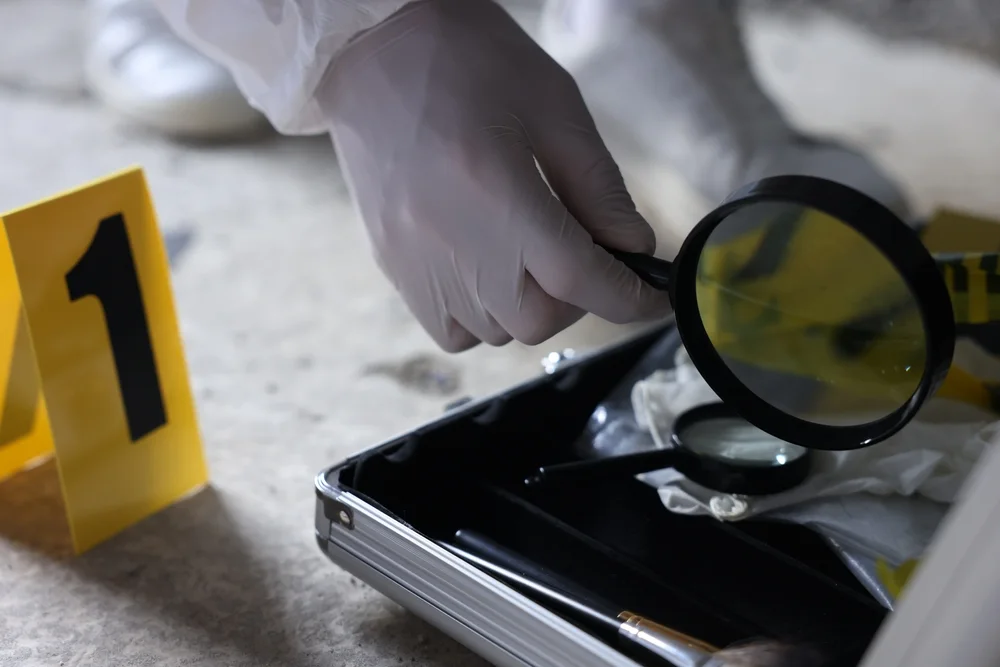
Civilian forensic investigators document scenes and recover evidence in a manner that preserves its value for laboratory examination and court. Their work commonly includes:
- Photographing overall scenes, intermediate views, and individual items
- Creating diagrams, measurements, scans, or other scene records
- Recognizing items with potential evidentiary value
- Collecting and packaging biological, trace, impression, firearm, and other evidence
- Developing and lifting latent fingerprints
- Preserving chain of custody
- Submitting evidence to laboratories
- Writing technical reports
- Comparing or documenting fingerprints, depending on the position
- Preparing courtroom exhibits
- Explaining methods and findings in court
The Bureau of Labor Statistics places related field and laboratory workers within the broader forensic science technician occupation. It describes crime-scene duties such as determining what evidence to collect, photographing and sketching scenes, recording observations, collecting and preserving evidence, and assisting with reconstruction.
California job descriptions add more detail. Riverside County’s 2026 Forensic Technician recruitment included evidence collection, photography, fingerprint work, technical reporting, autopsy-related evidence, and testimony. Santa Barbara County describes its Crime Scene Technician series as non-sworn and assigns duties involving DNA evidence, latent prints, diagrams, reports, and courtroom testimony. Ventura’s Forensic Specialist specification includes crime-scene response, reconstruction, evidence processing, photography, and work around bloodborne pathogens, chemicals, confined spaces, and deceased persons.
Some positions are primarily field based. Others divide time among scenes, an evidence-processing area, fingerprint work, photography, and testimony. Jobs involving advanced latent-print comparison or scene reconstruction usually expect more specialized training and experience than a basic evidence-collection position.
Step 1: Choose the target role before choosing a degree
Education planning is easier once the intended occupation is specific. Compare job announcements for duties and minimum qualifications, not merely for title similarity.
Choose civilian crime-scene work if you want to process physical scenes
This route fits work centered on photography, fingerprints, diagrams, evidence recognition, recovery, packaging, chain of custody, and courtroom presentation. Chemistry and biology remain useful, especially for understanding biological and trace evidence, but many entry-level field positions do not demand the same upper-level science preparation as laboratory criminalist jobs.
Relevant majors can include forensic science, criminal justice, criminology, police science, biology, chemistry, or another closely related subject. The better curriculum is one that combines investigative procedure with practical evidence work rather than relying entirely on broad criminal justice theory.
Choose laboratory criminalistics if you want to analyze evidence scientifically
Criminalists and other crime-laboratory analysts use scientific methods and instrumentation to examine evidence. Depending on the laboratory and assignment, the work may involve forensic biology, DNA, toxicology, controlled substances, trace materials, firearms, or other specialties.
Laboratory applicants need substantially more science than many field CSI applicants. California DOJ’s Criminalist examination bulletin requires a major in a physical or biological science that includes eight semester hours of general chemistry and three semester hours of quantitative analysis. The classification covers laboratory testing and can include assisting with crime-scene examinations and scientific investigations.
A degree called criminal justice, forensic studies, or crime-scene investigation may not contain those courses. Even a degree with “forensic” in its title can be too light in chemistry for this route. Anyone aiming at criminalist work should prioritize a physical or biological science curriculum that includes general chemistry, quantitative or analytical chemistry, biology, statistics, instrumentation, and substantial laboratory work.
Choose a sworn investigator route if you want arrest and case authority
Sworn investigators conduct broader criminal, civil, or administrative investigations. Their duties can include interviewing witnesses and suspects, conducting surveillance, serving warrants, making arrests, planning cases, gathering records, writing reports, and coordinating with prosecutors and other agencies.
The California state Investigator classification, for example, requires either 120 semester units of college or four years of qualifying investigative experience, in addition to applicable peace officer standards. It is not a crime-laboratory classification.
Peace officer candidates face selection requirements involving education, legal work authorization, fingerprinting, background investigation, medical fitness, and psychological fitness. Agencies participating in the California Commission on Peace Officer Standards and Training process also use reading and writing assessment, interviews, and other evaluations. Local employers can add physical testing, drug screening, higher education requirements, polygraph examinations, or other screening.
Many peace officers complete the POST Regular Basic Course, which has a standard-format minimum of 680 hours. Certain designated investigator classifications use the Specialized Investigators’ Basic Course, a minimum 591-hour program covering investigative case management, surveillance, weapons, arrest and control, and practical scenarios. The specialized course applies only to designated positions. It is not a general requirement for civilian crime-scene personnel.
Choose medicolegal death investigation if you want to work in a coroner or medical examiner system
Death investigators examine the circumstances surrounding deaths that fall within a coroner’s or medical examiner’s jurisdiction. Their work can include visiting death scenes, examining and identifying decedents, interviewing witnesses, preserving evidence and property, reviewing medical information, notifying next of kin, assisting with postmortem processes, and testifying in court.
A death investigator is not a forensic pathologist. A forensic pathologist is a physician who performs medical examinations and determines cause and manner of death. An investigator gathers scene, medical, identity, and circumstantial information for the medicolegal investigation.
California employers use varied entry routes. Los Angeles County’s Medical Examiner Investigator Trainee classification accepts several combinations of education and experience. These include relevant investigative experience, a relevant bachelor’s degree, an associate degree plus investigative experience, and specified paramedic, registered nurse, or physician assistant backgrounds with related experience.
Shasta County’s Deputy Coroner Investigator I specification permits a bachelor’s degree in fields such as criminal justice, forensic science, forensic investigation, forensic anthropology, or mortuary science. It also permits two years of relevant experience in areas such as medical care, nursing, coroner work, mortuary work, law enforcement, or investigation.
Some coroner investigators occupy a position between the usual civilian and sworn categories. Shasta County’s classification carries limited peace officer status and requires PC 832 Arrest and Firearms training plus the 80-hour POST Death Investigations Course within one year of appointment. Those requirements are specific to the classification and are not universal across every California coroner or medical examiner office.
Step 2: Earn education that matches the intended work
There is no single statewide minimum degree for all California jobs informally grouped under “forensic investigator.” Current and recent employer requirements range from high school completion with technical preparation to bachelor’s-level education.
The BLS reports a bachelor’s degree as the typical entry-level education for the broad forensic science technician occupation. California’s Employment Development Department says employers within that broad occupational category are usually looking for an associate degree. Local government recruitments explain why the two summaries differ: California agencies hire field technicians, fingerprint specialists, laboratory personnel, and experienced investigators under varied standards.
Examples from 2026 recruitments and current specifications include:
- Riverside County Forensic Technician I: Twenty semester or 30 quarter units in criminology, criminal justice, police science, or a related field. Qualifying evidence experience could substitute.
- Kern County Crime Scene Technician I: Sixty semester or 90 quarter units, including coursework in criminal justice, computer technology, photography, or related sciences, or an equivalent education and experience combination.
- Irvine Forensic Specialist I: An associate degree in a related field combined with three years of paid law enforcement experience and specialized CSI training, or an equivalent combination.
- Redlands Forensic Specialist: High school completion, related training, and at least one year of forensic specialist or technician experience. An associate degree was highly desirable rather than mandatory.
- Ventura Forensic Specialist I: High school completion plus two years of relevant experience or technical preparation in fingerprint classification, crime-scene photography, and identification work.
- Fontana Forensic Investigator: High school completion supplemented by college coursework in criminology, biology, chemistry, or a related field, plus two years of relevant technical experience.
These are examples of employer variation, not statewide rules. They also show that “entry level” can have different meanings. Riverside and Kern offered routes based substantially on coursework, while Irvine’s first level expected several years of paid law enforcement experience and specialized training.
Associate degree route
An associate degree can support entry into crime-scene technician, evidence technician, identification, or property and evidence work. It is most useful when the curriculum includes practical coursework in:
- Crime-scene processing
- Digital and low-light photography
- Latent fingerprints
- Evidence collection and packaging
- Criminal investigation
- Biological evidence and safety
- Technical report writing
- Courtroom testimony
- Introductory chemistry and biology
- Statistics or quantitative reasoning
The limitation is career range. An associate degree may satisfy the educational component of some field jobs, but it will not satisfy bachelor’s-level laboratory positions. Some agencies also pair an associate degree with experience requirements, as Irvine did in its 2026 recruitment.
An associate program can still be an efficient starting point when it has a clear transfer pathway. Completing transferable chemistry, biology, mathematics, writing, and criminal justice courses preserves the option to finish a bachelor’s degree later.
Bachelor’s degree route
A bachelor’s degree generally provides broader access to forensic science technician positions and advanced career development. The major should reflect the intended specialization.
For field investigation, a useful bachelor’s curriculum combines science with applied scene work. Courses in chemistry, biology, statistics, photography, fingerprints, evidence documentation, criminal procedure, technical writing, and courtroom presentation create a stronger mix than a curriculum dominated by general criminal justice surveys.
For crime-laboratory work, select chemistry, biochemistry, molecular biology, forensic chemistry, or another physical or biological science with the necessary laboratory sequence. General chemistry alone may not be enough. California DOJ specifically requires quantitative analysis in addition to eight semester hours of general chemistry.
For death investigation, relevant degrees may include forensic science, criminal justice, forensic anthropology, mortuary science, nursing, or another health science. Employer examples show that medical and emergency-response experience can carry substantial value because the work involves medical terminology, decedent examination, records, injuries, postmortem procedures, and communication with healthcare personnel.
Certificates and short-term CSI training
A certificate can develop practical skills or supplement a degree. It is less reliable as a standalone credential because employer requirements vary and many positions demand either college units or prior experience.
A useful certificate should provide meaningful instruction in photography, fingerprints, evidence handling, biological hazards, scene documentation, and report writing. Programs consisting mainly of introductory theory offer less preparation for technical hiring examinations or practical interviews.
Certificates also serve employed personnel seeking a new assignment or expanded duties. They do not replace a science bachelor’s degree for laboratory criminalistics or a POST academy for a position with full peace officer authority.
Step 3: Build the technical skills California employers use
Crime-scene work is procedural and documentation intensive. A candidate needs more than familiarity with forensic terminology.
Crime-scene photography
Investigators must produce photographs that accurately document the scene, spatial relationships, and individual evidence. Useful preparation includes exposure control, depth of field, scale use, close-up photography, low-light methods, flash techniques, image management, and maintenance of an accurate photo log.
Digital photography experience appeared explicitly in Redlands’ requirements. Fontana’s forensic investigator duties included photography and digital scanning. Because photographs can become courtroom exhibits, investigators must be able to explain how and when they created an image and how the file was preserved.
Evidence recognition and recovery
Coursework and supervised training should cover common evidence categories, contamination control, collection methods, packaging, labeling, sealing, storage, and laboratory submission. Biological evidence requires particular attention to personal protective equipment, drying and packaging practices, and cross-contamination prevention.
Chain of custody is not a clerical afterthought. Every transfer and handling step must be documented so the agency can account for the evidence from collection through analysis and court presentation.
Latent-print work
California forensic specialist and technician positions commonly include fingerprint development or comparison. Entry preparation can include powder processing, chemical methods, lifting, photography, classification, and the foundations of comparison.
Advanced latent-print examination is a specialty. Irvine’s higher-level Forensic Specialist requirement included either latent-print certification or completed comparison training. Entry-level scene processing and expert comparison should not be treated as identical skill levels.
Diagrams, measurement, and reconstruction
Investigators create sketches or digital diagrams and record measurements that allow others to understand the scene after it has been released. Advanced positions can involve trajectory documentation, bloodstain interpretation, or scene reconstruction. Fontana’s exact-title position included trajectory work and digital scanning, while Ventura’s classification included reconstruction duties.
Technical writing and testimony
Reports must describe observations, methods, evidence, and actions precisely. Vague writing creates problems during review, prosecution, and testimony. College composition, technical writing, criminal procedure, and public speaking all support this part of the job.
Courtroom work requires explaining procedures under direct and cross-examination. The investigator may need to defend collection methods, chain of custody, photographs, diagrams, or fingerprint work without overstating what the evidence establishes.
Step 4: Gain relevant experience
Some California positions allow education to substitute for experience, but many recruitments prefer or require practical exposure. Relevant experience can come from several settings:
- Property and evidence units
- Evidence-room or law enforcement internships
- Community service officer positions
- Police or sheriff volunteer programs with approved duties
- Laboratory assistant work
- Medical examiner or coroner internships
- Photography work
- Fingerprint or identification assignments
- Mortuary, emergency medical, nursing, or other healthcare work for death-investigation careers
- Military or public-sector investigative assignments
- Sworn patrol experience for detective routes
Evidence and property work can be especially useful for understanding chain of custody, secure storage, evidence-management systems, legal disposition, and laboratory submission. It does not provide the entire crime-scene skill set, but it creates directly related experience.
Internships vary by agency and can require fingerprinting, background review, confidentiality agreements, or minimum enrollment status. Their value comes from supervised exposure to real procedures rather than the internship title alone.
Keep copies of transcripts, course descriptions, training certificates, internship evaluations, and records of technical instruction. Public employers may require applicants to document exact college units, chemistry courses, photography preparation, fingerprint training, or the number of instructional hours completed.
Step 5: Prepare for government hiring and background screening
A qualifying degree is only one part of the selection process. Public safety agencies can use written examinations, structured interviews, practical exercises, background investigations, medical examinations, psychological screening, drug testing, fingerprint checks, and driving-record review.
Current and recent California examples illustrate the range:
- Fontana’s forensic investigator recruitment included drug screening, fingerprint screening, a physical examination, and a background investigation.
- Irvine required a public-safety background process that included psychological examination.
- Kern County indicated that a background check and post-offer medical or drug screening could be required.
- Redlands required a background check and a post-offer medical examination, potentially including drug or alcohol screening.
- Riverside, Kern, and Ventura required or addressed possession of a California driver’s license.
Background investigations can examine employment history, education, driving, finances, criminal history, drug use, references, and truthfulness during the process. Standards differ among employers, but complete and consistent disclosure is central to public-safety hiring.
Applicants for sworn positions face the additional California POST selection framework. Academy completion by itself does not guarantee employment because each agency controls its hiring process and can apply standards beyond the statewide minimum.
Professional certification usually comes after entry
The International Association for Identification offers crime-scene certifications, but its entry-level crime-scene credential is designed for people already performing the work.
The IAI Certified Crime Scene Investigator credential requires:
- Full-time employment involving significant crime-scene duties
- At least one year of crime-scene-related experience
- At least 48 hours of approved instruction completed within the preceding five years
- A written examination score of at least 75 percent
Higher certification levels require more training and experience. Certified Crime Scene Analyst requires three years of experience, while Certified Senior Crime Scene Analyst requires six years.
This sequence makes certification more useful as documentation of developed competence than as the first step into the occupation. Some advanced employers require or prefer certification. Ventura listed IAI crime-scene or latent-print certification as desired rather than mandatory, while Fontana described crime-scene and forensic-photography certifications as desirable.
POST credentials belong to a different system. They apply to qualifying peace officers and have employment, training, and service prerequisites. A basic academy completion certificate is also different from a POST Basic Certificate. Neither should be generalized to non-sworn forensic technicians.
Experienced detectives and investigators can pursue additional POST professional development through the Robert Presley Institute of Criminal Investigation. Its Certificate of Achievement requires the ICI Core Course, a foundation specialty course, and at least 72 hours of qualifying investigative electives, totaling about 200 hours. This is advanced training for working investigators, not a replacement for initial peace officer selection or basic training.
Working conditions and physical demands
Forensic investigation is not confined to a clean laboratory or office. Field personnel respond wherever evidence is located, including homes, businesses, roadways, hospitals, outdoor terrain, vehicles, detention facilities, and autopsy settings.
Schedules can include nights, weekends, holidays, overtime, rotating shifts, and on-call response. Irvine’s forensic unit operates throughout the year and requires rotating schedules and on-call availability. Kern County required availability for any shift in a 24-hour period. Oceanside’s forensic specialist responds to after-hours, weekend, and holiday callouts. Santa Barbara County technicians can be called back after hours.
The environment can involve:
- Decomposed or severely injured bodies
- Blood and other biological material
- Autopsies
- Hazardous chemicals
- Needles and sharp objects
- Smoke, dust, or strong odors
- Bad weather and uneven ground
- Confined spaces
- Traffic hazards
- Emotionally distressed witnesses or family members
- Repeated exposure to violent imagery
- Adversarial courtroom questioning
Death investigation can be particularly physical. Los Angeles County designates its Medical Examiner Investigator Trainee classification as physically arduous. Shasta County’s specification includes moving bodies weighing more than 100 pounds and working in hazardous or adverse environments.
The job rewards careful, methodical work under difficult conditions. Scene personnel must maintain documentation standards even during overnight callouts, bad weather, emotionally disturbing cases, and time-sensitive investigations.
Salary for forensic investigators in California
Salary data require careful interpretation because “forensic investigator” is not a single statistical occupation. The BLS and California EDD report figures for forensic science technicians, a broad category that includes both field and laboratory personnel. Those figures do not isolate civilian municipal forensic investigators, sworn detectives, latent-print examiners, or medicolegal death investigators.
The California Employment Development Department occupation profile reported the following statewide wages for forensic science technicians in the first quarter of 2026:
- Mean hourly wage: $51.87
- Median hourly wage: $50.46
- 25th-percentile hourly wage: $39.94
- 75th-percentile hourly wage: $65.64
Annualizing the $50.46 median at 2,080 paid hours produces approximately $104,957. That is a mathematical conversion, not a separately published EDD annual salary. Actual annual earnings depend on the employer, classification, work schedule, overtime, step placement, and benefits.
Recent local recruitments show substantial variation:
- Riverside County posted annual ranges of $64,311.76 to $95,813.52 for Forensic Technician I and $72,663.61 to $108,236.81 for level II in 2026.
- Irvine posted $32.89 to $51.69 per hour for Forensic Specialist I and $37.57 to $59.04 per hour for level II.
- Redlands posted an annual range of $76,979 to $95,964 for a forensic specialist.
- Oceanside posted $67,164 to $90,000 annually for a forensic specialist.
These are agency-specific ranges, and their upper ends can represent experienced employees at advanced salary steps. They are not universal starting salaries.
Nationally, BLS reported a median annual wage of $72,060 in May 2025 for forensic science technicians. California’s higher occupational wage figures reflect the state market, but a new technician should not interpret the statewide median as guaranteed entry pay.
Employment outlook
California EDD projects forensic science technician employment to increase from 2,200 jobs in 2022 to 2,600 in 2032. That is an increase of 400 jobs, or 18.2 percent.
BLS projects 13 percent national growth from 2025 to 2035, with about 2,800 openings per year nationally. These projections cover the broader forensic science technician occupation rather than every position carrying an investigator title.
The field remains relatively small despite its projected growth. Hiring can be competitive because a single agency may employ only a limited forensic unit. Geographic flexibility and preparation for multiple related classifications can improve the number of viable applications.
How to search for California jobs effectively
Searching only for “forensic investigator” misses many relevant vacancies. Use multiple titles and read each duty statement carefully.
Useful search terms include:
- Crime scene technician
- Crime scene investigator
- Forensic technician
- Forensic specialist
- Identification technician
- Latent print examiner
- Evidence technician
- Property and evidence technician
- Criminalist
- Laboratory analyst
- Medical examiner investigator
- Coroner investigator
- Deputy coroner investigator
- Investigator trainee
Government job portals, city and county career pages, CalCareers, district attorney offices, sheriff-coroner agencies, police departments, and medical examiner offices all use different naming conventions.
Separate the results into job families. A criminalist vacancy should be evaluated by science-course requirements. A civilian forensic specialist posting should be evaluated by evidence, photography, fingerprint, and experience requirements. A state investigator announcement requires attention to peace officer standards. A medical examiner investigator classification may value medical, mortuary, emergency-response, or death-investigation experience.
Our broader guide to forensic and investigative careers in California can help place these titles within related career paths.
A practical education plan for maximum flexibility
Someone who has not yet selected between field CSI and laboratory criminalistics can preserve both routes with a science-centered bachelor’s degree plus applied forensic coursework.
A flexible course plan would include:
- A physical or biological science major
- At least eight semester hours of general chemistry
- Quantitative or analytical chemistry
- Biology and, where available, molecular biology
- Statistics
- Laboratory methods and instrumentation
- Crime-scene photography
- Evidence recognition, collection, and packaging
- Latent-print processing
- Technical and scientific writing
- Criminal procedure and courtroom testimony
- An internship, laboratory placement, or supervised practical experience
This plan is more demanding than the minimum for some civilian technician jobs. Its advantage is that it preserves eligibility for science-based positions while still developing field investigation skills.
A criminal justice major can be appropriate for crime-scene or sworn-investigator goals, especially when paired with photography, fingerprints, evidence handling, science, and technical writing. It is a narrower choice for laboratory criminalistics unless the student adds enough chemistry and biological science to meet the employer’s exact requirements.
Someone certain about medicolegal death investigation can choose among several relevant foundations. Forensic science, forensic anthropology, criminal justice, nursing, emergency medical services, mortuary science, and other health sciences can all align with particular employer pathways. Practical exposure to medical terminology, human anatomy, death scenes, records, evidence, and difficult family communication is especially useful.
A realistic route into civilian crime-scene investigation
A direct civilian plan can look like this:
- Complete relevant college coursework or a degree. Build preparation in crime-scene methods, photography, fingerprints, biology, chemistry, report writing, and criminal procedure.
- Develop demonstrable technical skills. Practical exercises should include photo logs, scene diagrams, evidence packaging, contamination control, fingerprint processing, and formal reports.
- Gain related experience. Evidence units, internships, laboratory support, photography, community service officer work, and identification assignments can all contribute.
- Search under several job titles. California employers do not use a consistent statewide title.
- Apply at the level matching your record. Some first-level positions accept coursework, while others expect years of experience.
- Prepare for public-safety screening. Maintain accurate education and employment records and expect a detailed background process.
- Complete agency training after appointment. BLS identifies competency-based on-the-job training as a normal part of entry into the broader occupation.
- Pursue certification after gaining qualifying experience. IAI certification can document professional development once the employment and training prerequisites are met.
Candidates who repeatedly encounter experience barriers can broaden the first job search to property and evidence, laboratory support, fingerprint technician, community service officer, records, or other technical public-safety roles. The goal is to gain directly transferable experience without mistaking an adjacent role for full crime-scene preparation.
Choosing the right route
Use the daily work to guide the decision.
Choose civilian crime-scene investigation for evidence photography, fingerprints, documentation, collection, packaging, and scene response. An associate or bachelor’s degree with practical CSI preparation can work, although California employers vary widely in how they combine education and experience.
Choose laboratory criminalistics for scientific testing and instrumentation. Prioritize a physical or biological science degree, general chemistry, quantitative analysis, statistics, and extensive laboratory work. General criminal justice training is not enough for the California DOJ Criminalist route.
Choose sworn investigation for interviews, surveillance, warrants, arrests, and full case responsibility. Plan for peace officer selection, background screening, medical and psychological evaluation, and the academy or specialized basic training applicable to the classification.
Choose medicolegal death investigation for work centered on deaths, decedents, medical information, family notification, evidence preservation, and postmortem coordination. Relevant routes can begin in forensic science, criminal justice, mortuary work, emergency medicine, nursing, or investigation, depending on the county classification.
The most efficient path is not the degree with the broadest forensic label. It is the education that contains the courses, practical training, and experience required for the specific California classification you intend to pursue.