
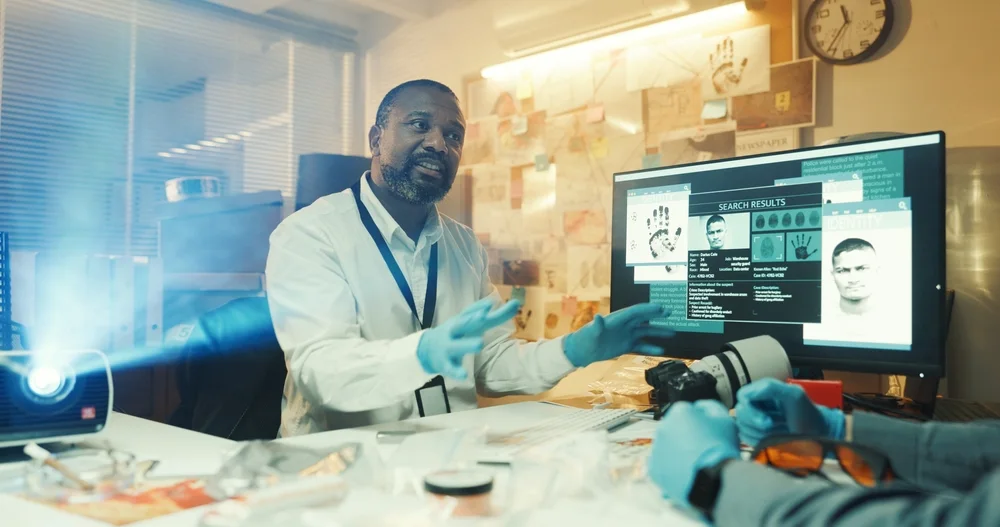
Crime analysts turn law-enforcement records and public-safety data into maps, reports, forecasts, bulletins, and investigative leads. Their work may reveal where burglaries are clustering, how an offender’s activity connects across jurisdictions, which hours produce the most calls for service, or where patrol resources could be deployed more effectively.
The occupation is separate from crime-scene investigation and forensic laboratory science. Crime analysts generally work with databases, police reports, geographic information systems, statistics, and intelligence records. They do not ordinarily collect fingerprints at crime scenes, process DNA, or perform chemical examinations of evidence.
California has no single statewide education requirement or occupational license for civilian crime analysts. The California Department of Justice accepts several entry routes for its Crime Analyst I classification, while many cities and counties prefer or require a bachelor’s degree, specialized analytical training, and relevant experience. A crime and intelligence analysis certificate can satisfy part of an employer’s requirements, substitute for some education or experience, or simply strengthen an application.
The most portable preparation is a bachelor’s degree supported by coursework in statistics, research methods, GIS, databases, criminal justice, and professional writing. Specialized certificates and associate pathways can also lead to entry-level work, especially when they include practical analysis, software training, or supervised experience.
What crime analysts actually do
Crime analysis covers several related functions. Job titles include crime analyst, crime and intelligence analyst, criminal intelligence analyst, investigative analyst, public-safety analyst, and intelligence analyst. Agencies do not use these titles consistently, so duties matter more than the title alone.
Common assignments include:
- Reviewing calls for service, incident reports, arrest records, field interview records, and other law-enforcement data
- Identifying geographic, temporal, and behavioral crime patterns
- Producing maps with GIS software
- Preparing tactical bulletins for patrol officers and investigators
- Conducting link analysis among people, addresses, vehicles, organizations, and events
- Supporting investigations with timelines, charts, database searches, and open-source research
- Preparing strategic studies of long-term crime trends
- Evaluating enforcement initiatives or crime-prevention programs
- Maintaining intelligence databases and checking data quality
- Briefing police managers, patrol personnel, detectives, prosecutors, or partner agencies
- Writing reports and presenting analytical conclusions
- Providing testimony about analytical methods or findings when required
The occupation usually combines technical analysis with frequent communication. An analyst may spend much of the day working in spreadsheets, databases, mapping programs, and records systems, then present findings to people who need a concise operational conclusion rather than a statistical lecture.
Tactical crime analysis
Tactical analysis concentrates on immediate or short-term patterns. An analyst might connect several robberies based on location, time, suspect description, and method of operation. The resulting bulletin could help patrol officers identify likely locations, times, or associated vehicles.
This work requires careful review of incident-level information, fast report production, mapping, and an understanding of police operations. Analysts must distinguish a meaningful pattern from an apparent cluster created by incomplete or inconsistent data.
Strategic and administrative analysis
Strategic analysis examines longer periods and broader questions. Examples include evaluating changes in vehicle theft over several years, identifying persistent hot spots, studying relationships between calls for service and staffing, or assessing whether a public-safety initiative affected reported crime.
Administrative analysis supports management decisions, grant applications, public reports, presentations, and resource planning. Statistics, data visualization, forecasting, and clear explanation are especially relevant.
Criminal-intelligence and investigative analysis
Criminal-intelligence analysts examine associations, organizations, communications, financial activity, online information, and other records related to criminal activity. Investigative support can include link charts, timelines, background research, telephone-record analysis, and database queries.
These assignments may involve sensitive information and restricted systems. Background investigations, fingerprinting, confidentiality requirements, and security clearances are common in positions with access to criminal-justice intelligence.
Database and records analysis
Not every position is centered on crime-pattern mapping. A 2026 California Department of Justice Crime Analyst I recruitment focused on criminal-justice databases, data quality, technical documentation, special searches, testing, and assistance to law-enforcement stakeholders. The associated duty statement covered systems involving wanted persons, stolen vehicles, restraining orders, supervised release, and property records.
That state role differs from a municipal analyst who spends more time identifying robbery patterns or preparing patrol bulletins. Both use analysis, but the operational setting and technical responsibilities are different.
Crime analyst versus CSI, forensic scientist, and detective
Crime analysis is sometimes grouped with forensic careers because it supports investigations. The educational preparation is different.
A crime scene investigator documents scenes and recognizes, collects, preserves, and packages physical evidence. A forensic scientist or criminalist examines evidence in a laboratory, often using chemistry, biology, microscopy, molecular methods, or analytical instrumentation. A crime analyst works primarily with information and data.
Students targeting crime analysis should prioritize:
- Statistics and quantitative reasoning
- Research methods
- Geographic information systems
- Database concepts and queries
- Excel and data visualization
- Crime mapping
- Criminology and criminal-justice systems
- Intelligence analysis
- Report writing and presentations
Laboratory chemistry and biology are central to criminalistics but are generally not the foundation of crime-analysis preparation.
Crime analysts also are not interchangeable with detectives. Many California crime-analysis jobs are non-sworn civilian positions. Sacramento County describes its classification as non-sworn, and Stockton identifies its crime analyst classification as civilian. Civilian analysts typically do not have peace-officer authority.
Some agencies may assign sworn personnel to analytical work, however, and agency practices vary. Police-academy training is not a general statewide requirement for civilian crime analysts.
Readers comparing this occupation with related options can review the broader collection of California forensic and public-safety careers.
California crime analyst education requirements
California employers use materially different qualification structures. The state Department of Justice offers an entry route based on college credit, experience, or specialized certification. Several local agencies use a bachelor’s degree plus professional experience as their normal benchmark.
The following examples illustrate the variation. Online class specifications may remain available when an agency is not actively hiring, so they show qualification standards rather than current vacancies.
| Employer and classification | Education and training example | Experience example |
|---|---|---|
| California DOJ, Crime Analyst I | 60 semester units or a Crime and Intelligence Analysis certificate or comparable program can provide a qualifying route | One year obtaining, analyzing, or disseminating criminal-justice information is another route |
| City of Los Angeles, Crime and Intelligence Analyst | A bachelor’s degree plus a recognized Crime and Intelligence Analysis certificate provides one route | A separate route uses two years of specified professional experience |
| City of Oakland, Crime Analyst | Bachelor’s degree in an identified related field; Sacramento State and Cal State Fullerton certificates are listed as highly desirable | Two years of crime-analysis or related experience is the normal benchmark |
| Sacramento County, Crime and Intelligence Analyst | Bachelor’s degree in an analytical or justice-related field | Two years of qualifying experience; a California DOJ Crime and Intelligence Analysis certificate can substitute for one year |
| City of Riverside, Crime Analyst | Bachelor’s degree in criminal justice, information management, statistical analysis, GIS, or a closely related field; a specialized certificate is highly desirable | Two years of analytical experience, preferably in law enforcement |
| Riverside County, Crime and Intelligence Analyst II | Associate degree in a related field; bachelor’s degree and an accredited-college analyst certificate are highly desired | One year of qualifying county-level experience |
| San Diego County, Crime and Intelligence Analyst | Bachelor’s degree provides one route; an associate degree plus a crime or intelligence analysis certificate provides another | Two years of relevant unit experience with a bachelor’s, or three years with the associate-plus-certificate route |
| City of Stockton, Crime Analyst | Bachelor’s degree with relevant coursework is the standard education route; a valid analyst certificate can replace up to two years of college | Two years of analytical or operational criminal-justice experience; additional experience can replace some college |
A bachelor’s degree appears across more of these local qualification structures than any other single credential. It is therefore the safest educational foundation for applicants who want access to a broad range of city, county, and state opportunities.
It is not universally mandatory. The California DOJ Crime Analyst I examination allows alternative routes, and some local classifications permit combinations of an associate degree, certificate, and experience. Those alternatives can work well when they match a specific employer’s formula.
Suitable bachelor’s degree fields
California class specifications identify a wide range of acceptable or relevant disciplines, including:
- Intelligence and crime analysis
- Criminal justice or criminology
- Statistics
- Geographic information systems
- Geography
- Information management
- Computer science
- Applied mathematics
- Data mining or data analytics
- Public administration
- Business administration
- Social science fields with strong research preparation
The name of the major is only part of the evaluation. A generic criminal justice program can explain courts, policing, corrections, and criminological theory while providing little training in statistics, GIS, data management, or analytical software. That curriculum is less direct preparation for crime analysis unless the student adds quantitative and technical courses.
Conversely, a statistics, geography, information systems, or data-analytics major can provide excellent technical preparation but leave gaps in criminal-justice terminology and agency operations. Criminal justice, criminology, intelligence, and law-enforcement research courses can fill that gap.
Certificates and associate degrees
Specialized Crime and Intelligence Analysis certificates occupy different roles across California hiring systems. Los Angeles includes a recognized certificate in one bachelor’s-based route. Oakland calls certificates from Sacramento State and Cal State Fullerton highly desirable. Sacramento County permits a qualifying certificate to substitute for one year of experience, while Stockton allows a valid certificate to replace up to two years of college.
A certificate is therefore more than an informal résumé addition in some classifications. It can have direct value under a stated substitution formula. It does not create a statewide license, and it is not accepted under one uniform rule by every California agency.
An associate degree paired with specialized training and work experience can also lead to employment. San Diego County provides an associate-plus-certificate route, and Riverside County’s journey-level specification identifies an associate degree as part of one benchmark. The tradeoff is that some other agencies use a bachelor’s degree as their normal minimum, so advancement or movement between jurisdictions can be more limited without one.
A practical route into the occupation
1. Compare target employers before choosing a credential
Begin with several agencies rather than one job title. Review city police departments, county sheriff’s departments, district attorney offices, state agencies, regional intelligence centers, and other public-safety organizations.
Create a simple requirements chart covering:
- Minimum degree or college units
- Accepted majors
- Specialized certificate language
- Required years and types of experience
- GIS, statistics, or database expectations
- Driver’s-license requirements
- Security-clearance language
- Examination and civil-service procedures
This prevents a common planning error: completing a narrowly focused certificate and later discovering that the desired agencies use a bachelor’s degree as their normal entry benchmark.
2. Build quantitative and technical preparation
The O*NET Intelligence Analysts profile lists crime analyst and crime and intelligence analyst among reported job titles. Associated tools include GIS and Esri ArcGIS, spreadsheets, Access, SQL, database systems, link and timeline tools, and visualization software.
A useful academic plan includes:
- Introductory and applied statistics
- Research design and methodology
- GIS and spatial analysis
- Spreadsheet analysis
- Relational database concepts
- SQL or database-query fundamentals
- Data cleaning and quality control
- Data visualization
- Criminal-justice information systems
- Crime mapping
- Intelligence analysis
- Technical and professional writing
Excel remains relevant even in agencies with specialized systems. Analysts routinely need to organize, clean, filter, compare, and summarize data. GIS training adds the ability to evaluate spatial concentrations and create operational maps. Database and query skills help analysts retrieve records without relying entirely on prebuilt reports.
3. Learn law-enforcement operations and legal constraints
Technical skill is not enough by itself. Analysts need to understand how incidents are reported, how offenses are classified, how investigative information differs from public data, and why intelligence records require careful handling.
Useful subjects include:
- Structure of the criminal-justice system
- Police operations
- Criminal law
- Criminal investigation
- Criminology
- Crime prevention
- Ethics and confidentiality
- Intelligence processes
- Public-records and information-security principles
The goal is not to become a sworn officer. It is to understand what the data represent, where they came from, how operational personnel use an analytical product, and what information can be disseminated.
4. Complete applied work
Programs with practicums, internships, simulations, laboratories, or work experience provide evidence that an applicant can convert coursework into a usable product. Practical assignments might include hot-spot maps, pattern bulletins, link charts, trend reports, timelines, statistical summaries, or presentations.
A portfolio can also demonstrate ability when it uses public or synthetic data. Appropriate examples include:
- A GIS map and written interpretation based on public crime data
- A monthly trend report with charts and a concise executive summary
- A synthetic link-analysis chart
- A calls-for-service dashboard built from open data
- A short research report explaining methods, limitations, and operational implications
Confidential agency records, restricted criminal-history information, and personally identifying investigative data do not belong in a personal portfolio.
5. Gain related analytical experience
Employers often seek experience even when a candidate has relevant education. Entry routes can include police records, dispatch-data support, public-safety research, GIS, crime-analysis internships, military intelligence, fraud analysis, regulatory investigations, governmental research, and database-quality work.
The strongest related experience contains an analytical component. Data entry alone is less persuasive than work involving queries, quality control, recurring reports, trend identification, mapping, or briefings.
California DOJ’s entry classification offers another model. One qualifying route uses a year of experience obtaining, analyzing, or disseminating criminal-justice information. That language can encompass work different from municipal tactical analysis, provided the actual duties satisfy the examination standard.
6. Apply through civil-service systems
Public agencies commonly use structured hiring procedures. The state Crime Analyst I examination is an open, continuous departmental examination based on training and experience. Candidates need a score of at least 70 percent for placement on the eligible list, but list eligibility is not the same as a job offer.
A typical public-sector process can include:
- An examination, questionnaire, or rating of training and experience
- Placement on an eligible list
- Application to a specific vacancy
- Departmental interviews or analytical exercises
- Reference and employment checks
- Fingerprinting and a background investigation
- Medical, drug, or security screening when required
Application materials should describe analytical tasks precisely. Instead of writing “worked with crime data,” identify the systems, volume, methods, products, and audience. A stronger description might state that the applicant cleaned incident data in Excel, produced weekly ArcGIS maps, analyzed changes by location and time, and briefed a patrol supervisor.
California education and training options
The following are verified examples of direct California pathways. They range from a 120-unit bachelor’s degree to noncredit and continuing-education certificates. The list is useful for comparing structures but is not a claim that every crime-analysis course or employer-restricted training program in California is included.
California State University, San Bernardino: B.S. in Intelligence and Crime Analysis
CSUSB offers a 120-unit Bachelor of Science specifically focused on intelligence and crime analysis. The 2026-27 catalog assigns 55 units to degree requirements and combines criminal justice with geography, environmental studies, and information and decision sciences.
Required subjects include research methods, criminal-justice statistics, two levels of intelligence and crime analysis, crime prevention, and crime in public spaces. Students also study either crime-pattern detection or social-network analysis. Concentration options are Geographic Information Systems, Cyber Security, and Homeland Security.
An internship or independent study is required, and the school describes laboratory and applied project work. The GIS concentration is directly relevant to agencies that expect crime mapping and spatial analysis. Cyber Security can support intelligence or digital-information assignments, while Homeland Security provides a broader public-safety and intelligence context.
This degree has the broadest academic scope among the pathways profiled here. It addresses the bachelor’s-degree benchmark used by many California employers while retaining a direct occupational focus. It requires a substantially larger time commitment than a certificate, but it is better aligned with agencies that want both a four-year degree and specialized analytical preparation.
Moreno Valley College: Crime and Intelligence Analysis
Moreno Valley College offers an Associate of Science and a Certificate of Achievement pathway in Crime and Intelligence Analysis. The program page lists a range of 28.5 to 32 units, although it does not clearly assign that range between the two awards.
Coursework covers law-enforcement crime analysis, investigative technology, criminal-behavior analysis, intelligence analysis, crime mapping, data mining, and simulated analyst work. The program identifies ESRI ArcGIS Pro and IBM Analyst’s Notebook among the technologies used.
Several courses include laboratory work. A Crime and Intelligence Analysis Work Experience course coordinates paid or volunteer professional training, providing a route to the experience that appears repeatedly in California job specifications. Fall 2026 scheduling included online and hybrid classes, and one analysis course had an online laboratory. The complete pathway is not documented as fully online.
Moreno Valley’s combination of a college credential, software exposure, laboratories, and work experience is especially relevant to applicants pursuing an associate-based route. Someone targeting San Diego County’s associate-plus-certificate pathway or related entry classifications could use this type of program as a foundation, then build the required professional experience.
California State University, Sacramento: Crime and Intelligence Analysis Certificate
Sacramento State’s continuing-education certificate is online and asynchronous, with a listed duration of nine months. Its eight course components cover crime-data analysis, law-enforcement research and statistics, criminal intelligence, investigative analysis, pattern identification, and forecasting.
The program includes a supervised practicum. The current program materials do not provide enough detail to establish its hours or placement structure. Students are expected to enter with basic knowledge of the criminal-justice system and proficiency in Excel, Word, and PowerPoint.
As of September 25, 2026, the university listed an estimated total cost of $3,692 and stated that fees were under review for Fall 2026. A 2026-27 cohort schedule was published.
This certificate directly addresses the statistical, investigative, and crime-pattern functions found in local job specifications. Oakland’s class specification specifically identifies Sacramento State’s certificate as highly desirable, and Sacramento County permits a qualifying California DOJ Crime and Intelligence Analysis certificate to replace one year of required experience.
The asynchronous format supports employed learners who cannot attend scheduled evening sessions. Its main structural difference from a degree is academic breadth. It delivers concentrated occupational training rather than a general education and bachelor’s-level foundation.
California State University, Fullerton: Crime and Intelligence Analysis Certificate
Cal State Fullerton offers a live virtual continuing-education certificate designed for completion in approximately six to seven months. The curriculum includes criminal intelligence, open-source intelligence, crime-data analysis, applications in crime analysis, law-enforcement research and statistics, and computer applications.
Admission preparation includes introductory criminal justice and criminal law, or documented relevant work knowledge, plus basic computer skills. The program carries 20 continuing-education units. The official page listed a September 2026 start and an approximate program cost of $4,675 as of the research date.
Fullerton’s scheduled virtual meetings create more real-time interaction than Sacramento State’s asynchronous model. That can benefit learners who want instructor-led discussion and a fixed class schedule.
The official program page contains conflicting practicum information. One section mentions 400 hours of practicum or internship training, while the program-details section describes an optional 100-hour practicum. The current published material does not resolve which description governs the listed cohort.
Oakland names the Fullerton certificate as highly desirable. Los Angeles also recognizes a qualifying Crime and Intelligence Analysis certificate as part of one education route, although its class specification does not make every university certificate universally interchangeable.
California State University, Long Beach: Crime and Intelligence Analysis Certificate Program
CSULB’s open-enrollment certificate contains ten modules and 216 hours of scheduled virtual meetings and asynchronous work. High school graduation is the stated education prerequisite, and registration is open to the public.
The curriculum covers tactical and strategic analysis, investigative analysis, statistics, reporting, criminal intelligence, social-media research, crime mapping, spatial analysis, practical analyst work, and career preparation. It includes hands-on exercises, simulated law-enforcement products, software exposure, and a practicum. The university does not promise an internship placement.
The January through May 2027 online section was listed at $4,500 as of September 25, 2026. Optional graduate credit through a separate prior-learning assessment was listed at an additional $990.
CSULB states that the courses meet analyst training standards established by the International Association of Crime Analysts and the International Association of Law Enforcement Intelligence Analysts. That statement concerns curriculum alignment. It is not specialized accreditation, state licensure, or an award of professional certification.
The high-school-level entry requirement gives this program broader access than certificates requiring prior criminal-justice coursework. Applicants without a bachelor’s degree still need to compare the certificate with employer education requirements. Its occupational training can prepare someone for internships and entry-level analytical support, but it does not replace a four-year degree where a posting requires one without an applicable substitution.
College of the Canyons: Crime and Intelligence Analysis Certificate of Completion
College of the Canyons offers a noncredit Certificate of Completion consisting of ten courses and 224 instructional hours. Subjects include crime and intelligence fundamentals, computer applications, financial analysis, online-source research, dark-web and social-media research, GIS, spatial analysis, statistics, criminal behavior, reporting, and presentation.
Two capstone courses culminate in an analytical report and presentation. The curriculum also includes preparation related to the International Association of Crime Analysts Law Enforcement Analysis Foundation examination. Completing the college program is separate from earning an IACA credential.
The noncredit structure provides directly focused instruction without requiring completion of a degree. It can serve as an entry point for career changers or as technical training alongside a degree in criminal justice, geography, statistics, or another field.
The reviewed program page did not clearly state the delivery format or current incidental costs. Because the award is noncredit, its courses also have a different academic function from transferable semester units or a degree. Applicants seeking positions with minimum college-unit requirements need credit-bearing education unless the employer recognizes a certificate through a separate qualification route.
Los Angeles Pierce College: Crime and Intelligence Analysis Certificate of Achievement
Los Angeles Pierce College lists an 18-unit Certificate of Achievement focused on non-sworn crime and intelligence analysis. Required courses cover administration of justice, criminal investigation, offender profiling, criminal intelligence and data analysis, research methods and statistics, and applications in crime analysis.
The applied course gives the curriculum a practical component, but the reviewed certificate requirements do not list an internship. At least one required analysis course was scheduled online in fall 2026. Evidence was not sufficient to classify the entire certificate as online.
This is a shorter credit-bearing route than the Moreno Valley College pathway. It provides documented college coursework in research, statistics, criminal intelligence, and applications, all of which relate directly to analyst duties. Its 18-unit scope is less extensive than an associate or bachelor’s degree, so it aligns best with entry routes that recognize a certificate or with degree holders adding occupational specialization.
The certificate was directly verified in the 2025-26 catalog, and a required course remained active in fall 2026. The college also published a 2026-27 catalog landing page, though the specific certificate entry in that edition was not directly retrieved during the program review.
How to choose among degree and certificate routes
The appropriate route depends on the education already completed and the employers being targeted.
Starting without a college degree
A bachelor’s degree provides the widest access among the reviewed California classifications. CSUSB’s specialized degree combines the credential level many employers request with statistics, GIS or another concentration, analytical courses, and required applied experience.
A community-college pathway can reduce initial cost and create a staged route. Moreno Valley College offers an associate and certificate structure with software and work-experience components. Los Angeles Pierce provides a shorter credit certificate, while College of the Canyons offers noncredit occupational preparation.
Transfer planning deserves attention if the long-term goal is a bachelor’s degree. A career certificate can contain useful courses without fulfilling all lower-division general education or major-preparation requirements for a four-year program.
Already holding a bachelor’s degree
A continuing-education certificate can add the occupational content missing from a broad criminal justice, social science, geography, business, or technical degree. Sacramento State, Fullerton, and Long Beach all provide direct training in crime analysis, but their formats differ:
- Sacramento State is asynchronous and listed at nine months.
- Fullerton uses live virtual instruction over approximately six to seven months.
- Long Beach combines scheduled online meetings with asynchronous work across 216 hours.
Curriculum and applied requirements are more useful comparison points than the certificate title alone. Statistics, GIS, reporting, intelligence methods, software, and a substantive practicum relate directly to hiring expectations.
Already working in law enforcement or public safety
Current agency employees may have access to California POST courses, including the Crime and Intelligence Analysis Core Course, Crime Analysis: Expanded Application, Crime Analysis: Implementation/Evaluation, and Criminal Intelligence Data Analysis. Some POST-related training has agency-employment or departmental-approval restrictions.
POST coursework is specialized professional training, not a universal civilian crime-analyst license. An employee pursuing an internal analytical assignment can combine agency training with existing operational knowledge, while someone seeking mobility across employers may benefit more from a degree or university-issued certificate recognized in public job specifications.
Skills that influence hiring and advancement
GIS and crime mapping
GIS allows analysts to connect incidents with place. Useful abilities include geocoding, layer management, spatial queries, hot-spot visualization, map design, and interpretation of geographic concentrations.
A polished map is not enough. Analysts must explain the underlying data, time period, unit of analysis, and operational meaning. Poor geocoding or inconsistent addresses can create misleading patterns.
Statistics and research methods
Analysts need more than descriptive charts. Research methods help them define a question, select appropriate data, identify bias, explain limitations, and avoid unsupported causal claims.
Valuable topics include:
- Measures of central tendency and variation
- Rates and percentages
- Time-series comparison
- Correlation and regression fundamentals
- Sampling and data quality
- Forecasting concepts
- Program evaluation
- Clear visual presentation of uncertainty
Databases and data quality
Police data can contain duplicate records, inconsistent categories, missing locations, and changes in reporting practice. Analysts who understand relational data, queries, data dictionaries, validation, and documentation are better prepared to produce defensible conclusions.
The California DOJ database-focused role shows that data quality and system support can themselves be central crime-analyst functions.
Writing, briefing, and testimony
A useful analytical product gives its audience a clear conclusion, supporting evidence, and any material limitations. Dense charts without explanation are not enough.
California specifications refer to reports, briefings, presentations, training, and possible court testimony. Analysts need to explain methods to investigators, executives, attorneys, and other audiences with different levels of technical knowledge.
Pay for crime analysts in California
There is no clean Bureau of Labor Statistics or California Employment Development Department wage series limited to civilian crime analysts. The best direct evidence comes from individual agency salary schedules, which differ by location, bargaining agreement, classification, and experience level.
Recent class specifications displayed the following annual ranges:
| Agency | Displayed annual salary |
|---|---|
| City of Stockton | $73,404.56 to $94,240.80 |
| City of Riverside | $74,316 to $104,556 |
| Riverside County, Analyst II | $76,588.66 to $104,902.24 |
| San Diego County | $79,497.60 to $106,329.60 |
| City of Oakland | $91,730.76 to $112,629.84 |
| Sacramento County | $96,904.08 to $117,804.96 |
| City of Los Angeles | $70,574 to $103,188 and $83,165 to $121,542 across displayed ranges |
A 2026 California DOJ Crime Analyst I posting listed $3,984 to $6,236 per month across two ranges. It stated that employees new to California state service generally enter at the minimum of Range A unless alternate-range criteria apply.
These figures are examples, not a statewide average. Published maximums generally represent later salary steps rather than starting pay, and some tables include multiple grades or classifications.
The Bureau of Labor Statistics reported a May 2025 national median of $93,790 for Detectives and Criminal Investigators. California EDD reported first-quarter 2026 mean and median hourly wages of $59.91 and $61.54 for that occupation in California. Both categories are broader than civilian crime analysis and include work that may involve sworn investigative authority, so they are comparison data rather than exact crime-analyst wages.
Operations Research Analysts provide another broad analytical comparison. BLS reported a May 2025 national median of $88,940 and projected 12 percent employment growth from 2025 to 2035. That occupation emphasizes mathematics, databases, forecasting, and problem solving, but it is not a substitute category for law-enforcement crime analysts.
Background screening and working conditions
Crime analysts can access criminal histories, intelligence records, investigative details, and other restricted information. California employers commonly require fingerprinting and background investigations. Some positions may require a federal security clearance.
Disqualifying issues depend on the agency and assignment, but honesty during the background process is central. Employment history, education, criminal records, references, and other information can be examined.
Although the work is primarily computer-based, schedules are not always limited to standard office hours. Sacramento County notes that some assignments can involve nights, weekends, holidays, overtime, secure facilities, or contact with suspects or inmates. Other agencies may require a driver’s license, presentations in operational settings, or court testimony.
Hybrid work exists in some settings. The 2026 California DOJ position was listed as hybrid in Sacramento County, and its duty statement allowed approved remote or office work in California. Access rules, operational needs, and confidential systems can still limit remote work.
Professional certification and advancement
The International Association of Crime Analysts offers the Certified Law Enforcement Analyst credential. CLEA is designed for experienced professionals rather than first-time job seekers.
Applicants need at least three years of full-time analytical experience in law enforcement, intelligence, corrections, or a related field. They must also be current IACA members and meet a combined education and experience point threshold. Relevant coursework can include GIS, statistics, research methods, criminology, criminal justice, and crime analysis. Recertification is generally required every five years.
After gaining experience, analysts can progress into senior analyst, supervisory, intelligence, strategic-analysis, research, GIS, or program-management positions. Advanced responsibility may include reviewing other analysts’ work, setting methodological standards, coordinating regional intelligence, managing databases, training personnel, or leading complex studies.
Graduate education can help with specialized research, data science, public administration, GIS, or management roles, but it is not the normal entry requirement across the classifications reviewed.
A focused California career plan
A strong plan can be organized around four decisions.
First, identify several target employers and document their actual qualification formulas. Applicants interested in broad mobility should prioritize a bachelor’s degree. Those targeting classifications with explicit associate, certificate, or experience alternatives can use a more staged route.
Second, build the technical core. Statistics, research methods, GIS, Excel, databases, visualization, and analytical writing appear repeatedly across occupational and employer evidence. A criminal justice degree without this technical core is less direct preparation than its title may suggest.
Third, produce applied work. An internship, practicum, work-experience course, laboratory project, or public-data portfolio gives employers evidence of analysis rather than a list of completed classes. Reports should be concise, maps should be readable, and methods should be documented.
Fourth, treat the public-sector application as a structured examination process. Qualification questionnaires require detailed evidence. Eligible-list placement, interviews, background screening, and appointment are separate stages.
California offers multiple credible education routes, including a specialized bachelor’s degree, associate and credit-certificate pathways, a noncredit certificate, and university continuing-education programs. Their value depends on how they combine with prior education and experience. The broadest preparation is a bachelor’s degree plus statistics, GIS, databases, and applied analysis. A direct crime-analysis certificate can then add occupational methods or satisfy a specific employer substitution rule. For applicants using an associate or certificate route, practical experience becomes especially significant because many local classifications require both education and prior analytical work.