
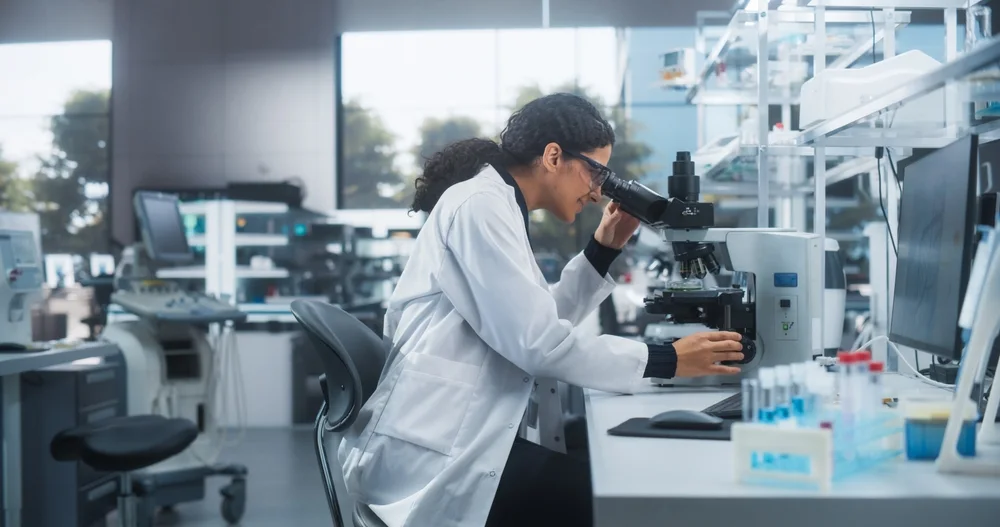
Firearms and toolmark examiners use laboratory methods to examine firearms, ammunition components, and marks created when tools contact other surfaces. California employers frequently place this work within civilian Criminalist or Forensic Scientist classifications rather than hiring under one uniform statewide title. Other titles include Comparative Analysis specialist and Firearms Examiner.
The professional discipline is usually called firearm and toolmark examination. “Ballistics examiner” is a common informal term, but it can be imprecise because ballistics also covers subjects such as projectile flight and wound effects. Job seekers will find more relevant openings by searching for terms such as criminalist, forensic scientist, comparative evidence, firearms examiner, firearm and toolmark examiner, and toolmark examiner.
The usual route into this career is:
- Earn a science-focused bachelor’s degree.
- Complete laboratory chemistry, laboratory physics, and statistics coursework.
- Meet the science-unit requirements in specific California job classifications.
- Apply for Criminalist, Forensic Scientist, comparative-analysis trainee, or similar positions.
- Pass the employer’s background and hiring process.
- Complete formal, documented specialty training after employment.
- Pass competency tests and perform supervised or mentored casework.
- Receive laboratory authorization for independent work in each assigned subdiscipline.
- Build experience and pursue professional certification later in the career.
A college degree provides the scientific foundation, but it is not the final professional qualification. Independent firearms and toolmark casework requires laboratory training, practical exercises, competency assessment, supervised work, and authorization from the employing forensic science provider.
What firearms and toolmark examiners actually do
The work extends beyond comparing two bullets under a microscope. Assignments vary by laboratory, but the discipline can include several types of examination.
Firearm examination
An examiner may identify a firearm’s manufacturer, model, caliber, operating system, and safety features. The examiner can assess whether the firearm functions as designed, whether it has been modified, and whether it is capable of firing submitted ammunition.
Function testing must follow laboratory safety procedures. Familiarity with firearms can help a trainee understand mechanical systems, but recreational shooting experience is not a substitute for scientific education, controlled laboratory training, or competency testing.
Bullet and cartridge-case comparison
When a firearm is discharged, interactions among the firearm, cartridge, primer, bullet, and internal components can produce marks. Examiners study these features through visual examination and comparison microscopy.
A laboratory may ask whether a questioned bullet was fired through a particular firearm or whether cartridge cases were associated with the same firearm. Examiners document their observations, apply the laboratory’s approved methods and conclusion criteria, and submit their work to the required technical and administrative review processes.
The job demands patience. Comparison work can require extended periods at a microscope, careful control of lighting and orientation, detailed notes, and repeated examination of small surface features.
Non-firearm toolmark examination
Toolmark work is related to firearms examination but is not limited to guns. Tools can leave impressions, striations, cuts, or other marks on contacted surfaces. An examiner may assess the type of tool that could have produced a mark or compare a submitted tool with a questioned mark.
Potential evidence can include marks associated with prying, cutting, gripping, or mechanical contact. The examiner must account for the material involved, the way the tool was used, manufacturing characteristics, damage, and variation between repeated marks.
Serial-number restoration
Some laboratories train examiners to restore obliterated or altered serial numbers. Restoration methods depend on the material, the manufacturing process, the extent of alteration, and the laboratory’s approved procedures.
This assignment is not universal. The current national training standard treats serial-number restoration as an optional or assignment-dependent topic rather than a task performed by every examiner.
Muzzle-to-target distance work
A firearms section may examine discharge residues and test patterns to help assess the possible distance between a firearm’s muzzle and a target. Such work can involve controlled testing, measurement, photography, chemical processing, and comparison with questioned evidence.
Gunshot residue responsibilities differ among laboratories. AFTE treats gunshot residue evidence examination and identification as a certification area separate from firearm evidence and toolmark evidence.
Documentation, reports, and testimony
Examiners prepare technical notes and reports that communicate what was examined, which methods were used, and what conclusions were reached. They may also explain their work to investigators, attorneys, judges, and juries.
California’s Criminalist classification includes report-related skills and courtroom testimony. Recent county recruitments have also listed written findings and expert testimony among the duties. Scientific ability alone is insufficient for this work. Examiners must explain technical observations clearly, respond to critical questioning, and stay within the limits of their conclusions.
Crime-scene response
Some California criminalist positions include crime-scene duties. An examiner could be called to assist with evidence recognition, trajectory-related documentation, firearm recovery, or other specialized tasks. Other laboratories keep scene work separate from firearms laboratory assignments.
A broad Criminalist recruitment may mention both laboratory and scene responsibilities without guaranteeing that every employee performs every task. The final assignment follows the laboratory’s organizational structure and training needs.
The best undergraduate preparation
A natural science or engineering degree is the safest academic route for California applicants. Chemistry, physics, engineering, and science-heavy forensic science programs can all provide relevant preparation when their required coursework matches employer specifications.
The ANSI/ASB Standard 105, Second Edition, published in 2025, establishes minimum education requirements for newly hired firearm and toolmark examiner trainees. It calls for at least a bachelor’s degree from an accredited college or university, or an international equivalent. The degree should be in a natural science or engineering.
The standard also identifies coursework in:
- Chemistry with a laboratory component
- Physics with a laboratory component
- Statistics
A trainee whose degree did not include all of that coursework must complete it by the end of the training period under the standard. California employers can impose additional or differently structured requirements, so meeting the national trainee standard does not settle eligibility for every state, county, or municipal classification.
Why chemistry matters
Chemistry supports evidence handling, material behavior, laboratory measurement, quality assurance, and some examination methods. More directly, California job classifications often specify chemistry units as a condition of appointment.
The California Department of Justice Criminalist classification requires the equivalent of graduation from college with a major in a physical or biological science. Its stated coursework includes:
- Eight semester hours of general chemistry
- Three semester hours of quantitative analysis
A candidate missing quantitative analysis may take the state examination, but the course must be completed before appointment. An otherwise strong science graduate can therefore lose eligibility at the appointment stage if quantitative analysis is absent.
Course names differ across colleges. Quantitative analysis might appear as quantitative chemical analysis, analytical chemistry, or a related upper-division laboratory course. Preserve course descriptions and syllabi in addition to transcripts. They provide evidence of laboratory content and subject coverage when a hiring agency evaluates equivalency.
Why physics matters
Physics supports the study of motion, force, energy, optics, measurement, and mechanical systems. These concepts relate to firearm operation, microscopy, measurement uncertainty, and the physical processes that create marks.
The national trainee education standard specifically calls for physics with a laboratory component. A survey course without laboratory work may leave a gap even when it satisfies a university’s general education requirement.
Engineering can also be a relevant major because firearms and tools are manufactured mechanical systems. An engineering student still needs to account for the chemistry, laboratory, and statistics requirements used by professional standards and individual employers.
Why statistics matters
Statistics supports experimental design, data interpretation, validation studies, measurement, and understanding the performance of scientific methods. It also helps examiners read technical literature and communicate the evidentiary meaning and limitations of findings.
A degree plan that includes chemistry and physics but omits statistics does not fully align with the current national trainee education standard. Introductory statistics is therefore a practical addition even when a particular California job bulletin does not list it separately.
Forensic science degrees
A forensic science bachelor’s degree can prepare an applicant well when it contains substantial chemistry, physics, mathematics, statistics, and laboratory work. The word forensic in the degree title is not evidence by itself that the curriculum meets California Criminalist requirements.
Review the actual course sequence. A suitable curriculum for this career should include laboratory general chemistry, physics, statistics, and enough upper-division science to meet the targeted employer’s definition of a physical or biological science education.
The Forensic Science Education Programs Accreditation Commission accredits qualifying bachelor’s and master’s programs in forensic science, as well as certain natural or computer science programs with forensic concentrations. FEPAC evaluates academic programs. It does not certify individual examiners, accredit crime laboratories, or replace post-hire specialty training.
A FEPAC-accredited program can provide evidence that an academic program meets established programmatic standards. A chemistry, physics, or engineering degree can also be an effective route when the transcript contains the required courses.
Criminal justice degrees
A general criminal justice degree is usually a poor match for laboratory firearms and toolmark examination unless it includes an unusual amount of natural science coursework.
Criminal justice programs often emphasize policing, courts, corrections, policy, and criminology. Those subjects can provide useful institutional context, but they do not replace laboratory chemistry, laboratory physics, statistics, or the scientific major requirements found in California recruitments.
AFTE’s eventual certification rules accept a bachelor’s degree under a broader degree-subject policy than many California employers use for initial hiring. That difference can create confusion. A graduate might satisfy AFTE’s degree-level requirement later in a career while failing to qualify for a California Criminalist position in the first place.
Applicants choosing between criminal justice and chemistry for this career should choose chemistry, provided they can also add physics and statistics. A science-heavy forensic science degree is another workable path. Criminal justice can be used as a minor or elective area without displacing the laboratory sciences.
Graduate degrees
A master’s degree is not established as the standard entry requirement in the verified California trainee classifications. Entry-level state and county routes generally begin with an appropriate bachelor’s degree and required science coursework.
Graduate study can deepen knowledge in chemistry, materials science, forensic science, physics, statistics, or engineering. It is most useful when it adds technical preparation, research experience, or advanced laboratory work. It does not replace the employer’s documented firearms and toolmark training process.
California hiring routes
California does not use one universal Firearms and Toolmark Examiner classification. Recent evidence shows three main hiring patterns: broad Criminalist recruitments, specialty trainee recruitments, and experienced-examiner appointments.
More career paths in California forensic agencies are covered on the site’s forensic science careers page.
Broad Criminalist classifications
The California Department of Justice recruits through the Criminalist classification. The classification is an entry, training, and subjourney level, and its examination includes knowledge related to firearm, bullet, and toolmark comparison techniques.
The state classification is broader than one specialty. Appointment as a Criminalist does not promise an immediate placement in firearms and toolmarks. California laboratories may operate with generalists, specialists, or a combination of both. Staffing needs and internal training capacity influence assignments.
The California DOJ Bureau of Forensic Services operates 10 regional crime laboratories serving 46 of California’s 58 counties. Its services include firearms and toolmarks, impression evidence, biology, toxicology, trace evidence, and crime-scene investigation. BFS states that its laboratory system is accredited by ANAB to ISO/IEC 17025 for activities identified on its accreditation scope.
Los Angeles County’s 2026 entry-level Criminalist recruitment illustrates a similar broad route. It required a bachelor’s degree specializing in criminalistics, chemistry, biology, biochemistry, or a closely related scientific field. The degree had to contain eight semester units or 12 quarter units of general chemistry.
The Los Angeles duties included work involving firearms, ammunition, and toolmarks, along with microscopic and physical comparison methods, reports, crime-scene response, and expert testimony. New employees had to complete in-service training before advancing to higher-level independent work.
Sacramento County’s 2026 Criminalist Level I-IV recruitment accepted several majors, including chemistry, biochemistry, physics, biology, microbiology, criminalistics, and forensic science with a natural or physical science emphasis. Its coursework rule required eight semester units or 12 quarter units of general chemistry or biology.
Level I was designed as a training and developmental classification for candidates with little or no forensic casework experience. Sacramento also required competency testing before casework in a new discipline or subdiscipline and annual proficiency testing when required by the accrediting body.
These examples show why there is no single California transcript checklist. The state required a physical or biological science major, general chemistry, and quantitative analysis. Los Angeles specified a scientific field and general chemistry. Sacramento accepted a wider set of science majors and allowed general chemistry or biology for its stated unit requirement.
Specialty trainee and comparative-analysis positions
Ventura County provided a direct specialty-entry example in July 2026. Its Sheriff’s Forensic Scientist Trainee/I/II/III recruitment covered comparative analysis involving firearms, toolmarks, and impressions.
The trainee level required a relevant bachelor’s degree containing at least eight semester units or 12 quarter units of general chemistry. Prior professional forensic science experience was not required at that level. The trainee would participate in agency-sponsored specialty training and had to demonstrate competence before promotion to Forensic Scientist I.
This route shows that a qualified science graduate can sometimes enter training in a position expressly connected to firearms and toolmarks rather than waiting for reassignment from a general Criminalist classification. Such vacancies can be narrow and short-lived. Ventura County’s application period ran from July 1 through July 8, 2026, and the recruitment identified one vacancy, although the eligible list could support similar future vacancies.
Search broadly rather than relying on the exact phrase firearms examiner. Comparative analysis and comparative evidence classifications can include firearms, toolmarks, and impression evidence under one organizational unit.
Experienced Firearms Examiner appointments
Some direct Firearms Examiner positions are intended for fully trained or experienced specialists rather than new graduates.
A City of Santa Ana bulletin used the title Firearms Examiner and listed duties such as firearm operability testing, bullet and cartridge-case comparison, serial-number restoration, muzzle-distance examination, database work, crime-scene reconstruction, reports, and expert testimony.
Its minimum qualifications included three years of firearm and toolmark casework, prior qualification as a court expert, and AFTE membership or eligibility for membership within six months. Those requirements describe an experienced-hire pathway.
The Santa Ana bulletin opened in 2024 and used continuous-recruitment language, but the archived posting does not establish that applications remained open in September 2026. It remains useful as evidence of how a California municipal employer can structure a direct specialty appointment.
What happens after hiring
The training period is where a scientifically educated employee becomes qualified for discipline-specific casework. The process can take substantial time because it combines technical study with practical performance and documented assessment.
ANSI/ASB Standard 124 addresses minimum requirements and recommendations for a firearm and toolmark examiner training program. Training can include:
- Assigned technical reading
- Lectures and demonstrations
- Firearm and ammunition examinations
- Manufacturing and machining principles
- Toolmark formation
- Microscopic comparison
- Evidence handling and documentation
- Practical exercises
- Supervised examinations
- Written and oral presentations
- Report writing
- Legal issues and testimony
- Mock trials
- Competency testing
- Mentored actual or simulated casework
The trainee must pass competency testing in each subdiscipline before beginning independent work in that subdiscipline. Qualification in one area does not grant unrestricted authority across the entire section.
For example, an employee could complete training and receive authorization for certain firearm evidence examinations while still working toward qualification in non-firearm toolmarks or another assigned area. The laboratory defines the authorized scope based on completed training, demonstrated competence, and its quality system.
New examiners also complete supervised or mentored actual or simulated casework before independent casework. Once qualified, they remain subject to proficiency testing, continuing education, review requirements, and laboratory procedures.
Standard 124 calls for a documented continuing-education program with at least 100 hours of discipline-specific education over five years. Professional development is therefore part of maintaining competence, not merely an entry-stage activity.
California and federal training academies
Two academy pathways help explain why full examiner training normally follows employment.
California DOJ Firearms and Toolmark Examiners Academy
The California Criminalistics Institute operates a Firearms and Toolmark Examiners Academy for people already employed as examiners or trainees in government forensic laboratories.
Its instruction covers subjects such as:
- Firearm examinations
- Bullet and cartridge-case comparison
- Documentation
- Serial-number restoration
- Technical writing
- Courtroom presentation
The academy combines formal course modules with supervised work, practical exercises, and projects completed in the trainee’s home laboratory. Applicants need an experienced examiner available as a mentor.
The academy describes its curriculum as approximately one-half to two-thirds of a typical training program. The employing laboratory remains responsible for the balance of training, competency testing, proficiency testing, and authorization for independent work. The academy is therefore an employer-linked component of development, not an open-admission college course or a complete professional qualification.
The official page listed no scheduled classes when reviewed on September 25, 2026. Its program structure still provides a useful picture of the relationship between academy instruction, home-laboratory mentoring, and employer-administered qualification.
ATF National Firearms Examiner Academy
The ATF National Firearms Examiner Academy trains apprentice or entry-level examiners from federal, state, and local law-enforcement laboratories.
Applicants must already be assigned to an established firearms section. Their employing agencies must provide experienced examiners who can guide the trainees and continue formal training after the academy.
ATF explicitly identifies the NFEA as a training program rather than a certification program. An individual generally cannot use it as a pre-employment substitute for college preparation or independently enroll as a way to become job-ready before joining a laboratory.
This employer-first model exists for practical reasons. Trainees need access to controlled laboratory facilities, reference materials, comparison equipment, evidence procedures, a quality system, practical exercises, and qualified mentors. They also need an employer capable of testing competence and defining the scope of authorized casework.
Competency, authorization, accreditation, and certification
Several terms in forensic employment have distinct meanings.
Competency testing
Competency testing assesses whether a trainee can perform assigned work before taking responsibility for independent casework. It can include written, oral, and practical components.
A test may require evidence examination, documentation, report preparation, explanation of conclusions, and testimony-related exercises. Passing the relevant assessments is part of the progression from trainee to qualified examiner.
Laboratory authorization
A qualified examiner is someone who has completed the required training and has been authorized by a forensic science service provider to perform the work. Authorization comes from the laboratory, not from the degree printed on a transcript.
The scope can be discipline-specific or subdiscipline-specific. A laboratory documents which examinations an employee may conduct independently.
Laboratory accreditation
Accreditation evaluates a laboratory’s quality system and activities within its formal scope. California DOJ BFS reports accreditation by ANAB to ISO/IEC 17025 for activities listed on its accreditation scope.
Accreditation of a laboratory is different from accreditation of an academic program. FEPAC evaluates qualifying college and university programs. Neither type of accreditation is personal certification for an individual examiner.
AFTE certification
The Association of Firearm and Tool Mark Examiners offers professional certification in three separate subject areas:
- Firearm evidence examination and identification
- Toolmark evidence examination and identification
- Gunshot residue evidence examination and identification
AFTE certification is a later-career credential. Applicants must document training and experience equivalent to AFTE’s two-year course of study. They also need three years of paid examiner experience after competency testing and laboratory authorization, producing five years of total training and experience.
Candidates must pass written and practical examinations in each certification area they pursue. Certification remains valid for five years and requires recertification.
AFTE certification does not replace employer training, competency testing, continuing education, or laboratory authorization. Ventura County listed it as desirable rather than mandatory in its 2026 comparative-analysis recruitment. Santa Ana’s experienced role used AFTE membership or near-term membership eligibility as part of a more advanced qualification profile.
A new graduate should focus first on science eligibility and entry into a laboratory. AFTE certification becomes relevant after the required training and casework experience have been accumulated.
NIBIN technician versus firearm and toolmark examiner
The National Integrated Ballistic Information Network, or NIBIN, is an ATF system used to capture and correlate digital images associated with firearm evidence. It helps agencies generate investigative leads and connect evidence from different incidents.
A NIBIN technician can be trained to perform image acquisition, correlation review, or both, depending on the person’s assigned duties and training. A qualified NIBIN user can be either a technician or a firearms examiner.
NIBIN work is not identical to full firearm and toolmark examination. NIBIN notifications are not laboratory reports, and ballistic image correlation does not replace the laboratory’s procedures for microscopic comparison and conclusions.
A NIBIN technician position can provide relevant experience with firearm evidence, evidence handling, imaging systems, and laboratory operations. It does not by itself establish qualification to perform the complete range of microscopic source-comparison casework. Job seekers should read the stated authority and duties rather than assuming that every position mentioning ballistic imaging is an examiner appointment.
Hiring requirements beyond the degree
California forensic laboratory hiring commonly involves more than transcript review.
Depending on the employer, the process can include:
- A competitive examination or application screening
- Official transcript evaluation
- Background investigation
- Drug screening
- Driver’s-license requirements
- Medical or other pre-employment review
- Interviews or technical assessments
- Availability for crime-scene response or irregular schedules
The California DOJ Criminalist series requires drug screening. Los Angeles County’s 2026 recruitment required a California Class C driver license before appointment. Sacramento County required a background check and a California driver license at appointment.
These conditions are employer-specific rather than a single statewide package. Firearms and toolmark evidence can be connected to criminal investigations and courtroom proceedings, so integrity, documentation, evidence security, and the ability to withstand close review are central to the occupation.
No separate statewide occupational license for firearm and toolmark examiners was identified in the authoritative sources reviewed for this article. The available evidence instead centers on employer qualification, laboratory authorization, accreditation requirements, proficiency testing, and optional or position-specific professional certification. The statewide licensing question was not expressly resolved by a California licensing authority in the reviewed material.
Salary and employment outlook in California
There is no reliable statewide salary series limited to firearm and toolmark examiners. The available government labor data group this specialty within the broader forensic science technician occupation.
O*NET, using Bureau of Labor Statistics wage data, reported a 2025 California median annual wage of $102,100 for forensic science technicians. The 25th percentile was $80,810, and the 75th percentile was $132,810.
Metropolitan estimates varied substantially. The reported median was $82,320 in Riverside-San Bernardino-Ontario and $137,280 in San Jose-Sunnyvale-Santa Clara. These figures combine multiple forensic specialties, employers, classification levels, and experience levels. They are not exact firearm and toolmark examiner salaries.
Recent California recruitments provide more concrete but time-limited examples:
- Los Angeles County’s 2026 entry-level Criminalist recruitment listed $85,178.16 to $108,729.84 annually.
- Sacramento County’s 2026 Criminalist Level I-IV recruitment listed a combined range of $74,541.60 to $158,437.44 annually across four levels.
The Sacramento range should not be read as an entry-level salary band because it combined trainee or developmental classifications with advanced levels. Recruitment salaries can also change through labor agreements, classification adjustments, and later job bulletins.
Nationally, the Bureau of Labor Statistics reported a May 2024 median annual wage of $67,440 for forensic science technicians. BLS projected 13 percent growth from 2024 to 2034, with about 2,900 openings per year nationwide.
California projections for the same broad occupation estimated employment increasing from 2,800 positions in 2024 to 3,200 in 2034. That represents projected growth of 14 percent and approximately 410 annual openings.
None of these projections isolate firearms and toolmarks. Openings in this narrow discipline depend on laboratory staffing, retirements, budgets, caseload, training capacity, and whether an agency recruits externally or develops current employees.
Is this career a good fit?
This field suits people who can combine scientific discipline with meticulous visual examination and clear communication.
The work may involve:
- Long periods using comparison microscopes
- Repeated examination of small physical features
- Strict evidence-control procedures
- Detailed technical notes
- Firearms and ammunition handling under controlled conditions
- Report revision and peer review
- Competency and proficiency testing
- Continuing education
- Testimony and cross-examination
- Exposure to evidence from violent crimes
Accuracy and consistency matter more than speed alone. An examiner must follow validated procedures, document observations, separate what the evidence supports from what it does not support, and explain conclusions under scrutiny.
Comfort around firearms is useful only when paired with safe laboratory behavior. Informal gun knowledge can create bad habits if it encourages assumptions or casual handling. Professional training emphasizes controlled procedures, evidence preservation, documentation, and operation within an accredited laboratory’s quality system.
Communication is equally central. An examiner may need to translate microscopic observations and laboratory methods into language understood by investigators and jurors. Court testimony also requires composure when attorneys challenge qualifications, procedures, terminology, and conclusions.
A practical California preparation plan
A high school student or early college student can begin with chemistry, physics, mathematics, writing, and laboratory courses. College planning should then focus on building a transcript that remains compatible with multiple California employers.
A strong undergraduate plan includes:
- A bachelor’s degree in chemistry, physics, engineering, or a science-heavy forensic science field.
- At least two semesters of general chemistry with laboratory work.
- Quantitative analysis or an equivalent analytical chemistry course, especially for California DOJ eligibility.
- Physics with laboratory work.
- Statistics.
- Additional laboratory science, such as instrumental analysis, materials science, organic chemistry, or advanced physics where available.
- Technical writing and public speaking, which support reports and testimony.
- Research or structured laboratory experience, especially work requiring formal notes, quality controls, instrumentation, or data analysis.
Students should retain official course descriptions and detailed syllabi. A transcript may list a shortened title that does not reveal whether the class contained the laboratory or quantitative content required by an employer.
Near graduation, search beyond one job title. Useful terms include:
- Criminalist
- Criminalist I
- Forensic Scientist Trainee
- Forensic Scientist I
- Comparative Analysis
- Comparative Evidence
- Firearms Examiner
- Firearm and Toolmark Examiner
- Toolmark Examiner
- NIBIN Technician
Read each bulletin’s minimum qualifications before investing time in the application. Compare the stated major, chemistry units, physics requirements, analytical chemistry expectations, statistics coursework, and experience rules with the completed transcript.
An applicant can also target broad Criminalist positions that provide structured in-service training. The tradeoff is that a general appointment may lead initially to another discipline. A specialty trainee recruitment offers a clearer connection to firearms and toolmarks but can be less common and may have a short application window.
Once hired, the priority shifts from academic eligibility to documented competence. Complete the laboratory’s training plan, practical exercises, supervised casework, competency testing, and proficiency requirements. Treat outside academies as components of employer-directed development rather than independent credentials.
AFTE certification belongs later in the plan. It becomes realistic after formal training, laboratory authorization, and several years of paid examiner experience.
Choosing the right route
For applicants still selecting a degree, chemistry is the most direct broadly compatible option among common majors because California classifications repeatedly specify chemistry coursework and the DOJ adds quantitative analysis. Physics or engineering can also align well with the mechanical and measurement aspects of the discipline, but the transcript still needs the chemistry, laboratory, and statistics components required by targeted positions and professional standards.
A forensic science degree is effective when the curriculum is genuinely science-heavy. Programs centered mainly on criminal justice, investigation, or crime-scene survey courses leave too little chemistry and physics for this laboratory specialty.
For applicants who already hold a bachelor’s degree, a transcript audit should focus on four questions:
- Is the degree in a natural science, engineering, criminalistics, or another field accepted by the intended employer?
- Are there at least eight semester units of general chemistry where the job requires them?
- Is quantitative analysis present for California DOJ appointment?
- Are laboratory physics and statistics present for alignment with the current national trainee standard?
Missing a course does not always require earning another degree. Targeted post-baccalaureate coursework can close specific gaps, provided it supplies the needed content, units, and laboratory component.
The most efficient career strategy is to prepare for several California classification systems at once. Build a science transcript that satisfies the stricter recurring elements, preserve documentation of course content, and search under both broad and specialty titles. That approach supports applications to state Criminalist positions, county forensic scientist series, comparative-analysis trainee roles, and later specialty appointments without relying on a single rare job title.