
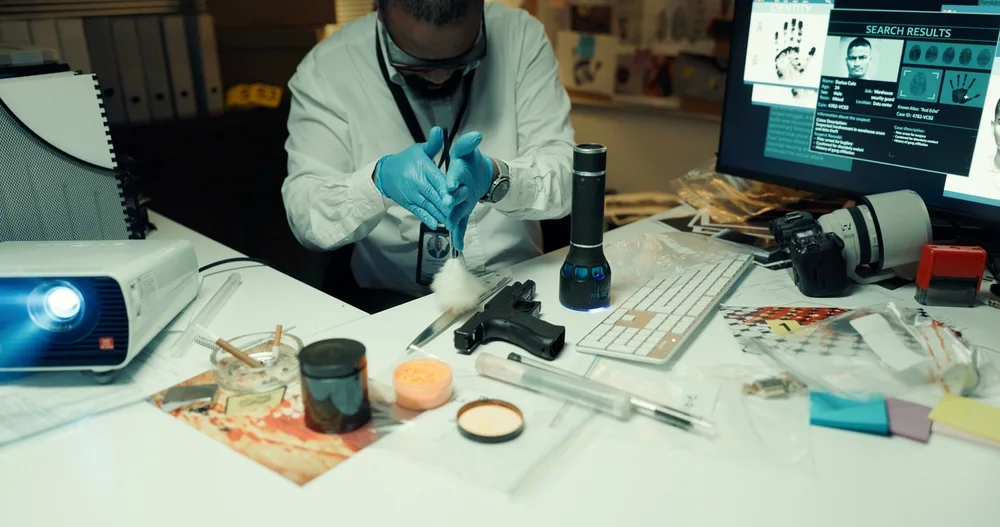
California has one current graduate degree formally titled an MS in Criminalistics and three verified forensic science master’s programs with a named criminalistics track, specialization, or concentration. The four programs differ substantially in chemistry prerequisites, laboratory access, research expectations, delivery format, accreditation, and cost.
A criminalistics master’s is primarily associated with the scientific examination of physical evidence. Depending on the curriculum, that may include controlled-substance analysis, toxicology, DNA and serology, trace evidence, microscopy, spectroscopy, and other forms of instrumental analysis. It is not automatically equivalent to education in crime-scene investigation, criminal justice, forensic psychology, digital forensics, or forensic anthropology.
This distinction has practical consequences in California. A degree containing the words “forensic science” or “criminalistics” does not automatically satisfy the educational requirements for a criminalist position. Government laboratories and law-enforcement agencies may require specific coursework in chemistry, quantitative analysis, biology, physics, statistics, or related laboratory sciences.
The programs below are the current California-based master’s degrees verified as having an explicit criminalistics degree, track, specialization, or concentration. The inventory is reasonably complete based on searches of public and private universities, alternate degree titles, current catalogs, and the FEPAC program roster. It should not be interpreted as a guarantee that no private institution will introduce or revise a concentration between catalog cycles.
Readers comparing other degree levels can also review the broader guide to criminalistics degrees in California.
California criminalistics master’s programs compared
| School | Degree and pathway | Delivery | Science preparation | Research or culminating requirement | Current FEPAC status | Published cost basis |
|---|---|---|---|---|---|---|
| California State University, Los Angeles | MS in Criminalistics | Primarily in person in Los Angeles; most courses meet in the evening | Biostatistics, general chemistry, quantitative analysis, organic chemistry with laboratories, and physics | Required research project | Not listed on the current FEPAC roster, despite historical accreditation | Fall 2026 graduate tuition and mandatory campus fees were $4,821.04 above six units or $3,027.04 for zero to six units |
| University of California, Davis | MS in Forensic Science, Criminalistics Track | In person in Davis; full-time and part-time options | Natural or physical science bachelor’s normally expected, plus chemistry, organic chemistry, physics, calculus, and statistics | Catalog lists thesis and capstone plans; applicants should verify availability and accreditation scope | Listed by FEPAC as fully accredited from March 1, 2026, through March 1, 2031 | Estimated 2026-27 annual tuition and fees of $25,110 for a new full-time student; estimated full cost of attendance of $59,170 |
| National University | Master of Forensic Sciences, Criminalistics Specialization | Online, in person, or hybrid depending on course availability; some laboratory participation may be required in person | Laboratory or physical science bachelor’s required unless the academic program director approves an exception | Supervised research project | Not listed on the current FEPAC roster | University-published estimated program cost of $25,830 based on 36 credits and current charges |
| Alliant University | MS in Forensic Science, Investigation, and Technology, Criminalistics and Technology Concentration | Primarily asynchronous online with two required on-site weekend residencies | Detailed science prerequisites are not clearly published on the program page | Research thesis and two residencies | Not listed on the current FEPAC roster | $580 per unit for 2026-27; 33 units equal about $19,140 in base tuition before fees and residency expenses |
Cost figures are not directly interchangeable. Cal State LA publishes semester charges, UC Davis publishes annual tuition and a full cost-of-attendance estimate, National University provides an estimated program total, and Alliant lists a per-unit tuition rate. Housing, transportation, books, insurance, fees, and travel can change the actual amount significantly.
California State University, Los Angeles MS in Criminalistics
Cal State LA awards the only verified California master’s degree with Criminalistics in the formal degree title. It is based in the Hertzberg-Davis Forensic Science Center and is closely associated with the university’s School of Criminal Justice and Criminalistics and California Forensic Science Institute.
The program is primarily campus-based in Los Angeles. Most courses are scheduled in the evening, although some electives may meet during the day. Evening scheduling can help a student maintain employment, but this should not be mistaken for an online or low-residency program. Laboratory courses, research activities, faculty access, and other academic obligations still require realistic planning around travel and time on campus.
Science prerequisites
Cal State LA expects extensive undergraduate preparation in the natural or physical sciences. The program’s published prerequisites include:
- Biostatistics
- Two semesters of general chemistry
- Quantitative analysis
- Two semesters of organic chemistry with laboratories
- Two semesters of physics
Quantitative analysis may be completed concurrently with graduate coursework if it has not already been satisfied. Applicants should confirm how that option affects their first-semester schedule and progress through later analytical courses.
The university also identifies a 3.0 GPA in the most recent 60 semester units or 90 quarter units and a 3.0 undergraduate-major GPA as standards for admission consideration. Meeting a published minimum does not guarantee admission.
These prerequisites reveal more about the degree’s orientation than its title alone. Two semesters of organic chemistry, quantitative analysis, physics, and laboratory work provide a foundation for evidence examination using chemical methods and scientific instruments. Someone with a bachelor’s in criminal justice may need substantial additional coursework before becoming academically prepared for admission.
A missing prerequisite can also affect employment planning. Completing a graduate criminalistics curriculum does not necessarily repair every undergraduate science deficiency identified by a public laboratory. Applicants should compare their entire transcript, including course numbers, units, laboratory components, and subject areas, with job announcements from agencies where they may eventually apply.
Curriculum and laboratory orientation
Current Cal State LA materials describe advanced criminalistics study built on chemistry, biology, physics, statistics, and research methods. Areas associated with the curriculum include trace evidence, controlled substances, toxicology, DNA and serology, microscopy, crime-scene reconstruction, evidence interpretation, courtroom issues, and statistical analysis.
Because the current catalog’s complete course sequence was not accessible during verification, applicants should obtain the live curriculum directly from the school before committing. Older Cal State LA catalogs may contain quarter-system unit totals and course numbers that no longer apply after the university’s conversion to semesters.
The Hertzberg-Davis Forensic Science Center gives the program a physical setting directly associated with forensic education and professional training. The California Forensic Science Institute supports research, training, student activities, and engagement with the forensic community. Graduate students are encouraged to participate in professional organizations such as the American Academy of Forensic Sciences and the California Association of Criminalists.
The degree concludes with a required research project. That requirement calls for more than completing a set of lecture courses. A graduate research project normally demands a defined question, appropriate scientific methods, data analysis, written presentation, and faculty supervision. Prospective students can ask how project topics are selected, what instrumentation is available, whether external laboratory partnerships are common, and how much time students typically devote to the project.
Internships have historically been available or encouraged through public and private laboratories, but current public materials do not establish a universal internship requirement. An internship should not be assumed until the school confirms its status for the applicable catalog year.
Admissions timing, cost, and accreditation
Cal State LA admits new criminalistics students for the fall semester. For fall 2026, the Cal State Apply deadline was March 15, 2026, with an earlier February 15 deadline for international applicants. Future dates may change, so preparation should begin well before the next published deadline. Applicants who need organic chemistry, physics, quantitative analysis, or biostatistics may require several terms to finish the prerequisite sequence.
For fall 2026, graduate and post-baccalaureate tuition and mandatory campus fees totaled $4,821.04 for enrollment above six units. The corresponding amount for zero to six units was $3,027.04. These are semester charges, not full-degree estimates. They exclude housing, books, transportation, parking, health insurance where applicable, and other personal expenses.
Cal State LA has historical associations with FEPAC accreditation, and older pages or third-party directories may still describe the program as accredited. It does not appear on the current AAFS/FEPAC accredited-program roster reviewed in September 2026. It should therefore not be represented as currently FEPAC-accredited unless FEPAC adds or confirms the program again.
Its present roster status does not erase the degree’s substantial science prerequisites or its direct criminalistics title. It does mean applicants who specifically need a currently FEPAC-accredited program should not rely on historical announcements.
UC Davis MS in Forensic Science, Criminalistics Track
UC Davis offers an in-person, research-focused MS in Forensic Science with Criminalistics and DNA tracks. The Criminalistics track concentrates on instrumental analysis, trace evidence, drug chemistry, toxicology, spectroscopy, chemical analysis, and the interpretation of physical evidence.
The degree requires 54 quarter units. UC Davis offers full-time and part-time enrollment, but it is an on-campus program. A working professional considering the part-time route should ask how frequently required courses meet, whether they are offered every year, and how laboratory and research schedules interact with employment.
UC Davis describes this degree as the only forensic science master’s program in the University of California system. That is a statement about the UC system, not all California colleges and universities.
Admission preparation
Applicants normally need a bachelor’s degree in a natural or physical science, engineering, or a closely related discipline. Published prerequisites include:
- General chemistry with laboratory
- Organic chemistry with laboratory
- Physics with laboratory
- Calculus
- Statistics
- Additional biology preparation for the DNA track
UC Davis lists a minimum 3.0 overall GPA and a minimum 3.0 GPA in prerequisite coursework. Applicants interested in criminalistics should still evaluate their biology preparation, particularly if they hope to work across evidence disciplines or compete for positions involving biological evidence.
The calculus requirement differentiates UC Davis from programs that focus more heavily on investigation, law, and evidence management. Quantitative preparation supports graduate work involving measurement uncertainty, analytical methods, data interpretation, instrumentation, and research design.
A science bachelor’s is not sufficient by name alone. A biology graduate may have limited analytical or organic chemistry, while a chemistry graduate may lack biology, molecular methods, or statistics. Transcript-level planning is more reliable than assuming a major title covers every prerequisite.
Curriculum, practical work, and research
The 54-quarter-unit curriculum includes 26 to 27 core-course units, three seminar units, nine elective units, and 15 to 16 research units. Students study forensic-science fundamentals, case reports, homicide crime-scene investigation, evidence analysis, laboratory methods, research, and professional communication.
Program activities include laboratory work, mock crime scenes, moot-court testimony, and case-report writing. These exercises address several different professional competencies. Laboratory analysis develops technical methods, while crime-scene exercises focus on recognition, documentation, collection, and preservation. Moot court requires a student to explain methods and conclusions clearly under questioning.
The Criminalistics track is especially relevant to applicants seeking laboratory roles involving chemical and physical evidence. Instrumental analysis and spectroscopy are central to many crime-laboratory disciplines because analysts must identify substances, compare materials, understand method limitations, and document conclusions that may later be reviewed in court.
UC Davis also places substantial weight on faculty-directed research. Research experience can help develop experimental design, scientific writing, literature review, quality control, and data interpretation. Those skills apply to laboratory validation and method development as well as academic research.
Thesis and capstone plans
The 2026-27 UC Davis catalog lists both Plan I, which requires a thesis, and Plan II, which uses a capstone. Other current program materials continue to describe thesis completion and 15 to 16 research units. Some university language also refers specifically to the thesis-based option in connection with FEPAC accreditation.
Applicants should ask two direct questions before enrolling:
- Which completion plans are available to the entering cohort?
- Does FEPAC accreditation cover both the thesis and capstone plans?
The degree is listed on the current FEPAC roster with Criminalistics and DNA tracks, but the public materials do not fully resolve how the newer cataloged capstone plan fits within that accreditation. A precise answer should come from UC Davis or FEPAC rather than an assumption based on the general program listing.
FEPAC accreditation
The Forensic Science Education Programs Accreditation Commission accredits bachelor’s and master’s forensic-science programs, along with certain natural or computer science degrees that have forensic concentrations. It is programmatic accreditation, separate from the institutional accreditation held by a university.
The current AAFS/FEPAC roster lists the UC Davis MS in Forensic Science, including the Criminalistics and DNA tracks, as fully accredited from March 1, 2026, through March 1, 2031. Among the four California programs on this page, UC Davis is the only one found on the current FEPAC roster reviewed in September 2026.
FEPAC accreditation can simplify part of the evaluation process for applicants seeking an independently reviewed forensic-science curriculum. It does not guarantee employment, replace an employer’s chemistry requirements, or establish eligibility for every California criminalist classification.
Cost and application timing
UC Davis operates the degree as a self-supporting program, with tuition set on a per-unit basis. For a new full-time student entering in 2026-27, the university estimated annual tuition and fees at $25,110. Health insurance was listed separately at $8,820. The university’s published full-time cost of attendance was $59,170, including estimated housing, food, books, transportation, and personal expenses.
The $59,170 figure is an annual planning estimate, not a fixed bill and not a guaranteed total for the entire degree. Part-time enrollment, housing choices, insurance waivers, personal expenses, and the number of years required can materially change the amount paid.
The general application deadline listed for fall 2027 was February 1, 2027, followed by a June 1 space-available deadline. Applicants should treat the earlier deadline as the safer planning target, especially if they need transcript reviews, recommendations, or prerequisite confirmation.
National University Master of Forensic Sciences, Criminalistics Specialization
National University offers a 36-semester-credit Master of Forensic Sciences with a Criminalistics specialization. The university reports an average completion time of 24 months and uses year-round monthly starts.
Delivery may be online, in person, or hybrid depending on course availability. Some Criminalistics courses may require in-person laboratory participation. The specialization should therefore not be treated as guaranteed fully online, even if much of the degree can be completed remotely.
Before applying, a prospective student should obtain written clarification about which required courses involve campus attendance, where laboratories are held, how often attendance is required, and whether the applicable schedule is available near the student’s location.
Curriculum breadth
National University’s program combines laboratory criminalistics with a broad forensic and investigative core. Subjects include:
- Crime-scene investigation
- Forensic pathology
- Forensic anthropology
- Fingerprints
- Digital evidence
- Law and criminal procedure
- Trace evidence
- Advanced forensic toxicology
- Forensic serology and DNA
- Forensic microscopy
The degree culminates in a supervised research project.
This curriculum spans several parts of the forensic process. Pathology and anthropology are associated with death investigation and human remains. Crime-scene investigation addresses evidence recognition, collection, documentation, and chain of custody. Fingerprints and digital evidence involve their own methods. Toxicology, serology, trace evidence, and microscopy are more directly associated with laboratory criminalistics.
Breadth can support professionals whose work crosses investigative and scientific boundaries. It also means fewer credits may be available for advanced chemistry and instrumental analysis than in a program designed mainly around analytical laboratory science. Applicants should review the actual course sequence rather than judging the curriculum from the specialization name.
Admission background
The Criminalistics specialization requires an undergraduate degree in a laboratory or physical science, such as chemistry or biology, unless the academic program director grants approval. An approved exception may permit admission, but it does not necessarily resolve future employer requirements.
Someone entering with a criminal justice degree and limited laboratory science should be especially careful. A graduate course in trace evidence or toxicology may not substitute for a required undergraduate sequence in general chemistry, organic chemistry, quantitative analysis, or biology. California agencies assess transcripts under their own classification and hiring rules.
The program’s science-degree requirement provides a useful screening point, but the content of the prior degree still needs examination. A transcript evaluation should identify total chemistry credits, laboratory courses, quantitative analysis, statistics, biology, physics, and any upper-division analytical coursework.
Research and laboratory participation
The supervised research project gives students an opportunity to apply scientific or investigative methods to a defined problem. Applicants can ask whether projects are experimental, literature-based, or practice-oriented; what access students receive to laboratory equipment or datasets; and whether publication or formal presentation is expected.
The warning that some Criminalistics courses may require in-person laboratories deserves close attention. Laboratory science cannot always be reproduced through lectures, videos, or home exercises. Employers may examine whether applicants have experience with instruments, controlled procedures, evidence handling, quality assurance, and documented laboratory methods.
Location also affects cost. Travel, lodging, local transportation, and time away from work can increase the practical price of a flexible degree. National University should confirm the attendance requirements for the specific catalog and start date before a student builds a budget.
Tuition and accreditation
National University’s September 2026 tuition page lists the program at 36 credits, with a base tuition rate of $683 per credit and a $105 course-material fee. The university publishes an estimated program cost of $25,830. Transfer credit, scholarships, additional fees, travel, and individual scheduling can change the total.
National University holds institutional accreditation through the WASC Senior College and University Commission. The Master of Forensic Sciences was not found on the current FEPAC roster. Institutional accreditation and FEPAC programmatic accreditation evaluate different levels of an institution and must not be presented as interchangeable.
Alliant University MS in Forensic Science, Investigation, and Technology
Alliant University offers a 33-unit MS in Forensic Science, Investigation, and Technology with a Criminalistics and Technology concentration. The program is primarily asynchronous online, with optional synchronous activities and two required on-site weekend residencies.
The university states that the degree normally takes less than a year and a half to complete. Actual completion time depends on course availability, enrollment intensity, thesis progress, and the scheduling of required residencies.
Concentration and applied study
The Criminalistics and Technology concentration addresses the collection, preservation, and analysis of:
- DNA evidence
- Trace evidence
- Physical evidence
- Toxicological evidence
- Pharmacological evidence
- Identification evidence
The broader program incorporates investigation, law, technology, simulations, and applied analytical work. Students also complete a research thesis.
Alliant’s blend of online study, short residencies, and a thesis may fit a working professional who cannot relocate for a conventional campus schedule. It is still a program with physical attendance requirements. The public program page does not clearly state where the residencies occur, exactly what laboratory activities they include, or what equipment students use.
Those details matter for both budgeting and professional preparation. Two weekends of on-site activity are not automatically equivalent to a series of semester-long laboratory courses. Applicants can request a residency agenda, course syllabi, lists of laboratory methods, and an explanation of how practical competencies are assessed.
Prerequisite uncertainty
The accessible program page directs applicants to general admissions materials but does not publish a detailed list of chemistry, biology, physics, mathematics, statistics, or laboratory prerequisites. That leaves a major question for anyone seeking laboratory criminalist work.
Admission to a graduate program and eligibility for a government classification are separate decisions. An applicant could be admitted to an interdisciplinary forensic program while lacking science credits required by a particular crime laboratory. A written transcript evaluation from the university is useful, but it should be paired with a comparison against actual job specifications.
Applicants can create a science inventory that records:
- General chemistry units and laboratory components
- Organic chemistry units and laboratories
- Quantitative or analytical chemistry
- Biology and molecular biology
- Genetics and biochemistry
- Physics
- Calculus and statistics
- Instrumental analysis
- Research methods
- Upper-division laboratory courses
This exercise can reveal whether the degree would build on adequate scientific preparation or leave an applicant dependent on additional post-baccalaureate coursework.
Thesis, residencies, and cost
The required thesis adds a sustained research component that can demonstrate scientific writing, literature review, analysis, and project management. Prospective students should ask how thesis supervision works at a distance, whether original data collection is expected, and what research facilities are available to online students.
Alliant requires two on-site weekend residencies. Travel and lodging are not represented in the base tuition calculation. The 2026-27 online tuition rate for the program is $580 per unit. At 33 units, base tuition is approximately $19,140 before institutional fees, student-government charges, books, travel, lodging, and other expenses.
The program was not listed on the current FEPAC roster. Any institutional accreditation held by Alliant should be described separately from FEPAC accreditation.
Why science coursework can matter more than the degree title
Criminalistics is laboratory science applied to legal evidence. A program name can indicate the general subject, but employers often examine the courses behind the degree.
California’s Senior Criminalist classification provides a concrete example. The state’s qualification language calls for education in a qualifying physical or biological science and identifies specific chemistry preparation, including eight semester hours of general chemistry and three semester hours of quantitative analysis. Under one pathway, a master’s degree can substitute for part of the required experience, but it does not replace the specified science education.
A Senior Criminalist specification is not a universal rule for every public laboratory, and it is not an entry-level standard. It demonstrates how a California employer may separate degree level from subject preparation. Cities, counties, state agencies, and private laboratories can use different classifications and screening methods.
Before enrolling, collect several recent job announcements from target employers. Record the required degree fields, semester units, laboratory courses, experience, driver’s-license requirements, background investigation terms, and any discipline-specific criteria. Archived announcements can help with planning, but current postings and official classification specifications deserve priority.
Criminalist, forensic scientist, and CSI are not interchangeable roles
California agencies use forensic job titles differently. A criminalist at one agency may perform controlled-substance analysis, toxicology, trace-evidence examination, firearms work, or biological testing. Another agency may use “forensic scientist” for similar laboratory functions.
Crime-scene investigators and crime-scene technicians typically focus more heavily on scene documentation, photography, evidence recognition, collection, packaging, fingerprints, reconstruction, chain of custody, report writing, and testimony. Some agencies hire civilian CSI personnel. Others assign sworn officers to crime-scene work.
Evidence technicians or property and evidence technicians may manage intake, storage, records, transfers, and disposal. Latent print examiners, forensic photographers, digital evidence specialists, forensic anthropologists, and forensic psychologists have distinct educational and professional routes.
The federal Bureau of Labor Statistics profile for forensic science technicians combines some laboratory and crime-scene functions within one occupational category. BLS projects 13 percent national employment growth from 2024 through 2034 and reported a national median annual wage of $67,440 in May 2024. Those figures describe a broad national occupation. They do not predict a graduate’s salary or define eligibility for a California criminalist position.
California’s Employment Development Department similarly describes forensic science technicians as workers who collect, identify, classify, and analyze evidence, including specialties such as fingerprints, ballistics, handwriting, and biochemistry. The broad category should not be used to assume that one educational standard applies to every role.
How FEPAC should affect the comparison
FEPAC accreditation is relevant when evaluating a forensic-science degree designed to prepare students in scientific evidence analysis. It indicates that the program has undergone review against educational standards established for the field.
It is not the same as institutional accreditation. A university can be institutionally accredited while its forensic program is not FEPAC-accredited. Conversely, FEPAC reviews a specific program rather than the university as a whole.
Among the four verified programs in this article:
- UC Davis is currently listed by FEPAC.
- Cal State LA has historical accreditation references but is not on the current roster reviewed in September 2026.
- National University was not found on the current roster.
- Alliant University was not found on the current roster.
A non-FEPAC program is not automatically unsuitable. Curriculum depth, faculty experience, laboratory access, research, cost, location, and employer requirements still require individual evaluation. FEPAC status also should not be applied as a general test for unrelated fields such as forensic psychology or forensic anthropology.
Applicants interested in UC Davis should confirm whether the accreditation applies identically to both cataloged completion plans. Public university pages specifically connect the thesis-based option with accreditation, while the catalog also lists a capstone plan.
Comparing laboratory access and research
All four degrees include a culminating research element, but the structure differs.
Cal State LA requires a research project and operates in a forensic science center. UC Davis assigns a substantial portion of its 54 quarter units to research and lists thesis and capstone routes. National University concludes with a supervised research project. Alliant requires a thesis.
Research titles alone do not describe the experience. Useful questions include:
- Does the project require original experimental work?
- Will the student use laboratory instruments?
- Are projects completed individually or in groups?
- Who supervises the work?
- Can working professionals conduct approved research through an employer laboratory?
- Are human subjects, biological samples, controlled substances, or sensitive case data involved?
- Is a written thesis, oral defense, publication, or poster presentation required?
- What happens if equipment or data are not available?
- How many terms do students typically need after finishing coursework?
Laboratory access deserves separate examination. A campus program may offer frequent instrument use but require relocation or commuting. A primarily online program may reduce travel during ordinary weeks but still require labs or residencies. Short intensive sessions can provide practical exposure, though they may not supply the repeated practice available in a semester-long laboratory sequence.
Cost planning beyond published tuition
Published prices use different accounting methods, so a simple ranking would be misleading.
Cal State LA’s figures are semester charges. A full estimate would require the number of semesters, enrollment load, future fee changes, books, commuting, parking, and living expenses.
UC Davis publishes both annual tuition and a cost-of-attendance budget. The latter includes indirect expenses such as housing and transportation. It is useful for financial planning but should not be read as a fixed university bill.
National University publishes an estimated program cost. Required in-person laboratories, if applicable to a student’s schedule, can add travel and lodging.
Alliant’s base tuition can be calculated from the 33-unit requirement and per-unit rate, but the result excludes separate fees and two residency trips.
A personal comparison should use the same categories for every school:
- Tuition for all required units
- Mandatory university and program fees
- Books, software, and laboratory materials
- Health insurance
- Travel, parking, and lodging
- Housing and food
- Lost income or reduced work hours
- Extra prerequisite courses
- Additional terms needed for research
- Expected annual tuition increases
Prerequisite repair can be a substantial hidden expense. An applicant missing organic chemistry with laboratory, physics, statistics, or quantitative analysis may need community-college or university coursework before admission. Course sequencing can also add a year if organic chemistry requires prior general chemistry or if quantitative analysis is offered only once annually.
Transfer and prerequisite planning
Graduate transfer policies are generally narrower than undergraduate transfer rules. A university may limit the number of graduate credits accepted, require a minimum grade, exclude courses already applied to another degree, or reject classes that do not closely match its curriculum.
Do not assume that professional training, police academy instruction, employer workshops, or undergraduate forensic courses will reduce the master’s credit requirement. Obtain a written transfer evaluation before calculating cost or completion time.
Science prerequisites require similar documentation. Keep official course descriptions and syllabi for classes with titles that may be ambiguous. “Chemical Analysis,” for example, may or may not be accepted as quantitative analysis. A statistics course taught in a social-science department may or may not satisfy a program’s expectations for biostatistics or scientific statistics.
Community-college coursework can sometimes supply lower-division chemistry, physics, calculus, or statistics at a lower cost. Upper-division analytical chemistry, instrumental analysis, biochemistry, molecular biology, or advanced laboratories may require enrollment at a four-year institution.
International applicants and graduates of institutions using quarter units should request an early evaluation. Unit conversion and differences in laboratory documentation can complicate both university admission and later employment screening.
Programs that were excluded from this list
The list is intentionally narrow. It does not include a degree merely because a department teaches one forensic course, employs forensic researchers, or offers an adjacent undergraduate program.
San Jose State University offers bachelor’s-level forensic science concentrations. Its current graduate offerings in the department are an MS in Justice Studies and an MS in Criminology with a Global Criminology concentration. The Justice Studies degree addresses criminology, policy, institutions, and related social-science subjects rather than a defined graduate criminalistics pathway.
Loma Linda University offers an MS in Criminal Justice that includes a Topics in Forensic Science course. One variable-topics course does not create a criminalistics concentration or laboratory-science curriculum.
Fresno State previously offered a Professional Science Master’s in Forensic Science. Official university records document its discontinuation, and current 2026 program listings identify an MS in Chemistry rather than a forensic science master’s. Archived catalogs and older directories may still display the former program.
A general MS in Chemistry can provide excellent preparation in analytical methods, instrumentation, and research. It has not been classified here as a criminalistics master’s unless the university offers an explicit and structured forensic pathway. The same boundary excludes general criminal justice, forensic psychology, digital forensics, anthropology, and investigation degrees without a named criminalistics component.
Out-of-state online programs that accept California residents are also outside this California-based program inventory.
A practical way to choose among the four programs
Start with the intended role, then work backward to the education.
Applicants targeting laboratory criminalist positions should compare Cal State LA and UC Davis closely. Cal State LA awards the MS in Criminalistics and publishes extensive chemistry and physics prerequisites. UC Davis offers a named Criminalistics track, substantial research, analytical coursework, and current FEPAC accreditation.
National University combines criminalistics subjects with crime scenes, pathology, anthropology, fingerprints, law, and digital evidence. Its broader curriculum may align with interdisciplinary forensic work, but laboratory attendance and local availability need confirmation.
Alliant provides primarily online study with two weekend residencies and a thesis. Its flexibility may help an employed professional, but the limited published prerequisite detail calls for a careful audit of prior science coursework and target-employer standards.
Before accepting admission, complete these steps:
- Choose several target California employers and save their current job specifications.
- Create a transcript inventory covering chemistry, biology, physics, mathematics, statistics, and laboratories.
- Ask each university for a prerequisite and transfer evaluation in writing.
- Obtain the current course sequence and confirm which courses require physical attendance.
- Verify access to instruments, laboratories, research supervision, and internships.
- Confirm the culminating requirement and typical time needed to finish it.
- Check FEPAC status directly on the current roster rather than relying on historical university pages.
- Build a full budget that includes fees, travel, prerequisite repair, residencies, and living costs.
- Ask whether the degree’s schedule is compatible with employment.
- Compare the complete academic record with employer requirements again before enrolling.
The correct program is not determined by which title sounds most forensic. It depends on whether the curriculum supplies the science, laboratory practice, research experience, and delivery structure required for the specific work the student intends to pursue.