
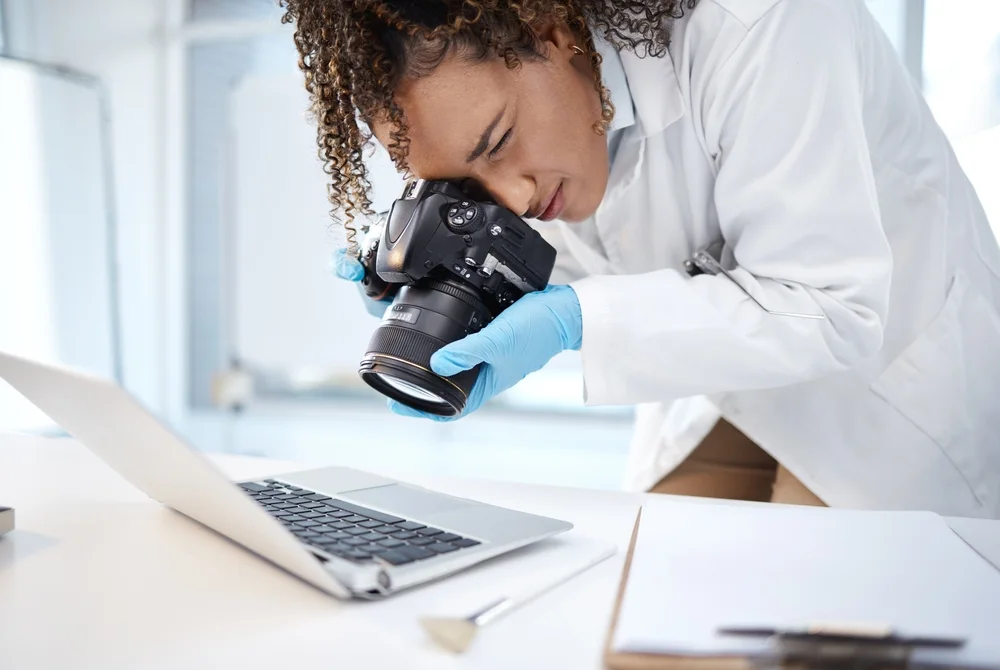
Crime scene investigators and detectives contribute to the same criminal cases, but they usually have different responsibilities. A crime scene investigator builds the physical-evidence record by documenting scenes, taking photographs, recovering fingerprints and biological material, preserving evidence, and preparing technical reports. A detective develops and manages the broader investigation through interviews, records, surveillance, warrants, suspect identification, arrests, and case coordination with prosecutors.
In California, another difference often separates the careers. Many crime scene investigator positions are civilian technical jobs, while municipal police detectives are generally sworn peace officers who first gain experience as police officers. The distinction is not universal. Some departments assign sworn officers to CSI duties, and agencies use titles such as forensic specialist, evidence technician, criminalist, and crime scene technician in different ways.
The practical decision is therefore larger than choosing between two job titles. It involves choosing between a technical evidence career and a sworn law-enforcement career, understanding that some California agencies combine parts of those roles.
CSI vs detective at a glance
| Comparison | Crime scene investigator | Police detective |
|---|---|---|
| Primary mission | Document a scene and identify, recover, preserve, and sometimes examine physical evidence | Develop the overall criminal case and pursue leads, suspects, warrants, arrests, and prosecution |
| Typical duties | Photography, measurements, scene notes, evidence collection, latent-print processing, biological evidence recovery, packaging, chain of custody, technical reports, testimony | Interviews, interrogations, records review, surveillance, search and arrest warrants, suspect identification, case management, arrests, prosecutor coordination, testimony |
| Employment status | Often civilian and non-sworn, but some agencies assign sworn officers to CSI work | Generally a sworn peace-officer assignment in municipal police departments |
| Arrest authority | A non-sworn CSI does not have police arrest authority | Sworn detectives exercise peace-officer authority within the scope of their position |
| Common entry route | College coursework or a degree, evidence-processing preparation, relevant experience, and agency training | Peace-officer selection, police academy, field training, foundational police experience, and competition for a detective assignment or promotion |
| Statewide education standard | No single statewide degree requirement for civilian CSI jobs | Peace-officer candidates must meet state and agency standards; departments may also set education and experience requirements for detective assignments |
| POST academy | Not automatically required for civilian CSI classifications | The standard POST Regular Basic Course requires at least 680 hours |
| Useful academic subjects | Evidence photography, fingerprints, biology, chemistry, statistics, documentation, chain of custody, report writing, courtroom testimony | Criminal law, constitutional law, interviewing, search and seizure, report writing, warrants, case management, surveillance, and interpersonal communication |
| Main work product | An accurate, defensible record of the scene and physical evidence | A complete investigative case connecting evidence, witnesses, records, suspects, and legal process |
| Working conditions | Scenes involving blood, decomposition, drugs, firearms, chemicals, confined spaces, outdoor exposure, callouts, and courtroom scrutiny | Shift work, overtime, hazardous contacts, raids or arrests, disturbing cases, extensive reports, on-call duties, and courtroom scrutiny |
| California pay data | Often mapped to the broader forensic science technician occupation | Usually mapped to detectives and criminal investigators |
| Advancement | Senior or lead CSI, forensic specialist, latent-print work, training, supervision, or another forensic specialty | Specialized investigations, lead assignments, corporal or supervisory positions, and other sworn investigative roles |
What crime scene investigators do
A CSI’s work begins with the integrity of the scene. Depending on the agency and incident, the investigator may photograph the location, prepare diagrams, record measurements, identify possible evidence, process surfaces for fingerprints, collect biological samples, package items, and document each transfer through the chain of custody. The work may continue through evidence submission, report preparation, consultation with detectives, and testimony in court.
The National Institute of Justice’s crime scene investigation guide organizes scene work into initial response, preliminary documentation and evaluation, scene processing, completion and recording, and equipment. That sequence illustrates why CSI work involves more than collecting objects. Scene security, contamination control, documentation, packaging, and the final record all affect whether evidence remains useful.
California employer classifications show the range of technical duties. Brea’s non-sworn Crime Scene Investigator locates, collects, preserves, processes, and documents physical evidence. The classification also covers forensic photography, latent-print processing, biological evidence collection, scene interpretation, assistance to detectives, and testimony.
Pomona likewise uses a non-sworn CSI classification for technical crime-scene and police-laboratory work. Oceanside’s non-sworn Forensic Specialist documents scenes, collects evidence, performs latent-print work and basic evidence examinations, writes reports, and testifies. Contra Costa County’s CSI classifications include evidence documentation, collection, preservation, examination, report preparation, and legal testimony.
These employees may interpret physical evidence in the context of a scene, but the detective normally controls the broader case investigation. A CSI might document a bloodstain pattern, recover a latent print, or explain where an item was found. The detective integrates those findings with statements, records, timelines, possible motives, suspect activity, and legal processes.
What police detectives do
A local police detective is usually a sworn officer assigned to follow-up investigations. Detectives gather facts, interview witnesses and suspects, examine records, conduct surveillance, develop probable cause, obtain warrants, make or coordinate arrests, and prepare cases for prosecutors. Their responsibilities are broader than physical-evidence processing because they must manage the direction of the case.
A detective investigating a burglary, for example, may compare witness accounts, review video, research stolen property, identify a suspect, seek a search warrant, coordinate evidence collection, conduct an interview, and present the completed case to prosecutors. The CSI’s findings may be central to that investigation, but they are one part of a larger evidentiary and legal record.
California classifications provide concrete examples. Redlands detectives conduct interviews and interrogations, direct investigations, prepare reports, obtain warrants, and assist with prosecution preparation. San Bernardino’s Detective/Corporal classification includes surveillance, warrants, arrests, evidence collection, case filings, and courtroom presentation. Irvine describes Police Detective as a specialized assignment involving follow-up investigations, interviews, surveillance, warrants, prosecutorial case preparation, and testimony.
Detectives do not necessarily leave all physical-evidence tasks to civilian specialists. Staffing, case type, agency size, and department policy influence who processes a scene. A detective may photograph evidence, participate in a search, preserve an item, or collect evidence during an arrest. Pleasanton’s police-officer classification includes investigation, evidence preservation, searches, interrogation, apprehension, and court preparation. It also lists both detective and crime scene investigator as sworn specialty assignments.
The clearest distinction is one of emphasis. CSIs concentrate on creating a reliable physical-evidence record. Detectives concentrate on using evidence, statements, records, legal authority, and investigative leads to resolve the case.
California job titles are not standardized
“Crime scene investigator” does not identify one standardized California classification. It can refer to a civilian forensic employee, a sworn police specialty assignment, or a role that labor agencies group with either forensic science technicians or criminal investigators.
Many agencies use civilian classifications:
- Brea explicitly classifies its CSI as non-sworn.
- Pomona has a non-sworn CSI job involving scene and police-laboratory work.
- Contra Costa County places its CSI series in a non-sworn bargaining unit.
- Oceanside’s Forensic Specialist is a non-sworn classification.
Pleasanton uses a different structure. It identifies Crime Scene Investigator as one of the specialty assignments available to sworn police officers. A person doing CSI work there may therefore have police authority and training that a civilian CSI in another jurisdiction does not have.
Detective structures also vary. Berkeley identifies detective as a possible rotational assignment for police officers. Irvine treats it as a specialty assignment available to an officer who meets department criteria. San Bernardino defines Detective/Corporal as a promoted specialist and lead position. Redlands requires applicants for Police Corporal/Detective to have two years of full-time service as a Redlands sworn police officer.
The title alone cannot reveal whether a position is civilian, sworn, entry level, promotional, rotational, or supervisory. The official classification provides more useful information: bargaining unit, peace-officer status, minimum qualifications, required certificates, assignment process, and actual duties.
CSI, criminalist, and evidence technician are different roles
The California Department of Justice distinguishes crime laboratory scientists, commonly called criminalists, from crime scene technicians or investigators and specially trained police officers. Criminalists may respond to scenes, but their broader work includes laboratory examination and interpretation of physical evidence.
A laboratory criminalist generally needs deeper natural-science preparation than many field-focused CSI jobs. Chemistry, biology, organic chemistry, analytical methods, molecular biology, statistics, instrumentation, and laboratory quality practices can be central to crime-laboratory work. The California DOJ’s California Criminalistics Institute FAQ associates criminalist preparation with a four-year physical or biological science degree.
That science-degree guidance applies to laboratory criminalistics. It is not a universal degree rule for every California job containing “crime scene” in its title.
Evidence technician and property/evidence technician can introduce further ambiguity. In some agencies, an evidence technician processes scenes. In others, a property or evidence employee primarily receives, stores, tracks, and releases items after collection. Someone seeking field investigation work should prioritize classifications involving scene response, photography, evidence recognition, latent prints, biological material, documentation, and testimony.
How the two professionals work on the same case
A representative serious-crime workflow may involve several distinct roles:
- Patrol officers respond, address immediate safety concerns, provide aid, detain involved people when legally justified, and secure the scene.
- A CSI documents the condition of the scene and systematically identifies, photographs, collects, packages, and records physical evidence.
- A detective interviews witnesses, develops leads, obtains relevant records, coordinates searches, pursues warrants, evaluates suspect information, and manages the follow-up investigation.
- A criminalist or another laboratory specialist conducts examinations that require scientific analysis.
- The detective coordinates the case for prosecutorial review, while CSIs, officers, criminalists, and other witnesses contribute reports and later testimony.
Actual staffing varies. A small agency may require sworn officers or detectives to perform more scene processing. A larger department or sheriff’s office may divide field response, latent-print examination, laboratory analysis, digital evidence, property storage, and follow-up investigation among separate units.
The roles also overlap without becoming interchangeable. A CSI may assist detectives by interpreting scene conditions or explaining the evidentiary significance of an item. A detective may collect evidence during a search or arrest. Both must write clear reports, preserve the integrity of evidence, respond to legal scrutiny, and testify accurately.
Becoming a civilian CSI in California
California does not impose one statewide degree requirement for civilian crime scene investigators. Individual cities and counties set their own education and experience standards, and the reviewed classifications demonstrate meaningful variation.
Education requirements vary by agency
Contra Costa County’s entry-level Crime Scene Investigator I classification provides a current example of defined college preparation. Its stated pathway includes an associate degree with coursework in report writing or English composition, mathematics or statistics, and chemistry or biology with a laboratory section.
That combination reflects the actual work. Writing courses support detailed technical reports. Mathematics and statistics help with measurements, scale, and analytical reasoning. Laboratory science introduces contamination control, observation, testing practices, and the disciplined handling of material evidence.
Pomona’s typical qualification combines two years of relevant college study or a forensic certificate with two years of crime-scene evidence experience. Brea describes a bachelor’s degree as highly desirable rather than an absolute minimum.
These examples show why there is no accurate single answer such as “all California CSIs need a bachelor’s degree.” Some positions provide an associate-degree route. Others combine college education with experience. A bachelor’s degree can improve preparation and eligibility, especially where hiring is competitive, but the job classification controls the formal minimum for a particular vacancy.
Coursework that aligns with field CSI work
A field-focused curriculum should address the tasks performed at scenes. Useful subjects include:
- Crime scene photography and low-light photography
- Evidence recognition and recovery
- Fingerprint development and comparison fundamentals
- Biological evidence collection
- Blood-borne pathogen safety
- Chemistry or biology with laboratory work
- Mathematics or statistics
- Scene sketching, measurement, and reconstruction principles
- Report writing and technical documentation
- Chain of custody and evidence law
- Search and seizure fundamentals
- Courtroom presentation and testimony
- Digital photography and image management
- Quality assurance and contamination prevention
Laboratory courses have special value because they require controlled procedures, accurate observations, documentation, and safe material handling. A program consisting almost entirely of criminal justice survey courses may explain policing and courts but provide limited practice with evidence, microscopy, chemistry, biology, or scene documentation.
A forensic science degree also needs to be interpreted by its curriculum. Some programs emphasize laboratory science; others emphasize crime-scene procedures or criminal justice. The degree title does not establish readiness for a particular CSI classification.
Experience and post-hire training
Some entry classifications permit candidates to begin with education and develop experience on the job. Journey-level positions often require prior evidence work. Contra Costa County’s CSI II classification, for example, requires two years of law-enforcement evidence experience that included crime-scene report writing.
Employers may also require technical credentials after appointment. Oceanside requires specified POST field-evidence training and International Association for Identification CSI certification within stated periods after hire. This is an agency requirement, not a statewide California license for all CSIs.
California POST recognizes technical courses for both peace-officer and non-peace-officer law-enforcement positions. Subjects can include evidence gathering and processing, criminal investigation, and other specialized functions. Civilian status therefore does not mean the work lacks formal law-enforcement training. It means the employee follows a different authority and entry pathway from a sworn officer.
Becoming a police detective in California
A municipal police detective is generally not a direct-entry civilian occupation. The usual path begins with qualifying for a sworn police-officer position, completing basic training and field training, gaining experience, and then competing for an investigative assignment or promotion.
1. Meet peace-officer selection standards
California peace-officer candidates must satisfy statutory and POST-related standards involving education, criminal history, background, and physical and psychological suitability. Agencies participating in POST apply those requirements and may impose standards above the statewide minimum.
This selection process belongs to the sworn pathway. A person can be well qualified for technical evidence work yet not have completed the separate requirements for peace-officer appointment.
2. Complete the police academy
The California Commission on Peace Officer Standards and Training sets a minimum of 680 hours for the standard-format Regular Basic Course. The course is the basic training standard for police officers, deputy sheriffs, district attorney investigators, and certain other peace officers.
Academy training covers a broad law-enforcement role rather than detective work alone. Recruits prepare for legal, tactical, physical, communication, and public-safety responsibilities associated with sworn service.
A civilian CSI classification does not require the Regular Basic Course solely because it handles evidence. A sworn CSI assignment, such as the model identified in Pleasanton, is different because the employee first serves as a police officer.
3. Complete field training
Academy graduates normally move into a POST-approved field or police training program. Field training helps new officers apply classroom instruction during actual police work. POST’s model includes competency areas involving search and seizure, report writing, patrol procedures, investigations, and evidence.
This stage builds the foundational judgment and operational experience later used in detective work. Detectives must understand how initial responses are conducted, how legal decisions affect evidence, and how reports from patrol officers contribute to follow-up investigations.
4. Gain police experience
The U.S. Bureau of Labor Statistics reports that detectives typically begin as police officers because investigative assignments require prior law-enforcement experience. California classifications support that general pattern.
Redlands requires two years of full-time service as a Redlands sworn police officer for its Police Corporal/Detective classification. Irvine appoints detectives from officers who are off probation and meet specialty-assignment criteria. Berkeley permits officers to rotate into detective work, while San Bernardino uses a promoted specialist classification.
The amount and type of experience depend on the department. Detective can be a promotion, a specialty assignment, a rotation, a lead classification, or a combined corporal/detective role.
5. Develop advanced investigative skills
POST’s Robert Presley Institute of Criminal Investigation provides advanced training primarily for full-time sworn detectives and investigators from POST-affiliated agencies. Its Certificate of Achievement pathway includes the ICI Core Course, a foundation specialty course, and at least 72 hours of qualifying investigative electives. The full pathway involves approximately 200 hours of training.
Investigative specialties can differ substantially. Homicide, robbery, sexual assault, fraud, property crime, gang investigations, domestic violence, and digital investigations require different bodies of knowledge. Detective preparation continues after appointment rather than ending with the academy.
Comparing education for CSI and detective careers
The best educational route depends on the work a person wants to perform.
Education for physical-evidence work
A future civilian CSI benefits most from coursework that develops technical accuracy. Photography, biology, chemistry, statistics, fingerprints, evidence collection, documentation, and chain of custody all connect directly to verified California CSI duties.
A criminal justice degree can help with legal systems, policing, courts, and procedure, but it may be too light in science and hands-on evidence work unless it includes a forensic concentration with laboratories. A forensic program with little chemistry, biology, or practical scene processing can create a similar problem.
Laboratory criminalistics requires a different level of scientific preparation. Someone targeting criminalist, forensic chemist, forensic biologist, or crime-lab analyst positions should prioritize a physical or biological science degree and the specific science coursework required by the employer. Field CSI education and laboratory criminalist education overlap, but they are not equivalent.
Education for detective work
A degree does not replace peace-officer selection, academy training, field training, or police experience. Academic work can still strengthen detective preparation, especially in:
- Criminal and constitutional law
- Search and seizure
- Interviewing
- Report writing
- Research and records analysis
- Psychology
- Accounting or finance for fraud investigations
- Computer science or cybersecurity for digital investigations
- Sociology and communication
- Statistics and analytical reasoning
The detective’s job demands legal judgment, communication, case organization, and the ability to assess information from people, documents, digital sources, and physical evidence. Classroom preparation supports those abilities, but appointment remains tied to the agency’s sworn career structure.
Arrest authority and investigative responsibility
Authority is one of the sharpest differences between a civilian CSI and a police detective.
A civilian CSI works within the technical and administrative authority of the employing agency. The employee may enter secured scenes, collect evidence, handle controlled items as part of assigned duties, prepare official reports, and testify as a technical witness. The position does not carry the general peace-officer powers associated with a sworn detective.
Detective classifications in Redlands and San Bernardino expressly include warrants, interviews or interrogations, arrests, and case preparation. Those functions require knowledge of constitutional limits, department policy, officer safety, and legal procedure.
The responsibility for the full investigation also differs. A CSI is accountable for the accuracy and integrity of scene work. A detective is accountable for directing or coordinating the case, pursuing leads, obtaining legal authority where required, documenting investigative decisions, and preparing the matter for prosecution.
Neither responsibility is minor. Poor evidence documentation can weaken an otherwise sound case. Weak interviewing, incomplete follow-up, or defective warrant preparation can prevent useful physical evidence from being connected to a suspect.
Salary and employment outlook
Salary comparisons require careful occupational framing because “crime scene investigator” is not mapped consistently in labor data.
The California Employment Development Department associates CSI-related titles with more than one occupational group. Its forensic science technician profile includes Crime Scene Technicians, Criminalists, Evidence Technicians, and Forensic Analysts. Its detectives and criminal investigators profile also lists Crime Scene Investigators as an alternative title.
The numbers therefore compare broad occupational categories, not every California employee carrying one of the two titles.
California wage data
For the first quarter of 2026, California EDD reported:
- Forensic science technicians: mean wage of $51.87 per hour and median wage of $50.46 per hour
- Detectives and criminal investigators: mean wage of $59.91 per hour and median wage of $61.54 per hour
The detective category had the higher statewide median, but this is not an exact civilian-CSI-versus-municipal-detective comparison. The forensic technician group includes laboratory and evidence occupations, while the detective group includes broader criminal-investigator roles and some title overlap.
Actual compensation can differ based on the agency, region, bargaining agreement, experience, overtime, on-call obligations, specialty pay, and benefits. A local classification range also may cover several steps rather than only entry pay.
California projections
EDD projected California forensic science technician employment to rise from 2,200 positions in 2022 to 2,600 in 2032. That is an 18.2 percent increase.
For detectives and criminal investigators, EDD projected an increase from 11,300 positions in 2022 to 11,500 in 2032, or 1.8 percent. The agency projected 8,510 total openings over the period, reflecting replacement needs as well as growth.
The faster percentage growth for forensic science technicians begins from a much smaller employment base. Detectives and criminal investigators constitute the larger category in the state projections.
National context
The Bureau of Labor Statistics profile for forensic science technicians reported a May 2025 national median annual wage of $72,060. BLS projected 13 percent employment growth from 2025 through 2035.
For detectives and criminal investigators, BLS reported a May 2025 national median annual wage of $93,790 and projected approximately level employment from 2025 through 2035. Retirements and occupational turnover can still produce openings even when net employment changes little.
These national figures provide context rather than precise California pay for a narrowly defined CSI or local police detective.
Working conditions and personal demands
Both careers involve more report writing and procedural documentation than television portrayals suggest. Every photograph, item number, interview, transfer, search, and investigative step may face scrutiny in court.
CSI working conditions
Crime scene work can involve:
- Deceased and decomposed remains
- Blood and other biological material
- Drugs and unknown powders
- Firearms and ammunition
- Chemicals and explosive hazards
- Confined or difficult spaces
- Outdoor scenes in poor weather
- Long periods of standing, kneeling, or bending
- After-hours callouts
- Protective clothing and respiratory precautions
- Repetitive documentation under time pressure
Oceanside’s classification specifically describes exposure to blood, body fluids, drugs, firearms, chemicals, explosive devices, decomposed remains, confined spaces, and after-hours work. Contra Costa County also identifies hazardous-material exposure and on-call responsibilities.
The work rewards patience and consistency. A CSI must follow the same disciplined process even when a scene is chaotic, unpleasant, or emotionally difficult.
Detective working conditions
Detectives face a different mix of pressures:
- Interviews with victims, witnesses, and suspects
- Exposure to traumatic case details
- Surveillance and irregular hours
- Arrests, searches, and potentially dangerous contacts
- Large volumes of reports and records
- Deadline pressure involving warrants or custody
- Coordination with patrol, forensic personnel, prosecutors, and outside agencies
- Court appearances and challenges to investigative decisions
- On-call responsibilities and overtime
Detective work also carries responsibility for prioritizing leads and making consequential decisions with incomplete information. Strong interpersonal judgment is as necessary as analytical ability.
Can a civilian CSI become a detective?
A civilian CSI can pursue a detective career, but the transition normally requires entry into the sworn peace-officer pathway. Technical forensic experience does not confer peace-officer status or replace academy and field training.
A typical transition would involve:
- Meeting the hiring standards for a police-officer or other peace-officer position
- Completing the required selection process
- Graduating from an approved basic academy
- Completing field training
- Working in patrol or another foundational assignment
- Meeting the department’s experience and performance requirements
- Competing for a detective assignment or promotion
CSI experience can provide useful knowledge of evidence, documentation, courtroom testimony, and investigative teamwork. The person must still develop the broader police competencies associated with enforcement, legal authority, field decision-making, patrol response, arrests, and suspect contacts.
The reverse move is also possible. A sworn officer or detective may pursue evidence-focused assignments, particularly in a department that uses sworn CSIs. Moving into a specialized civilian forensic classification can require specific education, technical experience, or certifications even when the applicant already has law-enforcement experience.
Which career fits your interests?
Choose the CSI direction when the work you want is centered on physical details. The strongest indicators are an interest in photography, fingerprints, biological material, measurement, controlled procedures, evidence packaging, technical writing, and reconstructing what happened from objects and scene conditions.
Precision matters more than speed alone. A good CSI notices small details, follows protocols consistently, accepts extensive documentation, and can explain technical procedures clearly in court.
The detective route fits people who want responsibility for the complete investigation. Interviews, human behavior, legal decisions, surveillance, records, warrant writing, suspect development, arrests, and prosecutor coordination occupy more of the job. The path also requires willingness to serve first as a sworn officer and perform the full range of police duties required by the department.
The following questions help separate the two choices:
- Do you prefer physical evidence or interviews and case strategy?
- Do you want sworn authority and the responsibilities attached to it?
- Are you prepared to complete academy and field training?
- Would you rather document one scene in exact detail or coordinate many streams of information across an investigation?
- Are laboratory science and photography more appealing than patrol, surveillance, and suspect contact?
- Do you want an entry route based mainly on technical education and evidence experience, or an internal law-enforcement route built on police service?
- Are you comfortable with the physical demands and hazards specific to each occupation?
A person interested in evidence but not arrest authority may find civilian CSI work better aligned with that preference. Someone who wants to direct investigations, conduct interrogations, obtain warrants, and make arrests needs the sworn detective pathway.
A practical California career plan
Begin with the type of work, not the title. California agencies attach the CSI label to civilian technicians and sworn officers, while detective can mean a rotation, specialty assignment, promotion, or lead classification.
For a civilian CSI career, prioritize education that includes evidence photography, fingerprints, report writing, mathematics or statistics, and chemistry or biology with laboratory work. Seek practical scene-processing instruction rather than relying only on general criminal justice classes. Entry-level county classifications such as Contra Costa County’s CSI I illustrate how writing, quantitative coursework, and laboratory science can appear together in an employer’s education standard.
For a laboratory career, build a deeper physical or biological science foundation. Criminalist and forensic scientist positions are not simply advanced versions of every field CSI job. They involve laboratory examination and interpretation that can demand substantially more chemistry, biology, instrumentation, and quality-assurance preparation.
For detective work, plan first for police-officer eligibility and service. The academy, field training, patrol experience, and internal assignment process are central parts of the career rather than administrative steps around it. Academic study can strengthen legal knowledge, writing, communication, analytical reasoning, and specialty expertise, but it does not substitute for the sworn pathway.
Finally, compare official classifications by duties and status. Determine whether the position is sworn or non-sworn, whether it responds to scenes, what evidence techniques it uses, how much experience it requires, and whether appointment occurs through open recruitment or an internal police process. Those details reveal far more than the words “CSI” or “detective” alone.