
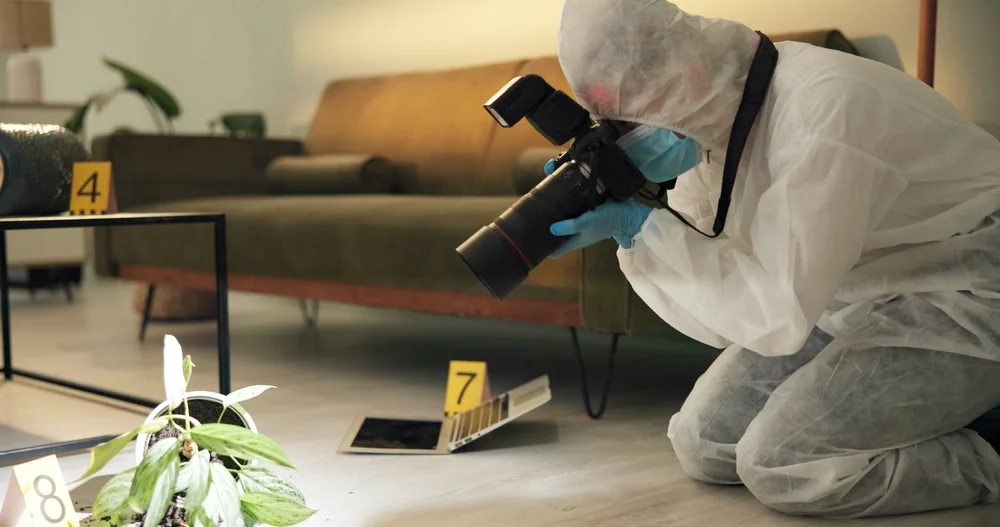
A crime scene investigator in California documents scenes, locates and recovers physical evidence, protects that evidence from contamination, maintains chain-of-custody records, prepares reports, and explains the work in court. Photography, measurements, diagrams, latent-print processing, DNA swabbing, impression recovery, evidence packaging, and coordination with detectives and laboratories are common parts of the occupation.
The exact assignment varies by employer. California has no single statewide definition of a crime scene investigator. Police departments, sheriff’s offices, forensic laboratories, and specialized identification units use titles such as Crime Scene Investigator, Crime Scene Technician, Crime Scene Specialist, Forensic Specialist, and Forensic Identification Specialist. Some positions are civilian. Others are filled by sworn police officers. Large agencies may divide the work among field investigators, print examiners, photographers, criminalists, and evidence personnel.
Whatever the title, the central responsibility remains consistent: create an accurate, defensible record of the scene and recover evidence without compromising its integrity.
The California CSI role at a glance
Most crime scene assignments involve several connected responsibilities:
- Receive a briefing and assess scene safety.
- Identify the boundaries and condition of the scene.
- Document the scene before evidence is moved.
- Search systematically for physical evidence.
- Photograph, measure, diagram, collect, label, and package evidence.
- Record custody and submit items for storage or laboratory examination.
- Conduct approved follow-up processing.
- Prepare reports, evidence lists, and photographic records.
- Testify about procedures and findings when a case reaches court.
These duties may occur at a residence, business, roadway, vehicle, hospital, jail, outdoor location, autopsy facility, or police evidence-processing area. Homicides receive the most attention in popular media, but California classifications also cover burglaries, assaults, robberies, suspicious deaths, traffic incidents, vehicle examinations, search warrants, and the processing of victims or suspects.
The occupation is procedural rather than theatrical. Much of the work consists of careful photography, repetitive documentation, precise labeling, contamination control, report writing, and evidence accounting. A mistake in an evidence identifier or custody record can create problems long after personnel have left the scene.
What happens during a crime scene response
The National Institute of Justice crime scene guidance organizes scene work into broad stages that include initial response, preliminary documentation and evaluation, processing, and completion of the scene record. Local policies govern the exact workflow, legal authority, and division of responsibility.
A typical California response may proceed as follows.
1. Receiving the call and preparing to respond
A CSI may be dispatched during a regular shift or called out after hours. The investigator receives available information about the incident, location, safety concerns, scene conditions, and requested services. The briefing helps determine what equipment and protective gear may be needed.
The initial information is not treated as a substitute for direct observation. Conditions can change quickly, particularly at outdoor scenes, active investigations, hospitals, or locations exposed to weather and public traffic.
Some agencies maintain round-the-clock callback systems. The San Diego Police Department’s forensic operations materials, for example, describe Crime Scene Specialists as available for 24-hour callback for homicides and other scenes. California job classifications in Brea, Richmond, Fresno County, and other jurisdictions also describe evening, weekend, holiday, overtime, or on-call assignments.
2. Assessing and controlling the scene
First responders usually address immediate threats, provide medical assistance, detain suspects when applicable, and establish an initial perimeter. A CSI arriving afterward assesses the scene from an evidence-processing perspective.
That assessment can include:
- Identifying areas that may contain evidence
- Noting entry and exit routes
- Recognizing environmental threats
- Determining whether additional personnel or equipment are needed
- Establishing a path that limits unnecessary movement
- Learning what first responders changed or touched
- Identifying fragile or temporary evidence
- Coordinating with the detective or officer responsible for the case
The investigator must work within lawful search authority and agency policy. A federal best-practice guide does not itself authorize a search or seizure. Warrants, consent, exigent circumstances, and other legal rules govern what personnel may examine and collect.
Scene control also has an evidentiary purpose. Unnecessary traffic can introduce hair, fibers, footwear impressions, DNA, or other material. It can also damage existing evidence. Personnel logs and controlled access help document who entered, why they entered, and when they left.
3. Documenting the original condition
Documentation begins before items are moved whenever circumstances permit. The objective is to preserve a record that allows investigators, attorneys, experts, and jurors to understand the scene later.
A CSI may use:
- Written notes
- Overall photographs
- Midrange or relationship photographs
- Close-up photographs
- Video
- Measurements
- Rough sketches
- Scaled diagrams
- Evidence markers
- Scene maps
- Photographic and evidence logs
- Three-dimensional scanning in agencies that use it
Overall images establish the setting. Relationship images show where an item was located relative to fixed features or other evidence. Close-up images record detail. Measurements and diagrams supplement photography by establishing distances and spatial relationships that a photograph alone may not preserve reliably.
The Los Angeles Police Department’s Field Investigation Unit lists scene assessment, documentation, evidence collection, scaled diagrams, evidence booking, and expert testimony among its functions. Roseville’s Crime Scene Investigator classification includes photography, video, diagrams, and 3D scanning as possible documentation methods.
Documentation continues throughout processing. Later photographs may show an impression after enhancement, an item after it has been moved, or an area after a surface has been examined. Notes identify what changed and why.
4. Searching for evidence
Crime scene evidence is not always obvious. Investigators use a search method suited to the scene’s size, layout, hazards, and available staffing. Their task is to locate material that may help establish what happened, connect people or objects to a location, test an investigative account, or support later comparison and analysis.
Common categories include:
- Latent fingerprints and palm prints
- Blood and other biological material
- DNA-bearing contact evidence
- Hairs and fibers
- Footwear and tire impressions
- Firearms, ammunition components, and related items
- Trace materials
- Broken objects and toolmarks
- Drugs or suspected controlled substances
- Documents and physical records
- Fire debris
- Clothing and personal property
- Items that may contain touch DNA or prints
- Digital devices requiring preservation or referral
A CSI does not decide that every object at a scene is relevant. The job requires recognizing potential evidence in context and documenting the reason for collecting it. Collecting too little can leave an investigative gap. Collecting items without adequate records, appropriate packaging, or a clear relationship to the scene can create a different set of problems.
Specialized lighting, chemical or powder-based print processes, DNA swabbing, impression casting, and presumptive field tests may fall within a local CSI’s assignment. The scope depends on training and agency organization.
5. Recovering evidence without compromising it
Recovery involves more than placing an item in a container. Investigators must choose methods appropriate to the evidence type, condition, and intended examination.
The National Institute of Standards and Technology’s trace-evidence guidance addresses recognition, collection, packaging, and preservation because different materials have different vulnerabilities. A method appropriate for a dry physical object may be unsuitable for biological evidence, volatile material, or an impression.
During collection, a CSI may need to:
- Change gloves or tools to reduce cross-contamination
- Collect known or control samples
- Separate items that could transfer material to one another
- Preserve wet or biologically hazardous evidence under approved procedures
- Protect fragile impressions
- Use suitable containers and seals
- Mark or label items with unique identifiers
- Document the exact recovery location
- Record the date, time, collector, and disposition
- Identify hazards for evidence personnel and analysts
Personal protective equipment serves two purposes. It reduces occupational exposure, and it helps prevent personnel from depositing material at the scene. Requirements differ according to the hazard, evidence type, and employer policy.
6. Packaging, sealing, and maintaining chain of custody
Evidence must remain identifiable and secure from collection through storage, examination, court proceedings, and final disposition. Chain of custody is the documented history of possession, transfer, handling, storage, and control. It does not require one individual to maintain uninterrupted physical possession.
A custody record may show:
- Who collected the item
- Where and when it was collected
- How it was identified
- How it was sealed
- Who received it
- When it entered an evidence facility
- When it was released for testing
- Which laboratory or examiner received it
- When it was returned
- Whether the seal was opened and resealed
The CSI’s documentation connects the item in storage or in court to the location where it was originally found. Evidence numbers, packaging labels, reports, photographs, and property records must remain consistent.
Depending on local organization, a property and evidence technician may assume responsibility after booking. That occupation overlaps with CSI work in evidence handling, but it is not identical. Property personnel commonly manage storage, release, inventory, security, and disposition, while CSIs respond to and process scenes. Some local classifications combine portions of both functions.
7. Conducting follow-up processing
Work often continues after personnel leave the scene. A CSI may process a vehicle, examine an item under controlled conditions, prepare photo records, develop latent prints, complete diagrams, submit evidence to a laboratory, or fingerprint a person connected with the investigation.
California classifications provide several examples:
- Oceanside forensic specialists may perform latent-print work, use fingerprint databases, attend autopsies, process victims and suspects, and conduct photography and evidence packaging.
- San Diego Crime Scene Specialists process vehicles and evidence involving latent prints, DNA, trace material, footwear and tire impressions, and blood.
- Sacramento County Forensic Identification Specialists may develop and compare impressions, collect contact DNA and trace evidence, prepare displays, and maintain technical records.
- Fresno County’s 2026 Crime Scene Specialist recruitment included surveillance-video recovery, latent-print work, autopsy documentation, mapping, and courtroom testimony.
- Los Angeles County’s Forensic Identification Specialist classification combines complex scene processing with fingerprint development, comparison, database work, reports, and expert testimony.
These examples show the range of assignments, not a statewide checklist. A smaller agency may employ a generalist who handles many forms of evidence. A large department may send different specialists for field photography, latent prints, firearms-related reconstruction, and digital evidence.
8. Preparing the report
A crime scene report must allow another qualified person to understand what the CSI observed and did. It generally records the location, time, conditions, personnel, sequence of work, evidence identifiers, processing methods, and disposition of collected items.
Good reports distinguish direct observations from information provided by others. They avoid unsupported conclusions and account for any changes made during processing. Reports may be reviewed by supervisors, detectives, prosecutors, defense attorneys, laboratory staff, and courts.
The work can become highly technical, but clear writing remains essential. A complicated scientific explanation has limited value if the report does not identify which item was tested, where it was found, or how it was handled.
9. Testifying in court
Court testimony is a routine possibility in this occupation. A CSI may explain:
- Qualifications and training
- Scene condition on arrival
- Documentation methods
- Where evidence was located
- How an item was collected
- What processing method was used
- How evidence was packaged and sealed
- How custody was maintained
- What photographs or diagrams depict
- Whether a procedure produced a result
Testimony can involve direct and cross-examination. The investigator must describe the work accurately without overstating what the evidence proves.
A CSI documents and processes evidence. The CSI does not determine guilt. Even when an investigator provides an interpretation within the limits of training, the ultimate legal decisions belong to the court and jury.
Evidence types a California CSI may handle
The precise evidence assignment changes across agencies, but several categories appear repeatedly in California job specifications.
Fingerprints and other impressions
Latent-print work can range from basic scene development and photography to advanced comparison and database searching. Generalist CSIs may process surfaces and collect developed prints. Specialized print examiners may conduct detailed comparisons, search biometric systems, prepare expert conclusions, and testify about identification.
LAPD describes its Latent Print Unit as a civilian unit whose specialists process scenes, collect shoe and tire impressions, fingerprint deceased persons, search databases, enhance and compare prints, and provide expert testimony.
Footwear and tire impressions may be photographed, documented, lifted, or cast. The investigator records scale, orientation, location, and relationship to the scene. Comparison may later be performed by the same specialist or referred to another examiner.
Biological evidence
Blood, saliva, other bodily fluids, tissue, hair, and items bearing contact DNA can require careful contamination controls. Field personnel locate, document, collect, preserve, and submit this material. They may use approved presumptive methods to help locate or characterize suspected biological material.
A presumptive result is not the same as a definitive laboratory identification. DNA profiling and confirmatory biological examinations are commonly handled by trained laboratory personnel.
Firearms-related evidence
A CSI may photograph and recover firearms, cartridge cases, bullets, fragments, and related objects. Some field units perform bullet-path or trajectory work. LAPD’s Field Investigation Unit lists bullet-path trajectory analysis among its functions.
That level of reconstruction is not universal. San Diego’s forensic operations materials separate general Crime Scene Specialist duties from specialized reconstruction performed by criminalists. Firearms examination, microscopic comparison, distance determination, and other advanced work may be assigned to crime-laboratory specialists.
Trace evidence
Trace evidence can include fibers, hair, glass, paint, soil, debris, and small transferred particles. The field investigator’s responsibilities typically center on recognition, contamination control, collection, packaging, and referral.
Because trace materials are easily transferred or lost, the sequence of processing can affect their value. The investigator must also avoid combining items that could transfer material to each other after collection.
Digital and video evidence
A CSI may photograph a device, secure it under approved procedures, or recover surveillance footage. Fresno County’s recent classification materials include collecting surveillance video among possible duties.
Full extraction and technical examination are often assigned to digital-forensics specialists. Computer and mobile-device analysis requires its own tools, training, documentation, and legal controls. Physical-scene processing and digital forensics can intersect without becoming the same occupation.
How California divides crime scene work
California agencies organize forensic responsibilities in different ways. Job title alone does not reveal whether a position is sworn, civilian, laboratory-based, or highly specialized.
Civilian and sworn CSI models
Brea defines its Crime Scene Investigator classification as non-sworn. Richmond similarly classifies Crime Scene Technician as a non-sworn professional position, while its specification references supervision by a police sergeant or police-officer CSI. That arrangement shows how civilian technicians and sworn officers can work in the same scene-response system.
The California Department of Justice’s criminalistics overview explains that scenes may be examined by laboratory criminalists, non-laboratory technicians or investigators, or specially trained police officers. The U.S. Bureau of Labor Statistics also notes that some crime scene investigators employed by police departments are sworn officers.
Sworn personnel may carry broader law-enforcement authority and responsibilities. Civilian CSIs generally concentrate on technical scene and evidence functions. The exact boundary is set locally.
Municipal police departments and county sheriff’s offices
CSI careers are not limited to city police departments. County sheriff and sheriff-coroner systems employ crime scene and forensic identification personnel as well.
Contra Costa County places its non-sworn Crime Scene Investigator II in the Sheriff’s Office Forensics Services Division. Sacramento County uses a flexibly staffed Forensic Identification Specialist classification, with an entry and training level followed by a journey level. Los Angeles County employs Forensic Identification Specialists whose duties may include field processing, print comparison, autopsy response, difficult scene access, training, and testimony.
Organizational placement affects the case mix. A sheriff’s forensic unit may serve unincorporated areas, contract cities, detention facilities, courts, or coroner-related operations, depending on the county.
Generalists and specialty units
A smaller department may expect one investigator to photograph the scene, recover prints and DNA, cast impressions, package evidence, prepare the report, and manage the submission. Large departments can divide those functions.
LAPD, for example, identifies separate field investigation and latent-print functions. California DOJ’s Bureau of Forensic Services provides regional laboratory services that include biology, DNA, controlled substances, toxicology, firearms and toolmarks, latent prints, trace evidence, impressions, gunshot residue, and crime scene assistance.
A local CSI may therefore perform preliminary examinations and decide which items need specialized laboratory analysis. Roseville’s classification expressly includes determining which evidence should be referred to major crime laboratories and documenting that referral.
CSI compared with related forensic and investigative jobs
Television often combines several occupations into one character. California agencies generally separate at least some of these functions.
| Role | Primary focus | Typical distinction from a field CSI |
|---|---|---|
| Crime scene investigator or technician | Scene documentation, evidence recognition, recovery, preservation, reports, and testimony | Concentrates on the physical scene and evidence |
| Detective | Broader case investigation | Interviews witnesses and suspects, develops leads, obtains warrants, conducts surveillance, and manages the overall case |
| Criminalist | Scientific laboratory examination | Usually has stronger chemistry or biology preparation and performs analytical laboratory work |
| Property and evidence technician | Evidence custody and storage | Manages booked evidence, inventories, releases, audits, and disposition |
| Latent-print examiner | Fingerprint and palm-print analysis | Develops, enhances, compares, searches, and evaluates impression evidence |
| Digital evidence specialist | Computers, phones, video, and electronic data | Conducts technical acquisition and analysis of digital evidence |
| Forensic pathologist | Medical investigation of death | Performs autopsies and determines cause and manner of death within the medical-legal system |
| Coroner investigator | Death investigation | Documents circumstances and identity and coordinates the medical-legal investigation |
| Forensic photographer | Specialized visual documentation | Produces technical scene, evidence, injury, or autopsy photography |
CSI versus detective
A CSI investigates the physical scene, but that does not necessarily make the person a detective. Detectives commonly develop the broader case through interviews, records, warrants, surveillance, suspect identification, and coordination with prosecutors.
CSIs provide physical-evidence support. They may communicate with victims and witnesses to understand scene boundaries or locate evidence, but many civilian classifications do not assign arrests, interrogations, or full case management.
CSI versus criminalist
A criminalist is a forensic scientist. California DOJ describes criminalists as laboratory professionals who examine physical evidence, although some also attend and reconstruct scenes.
California’s entry Criminalist classification requires bachelor’s-equivalent education in a physical or biological science with specified chemistry and quantitative-analysis coursework. That preparation is substantially more science-intensive than the minimum qualifications listed for some field CSI classifications.
A CSI-focused certificate or degree can be relevant to scene work without meeting the science requirements for criminalist employment. Someone targeting DNA analysis, controlled-substance analysis, toxicology, trace chemistry, or other laboratory work should prioritize a science degree containing the required chemistry, biology, mathematics, and laboratory courses.
More information about the broader occupation and education pathways is available in the site’s guide to crime scene investigator careers in California.
CSI versus evidence technician
CSIs collect and book evidence. Property and evidence technicians preserve its security and documented custody after booking. In some smaller organizations, one classification may assist with both scene processing and evidence-room operations. Roseville provides an example of a local CSI classification that can include some property and evidence responsibilities.
The overlap does not make the jobs interchangeable statewide. An evidence-room position may involve little or no field response, while a field CSI can spend much of a shift processing scenes away from the office.
What a CSI usually does not do
The boundaries differ by employer, but a typical field investigator does not personally perform every forensic service associated with a case.
Many CSIs do not routinely:
- Lead suspect interrogations
- Make arrests
- Conduct the entire criminal investigation
- Perform full DNA profiling
- Conduct confirmatory toxicology testing
- Analyze controlled substances to laboratory standards
- Perform complete firearms comparisons
- Conduct advanced bloodstain-pattern interpretation
- Perform all bullet-trajectory reconstruction
- Complete advanced fingerprint comparisons
- Conduct forensic autopsies
- Extract and analyze mobile-device data
- Decide whether a person is guilty
- Prosecute the case
Some specialized California classifications include one or more of these functions. LAPD field personnel may perform bullet-path analysis, while Los Angeles County identification specialists can perform advanced print work. San Diego distinguishes general scene specialists from criminalists assigned to specialized reconstruction. These are examples of agency design, not universal entry-level duties.
Work settings and schedules
Crime scene work shifts repeatedly between field and administrative environments. A CSI may spend part of a shift in a residence, move to a hospital to document injuries or collect evidence, process a vehicle in a secure facility, package items in an evidence room, write reports at a desk, and later testify in court.
Possible work locations include:
- Homes and apartments
- Businesses
- Roadways and parking areas
- Outdoor and remote locations
- Vehicles
- Hospitals
- Jails and detention facilities
- Police processing rooms
- Property and evidence facilities
- Crime laboratories
- Autopsy facilities
- Courtrooms
- Training facilities
Incidents do not follow a weekday office schedule. Job specifications commonly reference nights, weekends, holidays, variable shifts, overtime, and after-hours callouts. A scene that begins near the end of a shift may require several additional hours of documentation and recovery.
Weather and location create further demands. Personnel may work in heat, cold, rain, darkness, confined spaces, cluttered interiors, steep terrain, or traffic environments. Los Angeles County’s classification includes access to remote scenes requiring specialized entry and exit methods. Contra Costa County’s journey-level specification includes respiratory clearance for an air-purifying respirator.
Physical, health, and emotional demands
California employer materials describe exposure to firearms, drugs, body fluids, blood-borne pathogens, chemicals, explosive devices, confined spaces, and difficult physical positions. Oceanside’s 2026 recruitment also listed climbing, bending, crawling, and lifting up to 50 pounds among the conditions of work.
A CSI may need to:
- Carry cameras, lighting, packaging, and processing kits
- Stand or crouch for extended periods
- Work in protective clothing
- Reach confined or awkward areas
- Attend autopsies
- Process vehicles or outdoor terrain
- Maintain concentration during long callouts
- Handle chemically treated materials
- Work around biological hazards
The emotional demands are equally real. Scene personnel may encounter traumatic injuries, death, distressed relatives, abused children, strong odors, decomposition, and extensive property damage. The investigator must remain respectful and methodical while documenting distressing conditions.
Patience is essential. Processing can involve hours of slow searching and repetitive photography followed by additional time spent labeling evidence and writing reports. Later, every significant decision may be examined in court.
Education and entry requirements in California
There is no statewide educational minimum covering every California employee with a CSI-related title. Representative employers use different combinations of college credit, degrees, science courses, technical training, and prior experience.
Examples illustrate the range:
- Oceanside’s 2026 Forensic Specialist recruitment listed six months of relevant experience plus an associate degree or 60 semester units in evidence technology, biology, chemistry, or a related subject.
- Richmond’s Crime Scene Technician specification listed at least 60 semester units, including coursework in photography, criminalistics, and physical science, with an allowed experience substitution.
- Brea listed high school completion supplemented by relevant college coursework, while describing a bachelor’s degree as highly desirable.
- Contra Costa County’s journey-level CSI II specification listed an associate degree with writing, mathematics or statistics, and laboratory chemistry or biology coursework, plus two years of qualifying law-enforcement evidence experience.
- The Bureau of Labor Statistics identifies a bachelor’s degree as typical preparation for the broader Forensic Science Technicians occupation, while acknowledging that some positions accept an associate degree.
These are classification-specific standards. A journey-level job requiring prior evidence experience is not an entry-level benchmark.
Useful coursework for field CSI work
Education for scene-focused employment should build both technical and communication ability. Relevant subjects include:
- Crime scene photography
- Evidence recognition and recovery
- Fingerprint processing
- Criminalistics
- General biology
- General chemistry
- Physical science
- Statistics
- Technical writing
- Criminal law and procedure
- Chain of custody
- Courtroom testimony
- Digital photography
- Impression evidence
- Blood and biological evidence
- Occupational safety
Photography and writing deserve serious attention. California classifications repeatedly include scene photography, reports, diagrams, records, and testimony. A candidate with technical knowledge but weak written communication will struggle with a central part of the job.
Preparation for laboratory criminalistics
Laboratory careers require a different educational strategy. California’s Criminalist classification calls for a bachelor’s-equivalent physical or biological science major and specified coursework in general chemistry and quantitative analysis.
A field-oriented criminal justice program with a few forensic courses may prepare someone for evidence documentation without providing enough laboratory science for criminalist eligibility. Prospective laboratory scientists should prioritize chemistry, organic chemistry, analytical or quantitative chemistry, biology, molecular biology, statistics, instrumentation, and substantial laboratory work as relevant to their intended specialty.
Experience and practical training
Employers may value experience gained through internships, evidence units, law-enforcement support roles, photography, laboratory work, or supervised crime scene assignments. Entry-level classifications sometimes provide structured training before employees progress to independent scene work.
Sacramento County’s flexibly staffed identification series demonstrates this structure. The lower level functions as an entry and training classification, while the journey level handles more difficult print and scene assignments.
Experience must be documented accurately. Observing a scene, completing a classroom exercise, and independently processing a major scene are different levels of responsibility.
Background screening and other conditions
Crime scene personnel handle sensitive records, enter restricted facilities, access evidence, and may testify as government witnesses. Reviewed California recruitments commonly include extensive background investigations.
Oceanside’s 2026 recruitment required background, polygraph, psychological, and medical examinations. Richmond also describes extensive background screening. Driver’s-license requirements, medical clearance, drug screening, or other conditions can appear in local announcements.
Certification rules also vary. Oceanside required specified POST-certified CSI training and International Association for Identification certification within set periods after appointment. Those were Oceanside employment conditions, not a statewide CSI licensing system. California POST provides technical courses for peace-officer and non-peace-officer law-enforcement jobs, but course availability is not a universal California civilian CSI license.
Skills that affect job performance
Technical coursework provides a foundation, but successful scene work depends on habits that are visible in every report and evidence package.
Attention to detail
Identifiers, dates, times, measurements, photograph numbers, and custody entries must agree. Small discrepancies can cause substantial confusion later.
Written communication
Reports must be accurate, organized, and understandable to people who were not present. Technical language should clarify the work rather than hide it.
Photography and spatial documentation
An investigator must preserve context, not merely take visually sharp images. Photographs, measurements, and diagrams should work together to show where evidence was found.
Scientific restraint
A CSI must distinguish observations from interpretations and presumptive findings from confirmed laboratory results. The occupation rewards defensible conclusions, not dramatic ones.
Organization
Multiple scenes, evidence items, laboratory submissions, reports, subpoenas, and follow-up requests can be active at the same time. Weak evidence tracking creates legal and operational risk.
Composure
Investigators need to communicate professionally with victims, officers, detectives, attorneys, laboratory personnel, and jurors. They must also continue working around disturbing conditions without becoming careless or disrespectful.
Courtroom communication
Testimony requires direct answers and precise terminology. A good witness explains a procedure clearly, acknowledges limits, and does not advocate beyond the evidence.
Career progression
A California CSI career may begin with supervised work and advance toward independent processing, complex scenes, training, specialized assignments, or supervision. Agencies use different titles and promotion systems, so the ladder is not uniform.
A common progression can involve:
- Trainee or entry level: Learns agency procedures, assists experienced personnel, processes less complex assignments, and completes required training.
- Journey level: Responds independently, handles more difficult scenes, prepares full reports, coordinates evidence recovery, and testifies.
- Senior or specialist level: Processes major scenes, performs specialized print or reconstruction work, trains personnel, reviews technical work, or manages equipment and quality functions.
- Supervisor: Assigns cases, reviews reports, manages staffing and callouts, oversees training, and addresses procedural or quality issues.
Contra Costa County’s CSI II classification includes independent journey-level responsibilities and training assistance. Sacramento County differentiates its training and journey levels. Los Angeles County’s journey-level specialists may perform complex field and fingerprint assignments and train other personnel.
Additional education can support movement into criminalistics, laboratory specialties, supervision, quality assurance, or forensic training, but each route has distinct technical requirements.
Salary and employment outlook
Salary statistics require careful interpretation because neither California nor the federal government publishes a standardized statewide wage category limited to field CSIs.
The California Employment Development Department uses the broader SOC 19-4092 category, Forensic Science Technicians. For the first quarter of 2026, EDD reported a California mean hourly wage of $51.87 and a median hourly wage of $50.46 for that broader occupation. Those figures combine workers with different titles and scopes, including scene and laboratory roles.
The U.S. Bureau of Labor Statistics reported a May 2025 national median annual wage of $72,060 for Forensic Science Technicians. BLS projected 13 percent national employment growth from 2025 through 2035, with about 2,800 openings per year across the occupation.
Neither data set gives an exact salary or forecast for California field investigators alone. Local pay varies according to employer, classification level, bargaining agreement, experience, work schedule, specialty, and sworn status.
For a concrete employer example, Oceanside advertised an annual range of $67,164 to $90,000 for its specific 2026 Forensic Specialist recruitment. That dated recruitment illustrates local compensation only. It is not a statewide CSI salary range.
Is this career a good fit?
Crime scene investigation suits people who can combine technical procedure with disciplined communication. Interest in forensic science is useful, but the daily work demands more than curiosity about criminal cases.
The career aligns well with someone who can:
- Document small details for long periods
- Follow evidence procedures exactly
- Work irregular hours and remain effective during callouts
- Tolerate unpleasant odors and disturbing scenes
- Handle biological and chemical hazards responsibly
- Write clear, factual reports
- Accept close review of photographs, notes, and decisions
- Explain technical work under cross-examination
- Separate observation from speculation
- Coordinate with detectives, laboratories, evidence personnel, and attorneys
Someone primarily interested in interviewing suspects and directing investigations may prefer detective work. A person drawn to chemical instrumentation, DNA analysis, toxicology, or controlled laboratory examination should pursue criminalistics or another laboratory-science route. Digital evidence careers call for specialized computing preparation. Death investigation and forensic pathology follow separate medical-legal pathways.
For field CSI employment, prioritize education that includes photography, evidence processing, physical science, report writing, and realistic practical exercises. For California criminalist positions, prioritize the required bachelor’s-level physical or biological science curriculum and chemistry coursework. Those two educational routes overlap, but they are not interchangeable.
The most accurate picture of the occupation is methodical rather than glamorous. California CSIs preserve a scene in photographs, measurements, notes, diagrams, evidence packages, and reports. They protect the link between an item found in the field and the analysis or testimony that follows. For people comfortable with exacting procedures, unpredictable schedules, difficult environments, and accountable technical work, that responsibility can form a durable forensic career.