
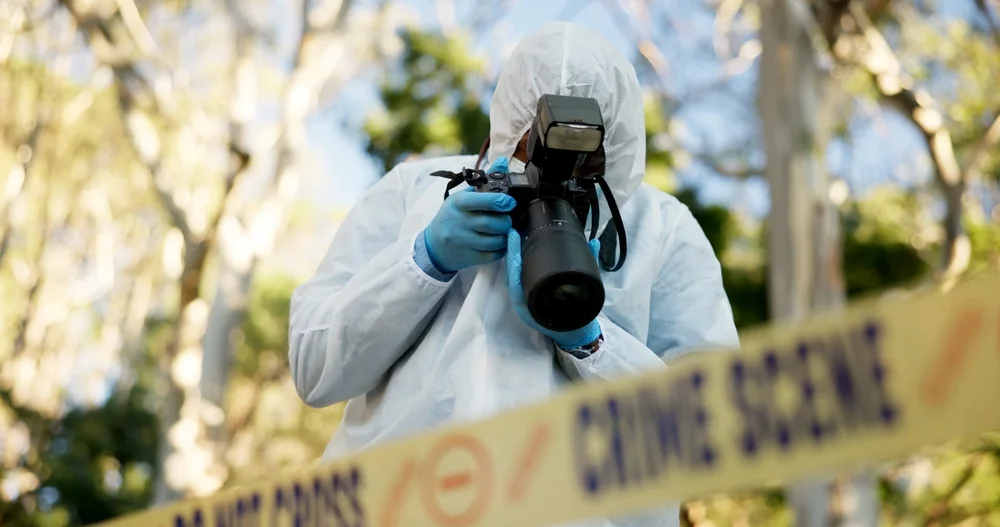
California crime scene investigator pay varies widely by agency, region, classification level, and assigned duties. The best official statewide benchmark is the California Employment Development Department wage estimate for forensic science technicians, a broader occupation that includes both crime-scene personnel and laboratory technicians.
For the first quarter of 2026, the California EDD reported a median wage of $50.46 per hour for forensic science technicians. That converts to approximately $104,957 per year based on 2,080 paid hours.
That figure is a useful statewide reference, but it is not an exact median limited to employees with the title Crime Scene Investigator. California agencies also use titles such as Crime Scene Technician, Crime Scene Specialist, Forensic Specialist, Forensic Evidence Technician, Field Evidence Technician, and Evidence Technician. Some of these employees work primarily at scenes, while others divide their time among scene response, fingerprint processing, evidence handling, laboratory work, autopsy documentation, and courtroom testimony.
California CSI salary snapshot
| Measure | Hourly wage | Annualized wage |
|---|---|---|
| 25th percentile | $39.94 | Approximately $83,075 |
| Median | $50.46 | Approximately $104,957 |
| Mean | $51.87 | Approximately $107,890 |
| 75th percentile | $65.64 | Approximately $136,531 |
The annual figures are calculations based on 2,080 hours. They are not guaranteed annual salaries or published starting rates. EDD’s estimates cover the broader Forensic Science Technicians occupation, SOC 19-4092.
The statewide 25th-to-75th-percentile range is approximately $83,100 to $136,500 annually. It should not be read as a formal progression from entry-level CSI to senior investigator. The data combine workers with different specialties, experience levels, employers, and job designs.
Among the agency recruitments and classifications reviewed, published minimums began at $22.22 per hour in Kern County’s combined Crime Scene Technician I/II recruitment. That rate annualizes to approximately $46,218 at 2,080 hours, but it is a calculation from an hourly rate rather than a guaranteed annual salary. Fresno County’s separate Crime Scene Specialist I recruitment began at $52,702 annually. At the other end of the reviewed examples, certain classifications in higher-paying jurisdictions exceeded $125,000, while senior and supervisory schedules reached still higher levels. Combined I/II ranges do not represent one uniform starting schedule, so applicants need to distinguish the first-level range from the journey-level range.
Why there is no single California crime scene investigator salary
No official statewide wage series isolates employees whose exact title is Crime Scene Investigator. EDD and the U.S. Bureau of Labor Statistics place crime-scene personnel within the larger forensic science technician occupation.
The BLS description of forensic science technicians includes workers who collect and analyze evidence. Some work at crime scenes, while others spend most of their time in laboratories. Combining these roles produces better statewide statistical coverage, but it also means the reported wage includes more than civilian field investigators.
Local government classification systems add another layer. Agencies use different titles for similar assignments, and the same title can refer to different work.
An Evidence Technician in one department may concentrate on property-room intake and chain-of-custody records. An Evidence Technician elsewhere may photograph scenes, recover latent prints, collect biological material, perform gunshot-residue testing, prepare diagrams, and testify in court. Salary comparisons based on titles alone can therefore be misleading.
California also has both civilian and sworn crime-scene staffing models. Many CSI classifications are explicitly non-sworn. Other departments assign police officers to crime-scene duties. A sworn officer usually remains under the applicable police classification and compensation structure rather than a civilian CSI salary schedule.
The most useful salary analysis combines three sources of information:
- Statewide occupational wage estimates
- Regional occupational estimates
- Agency salary schedules for classifications that perform substantial crime-scene work
Together, these sources show the likely pay environment more accurately than any single statewide number.
Statewide wage data in context
EDD’s first-quarter 2026 estimate places California’s forensic science technician median at $50.46 per hour. The mean is slightly higher at $51.87 per hour.
EDD updated these wage figures to first-quarter 2026 using the U.S. Department of Labor Employment Cost Index. The underlying occupational employment estimates are for May 2025. EDD also states that these figures are not prevailing-wage determinations.
The distinction between mean and median is useful. The median identifies the point at which half of estimated workers earn less and half earn more. The mean averages all reported wages and can be pulled upward by highly paid specialists, senior employees, and workers in expensive labor markets.
For comparison, the national median for forensic science technicians was $72,060 in May 2025, according to BLS. California’s annualized occupational median is substantially higher, but the difference does not reveal how far that income goes after housing, transportation, taxes, and other regional expenses. It also does not establish that a newly hired California CSI will begin near $105,000.
Public employers commonly publish a range containing multiple salary steps. A person may enter at a lower step and advance according to an agency’s compensation rules, labor agreement, performance standards, and time-in-class requirements. Some employers can appoint above the first step under specified circumstances, but the full advertised maximum is not a reliable estimate of starting pay.
Regional forensic science technician wages
California’s labor markets produce meaningful regional differences. First-quarter 2026 EDD median estimates for selected metropolitan areas were:
| California region | Median hourly wage | Approximate annualized median |
|---|---|---|
| Sacramento-Roseville-Folsom | $50.31 | $104,645 |
| Orange County | $50.77 | $105,602 |
| Los Angeles-Long Beach-Glendale | $51.74 | $107,619 |
| San Diego-Chula Vista-Carlsbad | $52.05 | $108,264 |
| San Francisco-San Mateo-Redwood City | $64.92 | $135,034 |
These are occupational medians for forensic science technicians, not advertised starting salaries for a specific CSI classification.
The Los Angeles regional mean was $54.03 per hour, while the median was $51.74. Orange County reported a mean of $48.64 and a median of $50.77. San Diego’s mean was $51.62, close to its $52.05 median. Sacramento reported a $52.10 mean and a $50.31 median.
The San Francisco-San Mateo-Redwood City division had the highest median among these examples at $64.92 per hour. Its 25th percentile was $50.01 and its 75th percentile was $79.31. Those figures show a high-paying regional labor market, but they do not represent all Bay Area classifications or all of Northern California.
Regional occupational data can reflect the local mix of crime-lab analysts, latent-print personnel, experienced forensic specialists, and crime-scene workers. Agency salary schedules remain the better source for evaluating a particular job.
Recent California CSI and forensic technician salary ranges
The following salary information was reviewed on September 25, 2026. Some figures come from standing classification schedules, while others come from 2026 recruitments that may have closed. A standing classification may display an authorized pay range even when the agency is not actively hiring.
| Agency and classification | Published base salary | Level or context |
|---|---|---|
| Kern County Crime Scene Technician I/II | $22.22 to $32.42 per hour | 2026 combined Level I and II recruitment |
| Fresno County Crime Scene Specialist I | $52,702 to $64,038 | 2026 Level I recruitment |
| City of San Bernardino Forensics Specialist I | $56,810.52 to $69,043.92 | Entry or probationary level |
| Stanislaus County Crime Scene Investigator I/II | $61,443.20 to $82,139.20 | 2026 recruitment; CSI I is entry level |
| Riverside County Forensic Technician I/II | $64,313.60 to $108,243.20 | 2026 combined entry and journey range |
| City of Roseville Crime Scene Investigator I | $33.27 to $46.82 per hour | Entry-level classification |
| San Diego County Forensic Evidence Technician | $79,268.80 to $97,468.80 | Sheriff’s Crime Laboratory classification |
| City of Costa Mesa Crime Scene Investigator | $79,980 to $107,172 | 2026 recruitment |
| Contra Costa County Crime Scene Investigator I | $81,332.40 to $101,331.52 | Entry-level, non-sworn classification |
| City of Brea Crime Scene Investigator | $83,691.92 to $107,146.21 | Non-sworn classification |
| City of Fremont Forensics Specialist I | $103,098.01 to $125,316.35 | Entry-level classification in local series |
These ranges are not directly interchangeable. Each reflects local bargaining, regional labor costs, assigned responsibilities, minimum qualifications, and classification design.
Fremont labels Forensics Specialist I as entry level within its series, but the listed salary is considerably higher than entry-level classifications in Fresno County or San Bernardino. “Entry level” describes placement within an agency’s career series. It does not create a uniform statewide pay category.
The Riverside County range requires similar care. Its 2026 recruitment covered both Forensic Technician I and II, and the hiring level was determined by the department. The upper end of the combined $64,313.60 to $108,243.20 range is not an expected starting salary for every new technician.
Kern County provides an example at the lower end of the reviewed evidence. Its 2026 Crime Scene Technician I/II recruitment listed an overall hourly span of $22.22 to $32.42, with separate biweekly schedules for Levels I and II. The $22.22 published minimum annualizes to approximately $46,218 using 2,080 hours, but that conversion is not an employer-stated annual salary. Reading only the broad combined range would also obscure which rates belong to Level I and which belong to Level II.
What agency examples reveal about CSI work and pay
Salary differences are easier to understand after comparing the work behind each title.
Contra Costa County Crime Scene Investigator I
Contra Costa County lists $81,332.40 to $101,331.52 for Crime Scene Investigator I. This is the entry-level class in the county’s CSI series and is expressly non-sworn.
The minimum education includes an associate degree with specified coursework in English, mathematics or statistics, and laboratory chemistry or biology. The science-course requirement separates this classification from positions that accept a general certificate or substitute experience for most college study.
Its salary range is an entry-level schedule within Contra Costa County, not a statewide entry-level benchmark. Local compensation and qualification standards both influence the published amount.
San Diego County Forensic Evidence Technician
San Diego County’s Forensic Evidence Technician schedule lists $79,268.80 to $97,468.80. Although the title does not contain “crime scene investigator,” the duties include crime-scene documentation, photography, fingerprint processing, evidence collection, autopsy attendance, and courtroom testimony.
The classification is allocated to the Sheriff’s Crime Laboratory and may require approximately one week of 24-hour standby each month. Qualifying routes include an associate degree plus an evidence-technology certificate, relevant experience, or evidence-technician experience.
This position shows why searches limited to the exact CSI title miss relevant jobs. It also shows how an employer can combine field response, forensic processing, and testimony within a technician classification.
Roseville Crime Scene Investigator I
Roseville’s entry-level Crime Scene Investigator I schedule lists $33.27 to $46.82 per hour. Duties include processing scenes, collecting evidence, taking photographs, producing diagrams and 3D scans, performing preliminary tests, working with fingerprints, and preparing reports.
The range converts to approximately $69,202 to $97,386 at 2,080 hours, though actual annual compensation depends on paid hours and the city’s payroll structure. The upper rate represents the top of the schedule, not the default new-hire rate.
Fresno County Crime Scene Specialist I
Fresno County’s April 2026 recruitment listed $25.34 to $30.79 per hour, or $52,702 to $64,038 annually.
The work extended beyond basic evidence pickup. Duties included photographing and mapping scenes, collecting evidence, lifting latent prints, documenting autopsies, analyzing bloodstain evidence and bullet trajectories, writing reports, and testifying in court.
Fresno County also used multiple qualification routes. Candidates could qualify through a relevant bachelor’s degree, 60 semester units plus criminal-justice-agency experience, or specified county identification or evidence experience. The structure allowed formal education and directly related work to serve as separate hiring routes.
Riverside County Forensic Technician I/II
Riverside County’s 2026 recruitment listed $30.92 to $52.04 per hour, equivalent to $64,313.60 to $108,243.20 annually, across Levels I and II.
The position included evidence collection, photography, fingerprint work, laboratory processing, autopsy documentation, reports, and testimony. The breadth of those duties makes it more than a narrow scene-photography job. It combines field, laboratory, evidence, and trial-support functions.
Because the posting covered entry and journey levels, its full range is best read as a career-series span rather than a single starting schedule.
Stockton Evidence Technician I
Stockton’s standing Evidence Technician I classification displayed $59,277.75 to $76,092.78 annually. Despite the broad “evidence technician” title, the civilian entry-level position includes scene examination, evidence preservation, photography, latent-print recovery, gunshot-residue testing, scene sketches, reports, and court testimony.
The city allows several qualification combinations, including a relevant bachelor’s degree, an associate degree or college units plus experience, or a high school diploma plus qualifying evidence-handling or photography experience.
Duties carry more weight than job titles in a salary search. A person searching only for “crime scene investigator” could overlook a role involving substantial scene-processing work.
Tulare County Field Evidence Technician II
Tulare County’s Field Evidence Technician II classification displayed $60,748.71 to $74,036.60. It is a non-sworn journey-level role that works in both field and laboratory settings.
The duties include scene documentation, photography, evidence collection, latent-print and DNA processing, fingerprint comparison, reports, testimony, call-outs, and rotating standby. The classification requires an associate degree or 60 relevant college units plus three years of related forensic experience, including one year directly performing crime-scene investigations for a law-enforcement agency.
Its journey-level status and experience requirement are central to interpreting the pay. Comparing it directly with a trainee or first-level classification would overlook the required prior field experience.
Starting salary versus the top of the range
Government salary schedules frequently contain several steps between the published minimum and maximum. The lower number may represent Step 1, while the upper number may represent the final step available to an experienced employee in that classification.
A posting such as $80,000 to $107,000 does not mean every selected candidate can negotiate anywhere within that interval. Appointment rules differ by jurisdiction. The actual hiring step can be influenced by agency policy, directly related experience, internal equity, and collective bargaining provisions.
Three distinctions help interpret a posting:
- Classification minimum: The lowest authorized base rate in the published schedule
- Hiring rate: The rate offered to the selected candidate
- Classification maximum: The highest base step in that classification
Combined recruitments need additional attention. A posting for CSI I/II or Forensic Technician I/II can place two classifications under one advertised span. The minimum may belong to Level I and the maximum to Level II. A candidate hired into the first level may have a much narrower schedule than the headline range suggests.
Classification labels also differ. An agency’s Specialist I may be a trainee or entry classification, while another agency’s Level I may require prior professional experience. The phrase “entry level” can mean entry into that local series rather than entry into forensic work with no prior training.
Base pay is only part of CSI compensation
Crime-scene operations continue outside ordinary business hours. California job specifications document rotating shifts, weekends, holidays, overtime, standby periods, and off-duty call-outs.
Those scheduling demands can affect cash compensation, but only when an employer’s rules provide additional pay. Base salary tables usually exclude at least some forms of premium compensation.
Kern County’s 2026 Crime Scene Technician I/II recruitment offered a documented example: 5 percent additional pay for evening work and 7.5 percent for night work. Applicants also had to be available for any shift in a 24-hour operation.
San Diego County previously advertised a conditional 2.5 percent crime-scene premium, depending on organizational needs. Its technician classification can require approximately one week of continuous standby per month.
Brea’s Crime Scene Investigator classification may require variable shifts, overtime, weekends, holidays, and off-duty response. Irvine’s forensic unit operates 365 days a year and may require overtime, rotating shifts, holidays, weekends, and on-call work.
Possible compensation components include:
- Base salary
- Overtime
- Evening or night-shift differentials
- Standby compensation
- Call-back or call-out pay
- Assignment premiums
- Employer retirement contributions
- Health coverage
- Paid leave
- Negotiated salary increases
Not every agency offers every item, and eligibility can depend on shift, assignment, bargaining unit, or operational need. Comparing two jobs solely by annual base maximum can miss meaningful differences in scheduling and the broader employment package.
On-call work also carries a personal cost. A position with recurring standby may restrict travel and off-duty activities even when no call-out occurs. Higher total earnings from overtime or premiums come with nights, interrupted sleep, holidays, and unpredictable response demands.
Civilian CSI pay versus sworn officer pay
Many California crime-scene jobs are civilian. Contra Costa County’s CSI I and Brea’s Crime Scene Investigator are explicitly non-sworn classifications. Richmond also identifies its Crime Scene Technician as non-sworn.
Richmond’s class specification says supervision may come from a police sergeant or a police officer assigned as a crime scene investigator. That language illustrates two separate employment models within the same operational area: civilian crime-scene technicians and sworn officers given CSI assignments.
A civilian CSI is normally paid according to a technician, specialist, investigator, or forensic classification. A police officer assigned to crime-scene work remains in the officer compensation system unless the agency has a separate arrangement.
Sworn compensation can include elements tied to law-enforcement status, academy completion, peace-officer duties, and police bargaining agreements. It should not be used as the standard salary for a civilian applicant pursuing technical evidence work.
The hiring paths also differ. A civilian position can emphasize evidence recognition, photography, fingerprint recovery, scientific coursework, report writing, and forensic experience. A sworn route requires meeting peace-officer hiring and training standards in addition to obtaining the assignment.
Readers researching the broader occupation can review the main crime scene investigator career guide for more detail on duties, education, and civilian versus sworn pathways.
How experience and specialization affect pay
Advancement is not limited to staying in the same classification until reaching its final salary step. Larger agencies may have separate journey, senior, lead, or supervisory levels.
San Diego County provides a clear example:
| Classification | Published annual salary |
|---|---|
| Forensic Evidence Technician | $79,268.80 to $97,468.80 |
| Senior Forensic Evidence Technician | $92,289.60 to $113,484.80 |
| Supervising Forensic Evidence Technician | $105,601.60 to $129,833.60 |
The senior classification performs complex assignments and provides technical guidance and training. The supervising classification manages personnel, reviews casework, oversees assignments, and handles quality-related responsibilities.
Higher-level work can involve:
- Independently managing complex or major scenes
- Coordinating evidence-processing activities
- Applying advanced photography or imaging methods
- Conducting more difficult latent-print work
- Reviewing technical reports and case documentation
- Training junior employees
- Maintaining quality procedures
- Preparing employees for testimony
- Assigning or supervising casework
- Addressing technical and administrative problems
Specialized ability can support advancement even where it does not produce an immediate pay premium. Friction-ridge examination, forensic photography, chemical evidence processing, 3D scene documentation, bloodstain interpretation, trajectory documentation, and courtroom presentation can qualify an employee for broader duties or a higher classification.
Promotion opportunities depend partly on agency size. A large county laboratory may maintain separate technician, senior, and supervisor classifications. A smaller police department may employ only one or two civilian scene specialists, producing fewer formal promotional levels.
Education requirements and their effect on salary opportunities
The BLS lists a bachelor’s degree as the typical entry-level education for forensic science technicians nationally. California job specifications show a less uniform hiring environment.
Some agencies require or recognize an associate degree, a specialized certificate, specified science coursework, prior evidence experience, or combinations of education and employment. Others provide a bachelor’s-degree route alongside experience-based routes.
Examples include:
- Contra Costa County CSI I requires an associate degree with specified English, mathematics or statistics, and laboratory chemistry or biology coursework.
- San Diego County allows routes involving an associate degree plus an evidence-technology certificate, relevant experience, or evidence-technician experience.
- Fresno County listed routes based on a relevant bachelor’s degree, college units plus agency experience, or qualifying county experience.
- Stockton permits several combinations ranging from a relevant bachelor’s degree to high school completion plus qualifying experience.
- Tulare County’s journey-level Field Evidence Technician II requires college education plus related forensic experience, including direct crime-scene investigation work.
Education does not create a uniform salary premium across agencies. Its practical value is access. A bachelor’s degree and relevant science or forensic training can make a candidate eligible for classifications that would otherwise be closed, including positions with higher pay schedules or more technical duties.
A short CSI certificate can be useful for evidence photography, fingerprints, documentation, and scene-processing methods. It will not satisfy a bachelor’s-degree requirement where one is specified. Likewise, a broad criminal justice degree may provide knowledge of law and procedure but contain less laboratory science than a forensic science or natural science curriculum.
For field CSI work, useful preparation includes photography, evidence recognition and recovery, fingerprint development, scene documentation, chain of custody, report writing, courtroom testimony, and basic scientific methods. Laboratory criminalist positions usually require substantially more chemistry, biology, quantitative analysis, and laboratory coursework. Those are related career paths, but their educational requirements and salary structures are not identical.
Work schedule and conditions behind the salary
Crime-scene pay reflects work that can be physically and psychologically demanding. A scene must be documented when the incident occurs, not at the convenience of a daytime schedule.
BLS reports that crime-scene technicians may work staggered shifts, overtime, or on-call schedules. California agency specifications support that description. Irvine’s forensic unit operates throughout the year, San Diego County uses standby assignments, Kern County requires availability for a 24-hour operation, and Brea may require off-duty response.
The schedule can include:
- Overnight scene response
- Weekend and holiday shifts
- Extended hours at major scenes
- Rotating days off
- Court appearances outside the normal shift
- Standby periods
- Overtime caused by late calls or lengthy processing
- Travel to autopsies, laboratories, or multiple agency facilities
The work itself can involve exposure to decomposing remains, blood, hazardous substances, severe injuries, and emotionally difficult circumstances. Employees also carry responsibility for accurate evidence handling and documentation. Errors can affect criminal investigations and courtroom proceedings.
A higher published salary therefore needs to be evaluated alongside schedule stability, call-out frequency, workload, commute, and assignment breadth. Two jobs with similar base rates can create very different working lives.
California employment outlook
EDD projects that California employment for forensic science technicians will increase from 2,200 jobs in 2022 to 2,600 in 2032. That represents growth of 400 jobs, or 18.2 percent.
EDD projects 3,310 total openings over the ten-year period. Dividing that decade total evenly produces an average of about 331 openings per year, though actual hiring will fluctuate. Total openings include replacement needs as well as newly created positions.
Nationally, BLS projects 13 percent employment growth from 2025 to 2035 for forensic science technicians, with about 2,800 openings per year. The national figures cover the entire country and the broader occupation.
Projected growth does not mean every opening will carry the CSI title. Relevant California vacancies can appear under:
- Crime Scene Investigator
- Crime Scene Technician
- Crime Scene Specialist
- Forensic Specialist
- Forensics Specialist
- Forensic Evidence Technician
- Forensic Technician
- Field Evidence Technician
- Evidence Technician
- Latent Fingerprint Examiner
Searching across these titles produces a more realistic view of the labor market. Duties remain the deciding factor because some evidence technician positions focus mainly on property storage while others perform extensive field investigations.
Public-sector hiring can also be uneven. Agencies may recruit only after a vacancy, budget authorization, retirement, promotion, or expansion. A classification can exist for years without a continuous stream of openings.
How to evaluate a California CSI job announcement
A reliable salary comparison starts with the classification details rather than the largest number in the posting.
Identify the actual level
Look for terms such as trainee, I, II, journey, senior, lead, or supervisor. In a combined I/II recruitment, separate the pay schedule for each level before estimating a likely offer.
Separate base pay from additional compensation
Record the published base rate first. Then identify documented shift differentials, standby pay, premiums, or overtime rules. Do not add optional or conditional premiums to the headline salary unless the assignment qualifies.
Determine whether the position is civilian or sworn
A civilian forensic technician and a sworn police officer assigned to CSI work follow different hiring and compensation systems. Job duties can overlap without making the salary schedules comparable.
Read the duty statement closely
Photography, latent-print processing, evidence recovery, biological-evidence handling, scene diagrams, autopsy response, laboratory processing, and testimony indicate substantial forensic duties. Property intake, storage, release, and inventory work may point toward a different evidence-management role.
Some positions combine both areas. Riverside County’s forensic technician classification, for example, includes field evidence collection, fingerprint work, laboratory processing, autopsy documentation, and courtroom support.
Examine the schedule
A daytime base salary and a rotating-shift base salary may look identical on paper. Nights, holidays, standby, and call-outs change both the working conditions and the possibility of premium compensation.
Compare minimum qualifications
A lower-paying job that accepts limited experience may provide an entry route into the field. A higher-paying entry classification may still demand college science courses, specialized training, or prior technical experience.
Journey-level positions often require direct crime-scene work. Tulare County’s Field Evidence Technician II requires three years of related forensic experience, including one year performing crime-scene investigations for a law-enforcement agency.
Review the whole compensation package
Base salary is central, but public-agency employment may also include retirement contributions, medical coverage, paid leave, and negotiated increases. Compare those elements using the employer’s compensation and benefits documents because contribution rates and employee costs differ.
What is a realistic starting salary?
There is no defensible single starting salary for every California CSI. The reviewed agency evidence supports a broad range.
At the lower end, Kern County’s combined Crime Scene Technician I/II recruitment published a minimum of $22.22 per hour. That equals approximately $46,218 at 2,080 hours, but the annual amount is a calculation rather than a guaranteed salary. The recruitment covered both Levels I and II, so its full $22.22-to-$32.42 range should not be treated as one uniform entry-level schedule.
Fresno County’s separate Crime Scene Specialist I recruitment began at $52,702 annually, while San Bernardino’s Forensics Specialist I schedule began at $56,810.52. Stanislaus County advertised $61,443.20 to $82,139.20 across its CSI I/II recruitment.
Other agencies publish materially higher entry-series rates. Contra Costa County lists $81,332.40 to $101,331.52 for CSI I, while Fremont lists $103,098.01 to $125,316.35 for Forensics Specialist I.
These figures show why the statewide annualized median of approximately $105,000 is not a dependable starting-pay estimate. It reflects the full occupational group, including experienced employees, laboratory personnel, specialists, and workers in higher-paying regions.
A practical target range should come from agencies where the applicant meets the stated qualifications. Someone with limited direct forensic experience should focus on trainee, I-level, or probationary schedules. A candidate with prior scene responsibility, fingerprint work, advanced photography, and courtroom experience may qualify for journey-level classifications.
Location can shift the range substantially, but geography is not the only influence. Fremont’s salary schedule differs from Fresno County’s because of local compensation structures, labor-market conditions, and classification design. The higher salary may also be offset by a higher cost of living.
Practical salary planning for a California CSI career
California’s broader forensic science technician median is about $104,957 annually, based on EDD’s $50.46 hourly estimate and a 2,080-hour conversion. Use that number as a statewide occupational reference, not a promised CSI salary.
For an entry plan, concentrate on three layers of evidence:
- Local entry-class schedules. These provide the most realistic picture of initial base pay.
- Qualification requirements. Education, science courses, certificates, photography skills, and agency experience determine which schedules are accessible.
- Career-series progression. Senior and supervisory classifications show the longer-term earning path more clearly than the maximum step of one entry-level range.
Applicants seeking field crime-scene work should search beyond the exact CSI title and prioritize postings that involve evidence recognition, recovery, photography, fingerprints, documentation, chain of custody, reports, and testimony. Those duties identify the occupation more reliably than the classification name.
The reviewed evidence shows a wider lower end than the statewide median suggests. Published minimums began at $22.22 per hour in Kern County’s combined Crime Scene Technician I/II recruitment, approximately $46,218 at 2,080 hours, while Fresno County’s Level I recruitment began at $52,702 annually. The Kern annual figure is a calculation, and the combined I/II range does not establish one starting schedule for every hire. Higher-paying jurisdictions listed entry-series or front-line classifications above $100,000, and experienced, senior, or supervisory employees can move into higher schedules.
The clearest salary comparison is local and classification-specific. Match the job level, duties, work schedule, and qualification route first. Then compare the base range, salary steps, and documented compensation provisions. That approach produces a more realistic estimate than treating California’s statewide forensic science technician median as the starting salary for every crime scene investigator.