
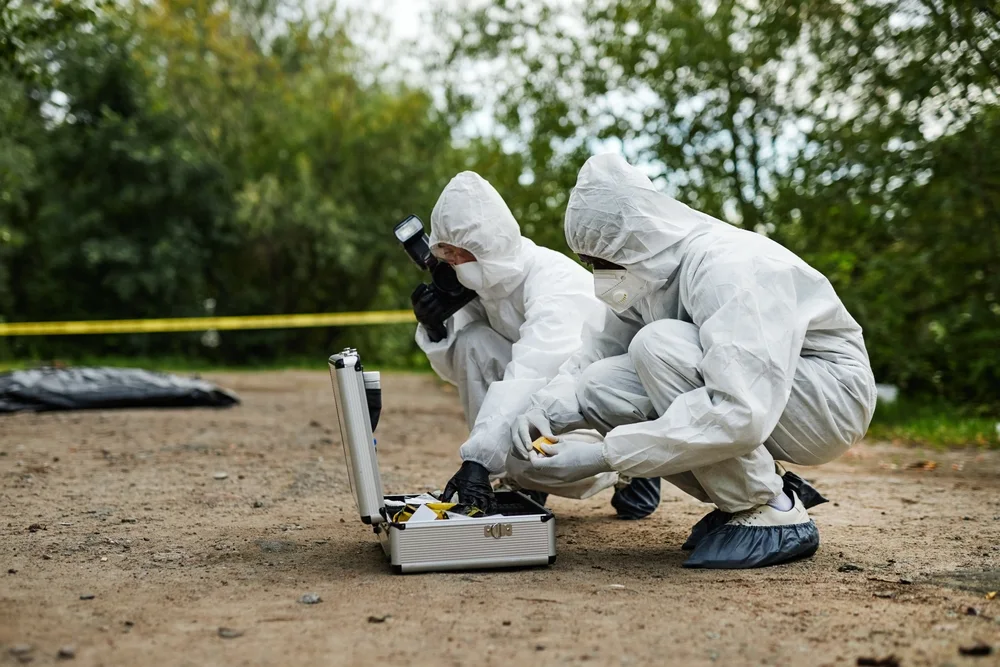
California offers many online master’s degrees in criminal justice, criminology, public administration, and public-safety leadership. Only a small number provide substantial coursework in crime scene investigation or forensic investigation.
That difference should guide the search. A working crime scene investigator seeking promotion may benefit from graduate study in leadership, research, or administration. Someone preparing for initial scene-processing work needs practical instruction in photography, documentation, evidence recovery, fingerprints, and chain of custody. A prospective criminalist or crime-lab analyst usually needs extensive undergraduate chemistry, biology, quantitative analysis, instrumentation, and laboratory coursework.
Among California-based online and primarily online options, Alliant University’s MS in Forensic Science, Investigation, and Technology and National University’s Master of Forensic Sciences contain the most explicit CSI and forensic-investigation curricula. Most of the other programs are better aligned with crime analysis, criminal justice policy, agency management, research, or supervisory advancement.
The 12 active pathways below include fully online degrees, primarily online degrees with required travel, and one program whose laboratory attendance varies by specialization. None is currently identified in the official FEPAC directory as a FEPAC-accredited program.
California online criminal justice and CSI master’s degrees compared
Costs below use each institution’s published terminology. A calculated base tuition figure does not include every fee, book, supply, residency, or travel expense.
| School and program | Degree and units | Delivery | Published cost information | CSI alignment | Travel or laboratory requirement |
|---|---|---|---|---|---|
| CSU Long Beach MS in Criminology and Criminal Justice | MS, 36 units | Fully online, generally asynchronous | $675 per unit; stated 2026-27 program price of $24,300 | Strong option for crime and intelligence analysis, not physical scene processing | No campus visits |
| CSU San Bernardino MA in Criminal Justice | MA, at least 34 units | Described as fully online | CSU graduate tuition and fees vary | Research, policy, policing, corrections, and administration | Confirm that preferred electives are available online |
| San Jose State MS in Criminology, Global Criminology Concentration | MS, 30 units | Fully online, asynchronous | $749 per unit for Spring 2027 | Comparative justice, research, policy, and some cyber-forensics coursework | No documented campus residency |
| California Baptist University MS in Criminal Justice | MS, 30 units | Fully online and asynchronous | $675 per unit; calculated base tuition of $20,250 before fees | Includes investigations, crime analysis, mapping, and evidence concepts | No documented physical CSI laboratory |
| USC MS in Criminal Justice | MS, 24 units | Online; one-year and two-year tracks | Estimated 2026-27 tuition of $60,936; $62,922 including listed materials and graduate fees | Policy, statistics, technology, leadership, and administration | No documented scene or laboratory residency |
| UC Irvine Master of Advanced Study in Criminology, Law and Society | MAS, 52 quarter units | Primarily asynchronous online | 2026-27 academic-year program fee of $17,188, plus $90 access fee | Research, policing strategy, policy, crime hotspots, and leadership | Five-day introductory campus course is currently optional |
| National University Master in Criminal Justice Leadership | Master’s, 33 credits | Online | $716 per credit; estimated program cost of $23,667 | Management, policy, constitutional law, and agency leadership | No documented CSI residency or laboratory |
| University of San Diego MS in Law Enforcement and Public Safety Leadership | MS, 31 units | Fully online, one seven-week course at a time | $729 per unit; calculated base tuition of $22,599 | Supervisory and command preparation for experienced professionals | No CSI laboratory |
| Alliant University MS in Forensic Science, Investigation, and Technology | MS, 33 units | Online with required residencies | $580 per unit; calculated base tuition of $19,140 before fees and travel | Direct concentrations in crime scene investigation, criminalistics, and intelligence analysis | Two on-site weekend residencies and a thesis |
| California Coast University MS in Criminal Justice | MS, 39 units | 100 percent online and self-paced | $250 per unit; calculated base tuition of $9,750 before fees and books | General criminal justice administration and theory | No residency, internship, or physical evidence laboratory documented |
| National University Master of Forensic Sciences | Master of Forensic Sciences, 36 credits | Online, in person, or hybrid depending on specialization and course | Estimated program cost of $25,830 | Direct investigation and criminalistics specializations | Some Criminalistics courses may require in-person laboratory participation |
| CSU Dominguez Hills MPA, Criminal Justice Policy and Administration concentration | MPA, 42 units | Fully online and asynchronous | $630 per unit; estimated tuition of $26,460 before books and course expenses | Public administration, police administration, policy, and budgeting | No forensic laboratory or scene practicum |
These are not 12 versions of the same degree. Their curricula lead toward substantially different forms of work. The broader criminal justice degree guide for California provides additional context on degree levels and occupational alignment.
The most CSI-focused online options
Alliant University MS in Forensic Science, Investigation, and Technology
Alliant offers a 33-unit master’s degree with three concentrations: Crime Scene and Incident Investigation, Criminalistics and Technology, and Criminal Investigative Intelligence and Analysis. The Crime Scene and Incident Investigation concentration has the clearest connection to field-based CSI work. The curriculum addresses evidence collection, investigative methods, technology, law, ethics, and related forensic subjects.
The degree is online but not travel-free. Students complete two on-site weekend residencies involving simulations and laboratory work. A research thesis is also required. Those requirements create a different experience from an asynchronous criminal justice degree with no practical component. They also add costs beyond tuition, including transportation, lodging, meals, and time away from work.
For 2026-27, Alliant publishes an online rate of $580 per unit. Multiplying that rate by 33 units produces $19,140 in base tuition. Institutional fees, books, supplies, and expenses associated with both residencies are separate.
The concentration decision deserves careful attention. Crime Scene and Incident Investigation is the logical match for evidence recognition, documentation, and scene work. Criminal Investigative Intelligence and Analysis is more closely connected to information assessment, mapping, threats, and investigative intelligence. Criminalistics and Technology addresses scientific evidence topics, but applicants pursuing crime-lab work still need to review the science courses on their undergraduate transcripts.
California’s state Criminalist classification requires a physical or biological science major and specified preparation that includes general chemistry and quantitative analysis. A graduate concentration with criminalistics in its title does not automatically replace those undergraduate requirements.
Alliant is institutionally accredited, but its program is not listed in the current FEPAC directory. It should not be described as FEPAC-accredited.
National University Master of Forensic Sciences
National University’s 36-credit Master of Forensic Sciences has two specializations, Investigation and Criminalistics. Its core covers crime scene investigation, fingerprint analysis, digital evidence, forensic pathology, forensic anthropology, law and criminal procedure, and supervised research.
The Investigation specialization is the more direct match for field investigators. It addresses advanced investigation and subjects connected to evidence documentation, fingerprints, death investigation, and digital evidence. Unlike the Criminalistics specialization, it does not specify a particular undergraduate major.
Criminalistics adds coursework in serology and DNA, toxicology, trace evidence, and advanced criminalistics. Admission to that specialization normally requires an undergraduate degree in a physical, biological, or laboratory science unless the program director approves an exception. That requirement reflects the scientific foundation needed for laboratory study.
Delivery requires close review. National University markets the degree as an online graduate option, but the current program information says delivery varies by specialization and that some Criminalistics courses may require in-person laboratory participation. Applicants should obtain a course-by-course completion plan before enrolling, especially if travel is difficult or if they live outside the area where laboratory sections are available.
A supervised research project is required. National University estimates the program cost at $25,830 for 36 credits, based on its published tuition and course-material charges.
This degree is not listed as FEPAC-accredited. It may still provide relevant graduate education, but applicants should evaluate it against the precise requirements of target employers. A graduate course in DNA or toxicology does not necessarily compensate for missing undergraduate organic chemistry, quantitative chemistry, molecular biology, or laboratory credits.
General criminal justice degrees with investigation or analysis relevance
CSU Long Beach MS in Criminology and Criminal Justice
CSU Long Beach’s 36-unit MS is fully online, generally asynchronous, and requires no campus visits. The normal schedule takes 24 months, with an accelerated 16-month route available. The next published cohort begins in Fall 2027, and the program currently limits enrollment to California residents.
Core study includes criminological theory, advanced research methods, statistics, criminal justice policy, and law and social control. The Crime and Intelligence Analysis concentration adds GIS, mapping, social-network analysis, intelligence analysis, and directed research.
That concentration is relevant to crime analysts, intelligence analysts, and professionals who use data to identify locations, patterns, associations, or emerging problems. Crime analysis is not crime scene investigation. Analysts usually work with records, calls for service, geographic information, intelligence, and statistical patterns. CSIs document scenes and recover physical evidence.
The program does not require a physical evidence laboratory or scene-processing residency. It therefore provides limited practice with photography, measurement, latent-print processing, packaging, contamination control, or evidence collection. Its stronger applications are analytical work, research, policy evaluation, and advancement within justice agencies.
Applicants normally need a 3.0 GPA in the last 60 semester units. Additional review may be possible for GPAs from 2.75 to 3.0. Application materials include transcripts, a resume or CV, statement, recommendations, and a writing sample or qualifying test scores. Applicants complete both Cal State Apply and a separate program application.
The published 2026-27 price is $675 per unit and $24,300 for the program, excluding books, software, and other materials.
California Baptist University MS in Criminal Justice
California Baptist University offers a 30-unit online MS that can be completed in 12 months on the advertised full-time schedule. Courses are accelerated and asynchronous.
The curriculum includes criminal investigations, crime analysis and mapping, advanced criminal law, criminal behavior, leadership, organizational subjects, and a capstone. The investigations course addresses scene preservation, evidence collection, interviews, search and seizure, and report preparation. Compared with many general criminal justice programs, it gives investigation a more visible place in the curriculum.
The program does not document a required physical CSI laboratory, internship, or campus residency. Topics such as evidence collection can be taught conceptually online, but proficiency usually requires supervised practice. Handling a camera under difficult lighting, measuring a scene, developing latent prints, packaging biological evidence, and maintaining contamination controls involve physical skills and agency procedures.
Applicants need a bachelor’s degree. The published GPA guideline is 2.75, and an interview or statement is part of the admission process.
Tuition is listed at $675 per unit. That produces calculated base tuition of $20,250 for 30 units, before university fees and other costs. The program can support investigative knowledge and professional advancement, but applicants seeking initial CSI employment should plan separately for practical training.
CSU San Bernardino MA in Criminal Justice
CSU San Bernardino describes its MA in Criminal Justice as fully online. The degree requires at least 34 semester units and includes research techniques, statistics, criminological theory, policing or corrections, and program planning and evaluation.
Students finish with either a thesis and oral defense or a comprehensive examination. The thesis route may serve someone planning doctoral study, research work, policy evaluation, or an academic career. The comprehensive examination offers a non-thesis completion path.
Admission normally requires a 3.0 GPA. The expected academic background includes preparation in criminology, law enforcement, corrections, research methods, and statistics. Applicants submit transcripts, recommendations, and a personal statement. A GRE score may be requested when an applicant falls below the stated GPA standard.
The curriculum is oriented toward research, public service, policy, policing, corrections, and administration. It does not document a required scene-processing residency, forensic internship, or laboratory sequence.
Current university materials indicate that required criminal justice courses are available online, while language concerning elective delivery has varied. Anyone dependent on fully remote completion should ask the department to confirm that the electives needed for the intended plan will be offered online.
California Coast University MS in Criminal Justice
California Coast University provides the most flexible schedule and lowest published calculated base tuition in this group. Its 39-unit MS is 100 percent online, self-paced, and not organized around traditional semesters. Students may start throughout the year and complete 13 courses followed by a comprehensive examination.
Course subjects include criminological theory, criminal justice administration, multicultural issues in law enforcement, computer crime, supervision, police management, criminal justice policy, terrorism, corrections, deviant behavior, and research. The curriculum is centered on justice-system theory and administration rather than technical evidence work.
No internship, live class meeting, campus residency, physical evidence laboratory, or thesis is documented. That design can work for employed professionals who need schedule flexibility, but it provides little direct preparation in scene photography, fingerprint processing, evidence packaging, reconstruction, or forensic laboratory methods.
Master’s tuition is $250 per semester unit. Base tuition for 39 units calculates to $9,750. A $75 application or registration charge and textbook expenses are separate. Certain law-enforcement, government, military, firefighter, alumni, and corporate-partner students may qualify for a 10 percent tuition discount under current terms.
California Coast University is institutionally accredited by the Distance Education Accrediting Commission and approved to operate by California’s Bureau for Private Postsecondary Education. Institutional accreditation is different from FEPAC programmatic accreditation. The MS in Criminal Justice is not identified as FEPAC-accredited.
Public admission information calls for an application, official transcripts, a resume, and evaluation of previous education and specialized training. The university does not publish a program-specific graduate GPA threshold on the cited admissions page.
Criminology, policy, and research programs
San Jose State University MS in Criminology, Global Criminology Concentration
San Jose State’s 30-unit online MS uses asynchronous special-session courses and normally takes two years. Fall and spring entry options are advertised.
The Global Criminology concentration covers comparative criminal justice, applied research, statistics, international criminology, terrorism, human rights, policing, immigration law, cyber forensics, and an applied project. Its perspective is international and comparative rather than centered on California crime scene operations.
The inclusion of a cyber-forensics course should not be read as preparation for every digital evidence role. Technical digital forensics can require operating systems, networks, file systems, scripting, forensic imaging, tool validation, and laboratory procedures. One related course within a criminology degree does not create the same preparation as a computer science or dedicated digital forensics program.
The degree can support careers involving policy, program analysis, international justice, research, or comparative criminology. No physical evidence laboratory, evidence-collection residency, or scene-processing sequence is documented.
The published Spring 2027 rate is $749 per unit. Prospective applicants should use the current per-unit figure and request a written total from the university, since older displayed totals have not always aligned with the present rate multiplied by 30 units.
UC Irvine Master of Advanced Study in Criminology, Law and Society
UC Irvine’s Master of Advanced Study requires 52 quarter units across 13 courses. The primarily asynchronous program runs for two years over six quarters. A five-day introductory campus course is currently optional.
Coursework can include criminology, policing, research methods, applied statistics, crime hotspots, corrections, policy, leadership, cybercrime, and errors of justice. Students also complete a capstone.
This degree is suited to research, evidence-based policy, policing strategy, evaluation, and analytical leadership. Crime-hotspot analysis, for example, concerns geographic patterns and resource decisions. It does not teach the complete field process for documenting an individual crime scene.
No required evidence laboratory, scene-processing practicum, or internship was identified. Applicants need a bachelor’s degree and submit statements, a writing sample, recommendations, and transcripts. The GRE is not required.
For 2026-27, UCI publishes a $17,188 program fee plus a $90 student-services access fee. Those figures cover the academic year, not a verified two-year total. Applicants should review fees for each year of attendance rather than doubling the current amount without confirming future charges.
USC MS in Criminal Justice
USC’s Bovard College offers a 24-unit online MS in Criminal Justice with one-year and two-year completion tracks. Fall, spring, and summer starts are available.
The curriculum emphasizes criminology, statistics, research evaluation, policy, ethics, leadership, organizational change, technology, and justice-system administration. It is designed largely around professional and organizational decision-making rather than physical evidence processing.
There is no documented crime scene residency, forensic laboratory sequence, or required thesis. The degree has clearer relevance to administration, program evaluation, policy development, and leadership than to entry-level CSI training.
Applicants need a bachelor’s degree and submit a resume, statement, transcripts, and recommendations. USC does not require the GRE. The application fee is $120.
For 2026-27, USC estimates tuition at $60,936. Its published estimate rises to $62,922 after the listed materials and graduate student fees. This is the highest published program estimate among the options reviewed here, so applicants should connect that expense to a specific professional objective rather than assuming that a higher-priced master’s will carry more weight in CSI hiring.
Leadership and public administration degrees
National University Master in Criminal Justice Leadership
National University’s 33-credit Master in Criminal Justice Leadership is separate from its Master of Forensic Sciences. The leadership program is online and covers criminal justice administration, organizational management, constitutional law and procedure, policy, criminological theory, and qualitative and quantitative research.
No CSI residency, field practicum, evidence laboratory, or internship is documented. The degree is aligned with management, policy, training, administration, and organizational advancement.
National University publishes a 24-month average completion period while also advertising faster possibilities. The actual timeline depends on course load and scheduling. Tuition is $716 per credit, and the current estimated program cost is $23,667.
Applicants need a bachelor’s degree and must satisfy the university’s graduate admission standards. National University advertises no application fee, essay, or entrance examination for this program.
A prospective CSI comparing National University’s two graduate degrees should focus on curriculum rather than the shared institution. Criminal Justice Leadership addresses organizations and management. The Master of Forensic Sciences addresses crime scenes, fingerprints, digital evidence, pathology, anthropology, and criminalistics subjects.
University of San Diego MS in Law Enforcement and Public Safety Leadership
The University of San Diego’s 31-unit online MS is built for experienced public-safety professionals. Applicants normally need two years of work in public safety, law enforcement, the military, or a related area.
Courses run one at a time in seven-week terms. The program normally takes about 20 months and addresses leadership, policy, constitutional law, data, technology, budgeting, community engagement, communication, conflict resolution, and a capstone.
The degree does not include a CSI laboratory or evidence-processing practicum. Its intended use is supervisory, administrative, or command development. An experienced civilian forensic investigator moving toward unit supervision may find the management curriculum applicable. Someone trying to learn initial evidence-collection procedures would need a different educational or training source.
The published GPA guideline is 2.75. Admission materials include a resume, statement, transcripts, and a professional support letter. Certain qualifying executive law-enforcement training may be eligible for transfer credit.
At $729 per unit, calculated base tuition is $22,599 before additional expenses.
CSU Dominguez Hills MPA with a Criminal Justice Policy and Administration concentration
CSU Dominguez Hills offers a 42-unit online Master of Public Administration with a nine-unit criminal justice concentration. Current university pages use both “Criminal Justice Policy and Administration” and “Criminal Justice Administration and Policy,” so applicants should follow the title displayed in the current application system.
The accelerated online format is asynchronous and uses sequential eight-week courses. Expected completion takes approximately 2.5 years.
Core MPA study includes public administration, management, policy analysis, research methods, quantitative methods, budgeting, ethics, and a capstone. Concentration choices include advanced criminal justice issues, administrative law and policy, police administration and ethics, and homeland security and terrorism.
This is a public-administration degree, not a technical forensic science program. It can apply to police administration, justice policy, government budgeting, program management, and supervisory work. It does not require scene processing, evidence collection, forensic science, or laboratory study.
The 2026-27 rate is $630 per unit. CSUDH estimates program tuition at $26,460, excluding books and course-related expenses. The application fee is $70.
Applicants normally need a 3.0 GPA in the last 60 semester units or a 2.75 cumulative GPA. Required materials include a resume or CV, personal statement, and official transcripts.
Match the degree to the actual occupation
“CSI” is often used as an umbrella term, but California agencies do not use forensic job titles consistently. A crime scene investigator may be a civilian employee in one department and a sworn assignment in another. Requirements also change by level, agency, and duty.
Before choosing a degree, identify the work itself.
Crime scene investigator or forensic investigator
Typical duties can include scene photography, diagrams, measurements, evidence recognition, evidence collection, packaging, latent-print work, documentation, report writing, and courtroom testimony.
An official City of Sacramento Forensic Investigator classification includes photography, evidence evaluation and collection, diagrams, and latent-print responsibilities. West Sacramento’s CSI I classification lists a high school diploma or equivalent as its education requirement, with experience becoming more significant at higher levels. These examples show why no single statewide education formula can be applied to every CSI opening.
A master’s degree is often optional. Practical training, relevant experience, a suitable undergraduate background, and performance during agency training may matter more for entry-level hiring.
Crime analyst or intelligence analyst
Crime analysts work primarily with data rather than physical evidence. Their tools may include statistics, GIS, mapping, databases, link analysis, trend analysis, and intelligence products.
CSU Long Beach’s Crime and Intelligence Analysis concentration is the clearest match among the general criminal justice programs because it combines statistics with GIS, mapping, social-network analysis, and intelligence analysis. A CSI applicant should not assume that crime-analysis training covers scene processing, and a crime-analysis applicant does not necessarily need a forensic laboratory curriculum.
Criminalist, forensic scientist, or crime-lab analyst
These roles apply laboratory science to evidence. Depending on the assignment, work may involve controlled substances, toxicology, trace evidence, firearms, biology, DNA, or other specialties.
California’s entry Criminalist classification requires a physical or biological science major. The state also specifies coursework including general chemistry and quantitative analysis. Laboratory employers may expect additional organic chemistry, analytical chemistry, molecular biology, statistics, instrumentation, and hands-on laboratory experience.
A general criminal justice master’s does not document this preparation. Even a forensic science master’s may leave an applicant ineligible when required undergraduate science courses are missing.
Evidence or property technician
Evidence technicians may receive, inventory, store, release, transport, and document evidence. Some positions also assist with collection or processing. Chain of custody, secure storage, information systems, safety procedures, and agency policy can be central to the job.
An administrative criminal justice degree may support later advancement, but a master’s is rarely the only or primary requirement for entry into property and evidence work.
Latent print examiner
Latent-print work can include developing impressions, documenting results, comparing prints, using databases, writing reports, and testifying. Some agencies separate scene-based print processing from laboratory comparison work.
National University’s forensic master’s includes fingerprint analysis, while Alliant includes evidence and forensic investigation subjects. Applicants should still ask how much supervised comparison practice occurs and whether the curriculum aligns with the training standards used by the target agency.
Digital evidence specialist
Digital evidence is a technical discipline involving the preservation, acquisition, examination, and reporting of information from computers, mobile devices, networks, or cloud systems. A criminology course in cybercrime or cyber forensics may provide context without teaching full forensic acquisition and validation procedures.
Anyone targeting a technical digital laboratory should compare computer science prerequisites, operating-system study, scripting, forensic tools, hardware access, laboratory exercises, and internship opportunities. None of the broad criminal justice degrees should automatically be treated as a complete digital forensics qualification.
Public-safety supervisor or administrator
Leadership programs are built around personnel, budgets, policy, ethics, law, technology, and organizational change. USD, National University’s Criminal Justice Leadership program, USC, and the CSUDH MPA fit this category more closely than they fit technical CSI preparation.
These degrees may support an established professional seeking supervisory responsibilities. They are less suitable as substitutes for basic scene-processing or forensic laboratory training.
What online coursework cannot fully replicate
Online study can deliver theory, legal analysis, report-writing instruction, statistics, research, policy, mapping, and case-based exercises effectively. Physical forensic skills need equipment, repeated practice, feedback, and controlled procedures.
Scene photography involves more than learning camera terminology. Investigators must manage scale, perspective, exposure, low light, overall and close-up views, and accurate documentation without disturbing evidence.
Evidence recovery requires correct tools and packaging. Biological material, trace evidence, firearms, wet items, volatile substances, and sharps cannot all be handled or packaged in the same way. Contamination controls and personal protective equipment must become routine rather than remain abstract concepts.
Latent-print processing involves selecting suitable methods for different surfaces, controlling chemicals or powders, photographing results, and preserving usable impressions. Laboratory criminalistics adds instrument operation, quality assurance, method validation, calibration, and scientific interpretation.
Alliant addresses part of this limitation through two on-site weekend residencies. National University warns that some Criminalistics courses may require in-person laboratory participation. General criminal justice programs in the list do not document equivalent physical training.
Applicants without previous CSI experience can supplement an online degree through an internship, agency academy, supervised employment, community college laboratory course, professional workshop, or another verified hands-on program. Availability varies, and no short workshop guarantees employment. The goal is to avoid graduating with extensive theory but no supervised experience using basic field or laboratory procedures.
Accreditation and FEPAC
Institutional accreditation applies to the college or university. Programmatic accreditation evaluates a specific academic program under standards for a particular field. They are not interchangeable.
The Forensic Science Education Programs Accreditation Commission accredits eligible forensic science programs and certain related natural-science or computer-science programs. Broad degrees in criminal justice, criminology, public administration, and law-enforcement leadership generally fall outside its scope.
None of the 12 California-based online or primarily online programs listed here appears in the current FEPAC directory. That includes the two forensic-focused degrees at Alliant and National University. They may be described as institutionally accredited programs, but not as FEPAC-accredited programs.
FEPAC is more relevant when comparing forensic science or criminalistics degrees intended for laboratory practice. It is not an appropriate automatic test for an MPA, public-safety leadership program, or criminology degree.
UC Davis has a current FEPAC-accredited MS in Forensic Science, but it is an on-campus program. It therefore does not belong in the main online comparison.
Admissions and prerequisite planning
Admissions requirements reflect each program’s purpose.
Research-oriented programs commonly request a statement, recommendations, transcripts, and evidence of writing or quantitative preparation. Leadership programs may value professional experience. Technical forensic study may require an undergraduate science degree or specific laboratory courses.
A few examples show the range:
- CSULB normally expects a 3.0 GPA in the last 60 semester units, though applicants between 2.75 and 3.0 may receive additional review.
- CSUSB normally uses a 3.0 GPA threshold and expects background in criminal justice subjects, research methods, and statistics.
- California Baptist University publishes a 2.75 GPA guideline.
- USD normally asks for two years of relevant public-safety, military, law-enforcement, or related experience.
- National University’s Criminalistics specialization normally requires a physical, biological, or laboratory science degree unless an exception is approved.
- California Coast University reviews transcripts, a resume, and specialized training but does not publish a program-specific graduate GPA threshold on its public admissions page.
Applicants planning laboratory careers should conduct a transcript audit before applying. List every course in general chemistry, organic chemistry, quantitative or analytical chemistry, biology, molecular biology, physics, calculus, statistics, and laboratory methods. Record whether each course included a laboratory and how many units it carried.
Then compare that list with the exact minimum qualifications in current job announcements. Do not rely on a program title or an admissions representative’s general description of career outcomes.
Comparing costs accurately
Published prices in this group range from calculated base tuition of $9,750 at California Coast University to more than $60,000 at USC. Those figures do not always measure the same expenses.
A useful comparison should separate:
- Tuition or per-unit charges
- Mandatory university and program fees
- Books, software, and laboratory materials
- Travel and lodging for residencies
- Lost work time
- Annual fee increases during a multiyear program
- Estimated cost of attendance, which may include personal living expenses
California Coast University’s $9,750 is calculated base tuition for 39 units at $250 per unit. It excludes fees and books. Its curriculum is also general criminal justice rather than technical CSI.
Alliant’s $19,140 is calculated base tuition for 33 units at $580 per unit. It excludes institutional fees and the expense of attending two on-site residencies.
UCI’s $17,188 figure is an academic-year program fee, not a confirmed full two-year price. USC’s $62,922 estimate includes its listed materials and graduate fees. CSUDH describes $26,460 as estimated tuition for the full 42-unit MPA, excluding books and course-related items.
A lower-cost program can be appropriate when the curriculum meets a defined goal. It is not automatically a bargain if it lacks the science, analysis, practical training, or professional focus needed for the intended occupation.
California alternatives that are not fully online
Several California degrees may appear during a search but should not be placed in a table of fully online programs.
The UC Davis MS in Forensic Science is FEPAC-accredited and campus-based. It may be relevant to applicants who prioritize accredited forensic science study and can attend in person.
Cal State LA’s MS in Criminalistics remains active and accepts fall applications. It is associated with the California Forensic Science Institute and the Hertzberg-Davis Forensic Science Center. Current official pages do not describe the degree as online, and it is not listed in the current FEPAC directory. Historical references to former FEPAC accreditation should not be presented as current status.
Stanislaus State offers an active hybrid MA in Criminal Justice. A hybrid degree may reduce campus attendance, but it should not be represented as fully online.
San Diego State’s MS in Criminal Justice and Criminology and Fresno State’s MS in Criminology are active, but their official program pages do not verify online delivery.
Sacramento State’s MS in Criminal Justice should not be listed as an available option because admissions are currently suspended.
Online master’s degrees in forensic psychology at institutions such as UC Irvine and Touro University Worldwide are also separate from CSI education. Forensic psychology focuses on psychology, law, behavior, mental health, assessment, and related research. It does not train students in scene photography, physical evidence collection, criminalistics, or laboratory analysis.
A practical selection framework
Begin with the job description rather than the degree title.
Choose a forensic investigation pathway when the objective involves scene documentation, evidence collection, fingerprints, death investigation, or related field work. Alliant’s Crime Scene and Incident Investigation concentration and National University’s Investigation specialization provide the most directly related graduate curricula among the California-based online options. Compare their hands-on requirements carefully.
Choose a crime-analysis pathway when the work involves GIS, mapping, intelligence, statistics, and patterns. CSULB offers the most clearly defined concentration in this area.
Choose a criminology or policy program when the goal involves research, program evaluation, justice policy, policing strategy, or doctoral preparation. CSUSB, SJSU, UCI, USC, and other research-oriented criminal justice degrees address these areas in different ways.
Choose leadership or public administration when the applicant already works in public safety and wants to move toward supervision, budgeting, policy, training, or command. USD, National University’s Criminal Justice Leadership degree, and the CSUDH MPA are designed around those responsibilities.
For crime-lab employment, start with science prerequisites. Neither an online criminal justice degree nor a graduate forensic title guarantees eligibility for California criminalist positions. Chemistry, biology, quantitative analysis, instrumentation, statistics, and laboratory experience remain central.
Finally, verify delivery in writing. Ask whether every required course can be completed online, whether the chosen specialization requires laboratory attendance, where residencies occur, how often travel is required, and which additional fees apply. “Online” can mean fully remote, mostly remote with scheduled residencies, or online except for specialization-specific laboratory courses. That difference can change both the total cost and the feasibility of finishing the degree.