
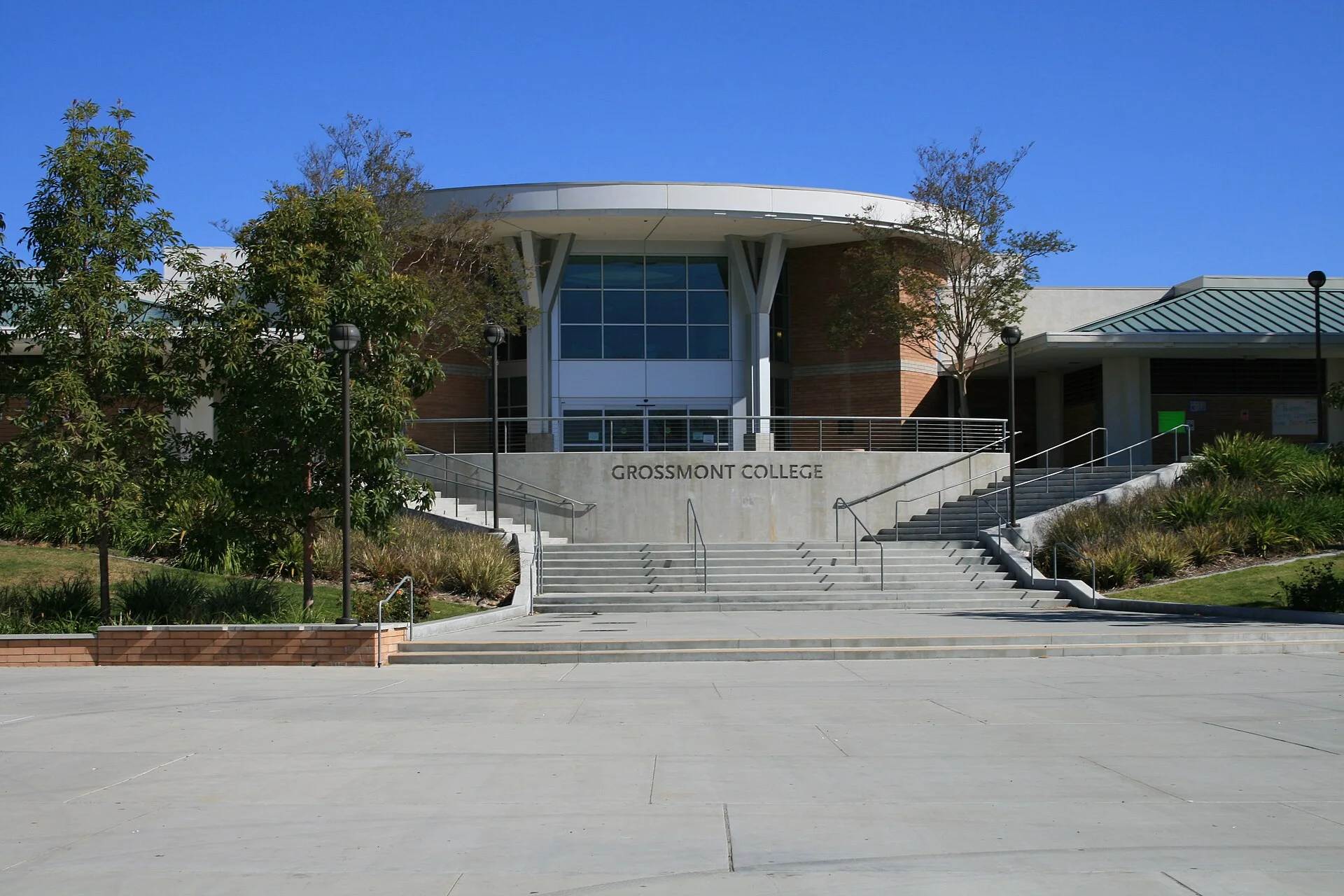
Grossmont College in El Cajon offers a focused, applied route into crime-scene processing, forensic photography, fingerprint identification, and evidence work. Its direct forensic offering is a single 42-unit Forensic Technology curriculum that leads to either an Associate in Science or a Certificate of Achievement.
This is primarily a field CSI and identification program, not a laboratory criminalistics degree. Required courses cover simulated crime scenes, evidence processing, advanced photography, fingerprint comparison, biology, and chemistry. The curriculum aligns most closely with crime-scene technician, evidence technician, forensic photographer, fingerprint examiner, latent print examiner, and related positions.
Grossmont also offers chemistry credentials with substantially more laboratory science. Those are relevant to students planning to transfer into a chemistry or other physical-science bachelor’s program before pursuing laboratory criminalist work. They are not forensic science degrees, but they provide more of the chemistry, mathematics, instrumentation, and laboratory foundation expected in that career path.
Grossmont’s forensic and related credentials
| Credential | Units | Primary focus | Best-aligned path |
|---|---|---|---|
| Forensic Technology Associate in Science | 42-unit major; at least 60 total units | Crime scenes, fingerprints, forensic photography, evidence analysis | Field CSI, evidence, latent prints, forensic photography |
| Administration of Justice: Forensics Technology Certificate of Achievement | 42 | Same forensic major without associate-degree general education | Focused occupational study in crime-scene and identification work |
| Chemistry Associate in Science | 36-unit major plus degree requirements | General chemistry, organic chemistry, mathematics, physics, laboratory methods | Transfer preparation for chemistry and laboratory science |
| Chemistry Certificate of Achievement | 36 | Same chemistry major without associate-degree general education | Concentrated chemistry preparation or transfer coursework |
| Administration of Justice Geospatial Literacy Certificate of Proficiency | 6 | Crime mapping and geographic information science | Crime analysis and investigative mapping |
| Administration of Justice AS-T | At least 60 CSU-transferable units | General criminal justice transfer | CSU criminal justice bachelor’s study |
The first two credentials are Grossmont’s direct forensic options. The chemistry programs, geospatial certificate, and Administration of Justice transfer degree are adjacent pathways with different purposes.
Forensic Technology Associate in Science and Certificate of Achievement
The Forensic Technology curriculum contains 42 units of required major coursework. The Associate in Science adds general education and electives to reach at least 60 total units. The Certificate of Achievement uses the same 42-unit major but does not include the associate degree’s general-education requirements.
The catalog heading uses “Forensic Technology,” while the certificate description calls the award “Administration of Justice: Forensics Technology.” These are not separate forensic certificates. They are two names appearing on the official page for the certificate built from the shared curriculum.
Required study includes:
- Introduction to Administration of Justice
- Fingerprint Identification
- Forensic Photography
- Criminal Law
- Criminal Investigation
- Crime Scene Technology
- Forensic Analysis
- Community and the Justice System
- Advanced Forensic Photography
- Advanced Fingerprint Identification
- BIOL-C1000 with laboratory work
- One approved chemistry course
Older Grossmont pages may refer to the biology requirement as BIO 120. The current 2026-2027 catalog uses the common-course-numbered BIOL-C1000.
All major courses must be completed with a grade of C or higher or Pass. The program also has meaningful course sequencing, so the 42 units cannot be approached as an unrestricted group of electives.
Applied crime-scene and identification training
Grossmont’s main strength is the amount of required practical work in photography, fingerprints, and physical evidence. Several courses combine weekly lecture and laboratory hours.
AOJ 148, Fingerprint Identification, includes two lecture hours and three laboratory hours. Students study fingerprint recording, classification, searching, and individualization. Advanced Fingerprint Identification later addresses friction-ridge comparison and the development and preservation of latent impressions.
The photography sequence is also more extensive than a single introductory survey. AOJ 150, Forensic Photography, includes three lecture and three laboratory hours and uses simulated crime scenes. AOJ 252 adds advanced forensic photography with another three lecture and three laboratory hours.
Crime Scene Technology follows introductory photography. It addresses evidence recognition, scene preservation, photography, sketching, processing methods, and preparation for courtroom presentation. Forensic Analysis then moves into subjects such as trace evidence, bloodstain patterns, impression evidence, firearms, ballistics, questioned documents, toxicology, and serology.
This structure is well matched to field and identification duties. A crime-scene technician needs to document a scene, recognize potential evidence, preserve chain of custody, recover items without avoidable contamination, and communicate findings in reports or testimony. A latent print or forensic photography role requires deeper technical practice in those specialties. Grossmont gives both areas multiple required courses rather than brief coverage inside a general criminal justice degree.
The program is described as hands-on, and multiple required classes carry scheduled laboratory hours. Grossmont does not publish a permanent program-wide delivery designation, however, so the degree should not be described as either entirely campus-based in every term or available fully online. Its laboratory and simulated-scene requirements make it a poor match for anyone seeking a completely remote forensic credential.
Choosing the chemistry course
The Forensic Technology curriculum allows students to select CHEM 113, CHEM 115, or CHEM 120. That choice affects later transfer options.
CHEM 113, Forensic Chemistry, is the most directly connected to physical evidence. It is a four-unit course with three lecture and three laboratory hours. Topics include chemical applications involving hair, fibers, glass, fingerprints, paint, and other evidence. Prior chemistry is helpful but not required, although appropriate mathematics placement is necessary.
CHEM 113 does not satisfy the prerequisite for CHEM 141, General Chemistry I. Students cannot receive graduation credit for more than one of CHEM 113, CHEM 115, and CHEM 120.
Grossmont identifies CHEM 120 as the option that also supports progression into a hard-science bachelor’s pathway. A student focused on crime-scene processing could reasonably prefer the immediate forensic applications in CHEM 113. Someone planning to continue into a chemistry, biology, or laboratory forensic science bachelor’s program has a stronger transfer reason to use CHEM 120.
Neither choice turns the Forensic Technology AS into a laboratory criminalistics degree. One introductory chemistry course is far short of a full general chemistry, organic chemistry, analytical chemistry, mathematics, and instrumentation sequence.
Associate degree or certificate?
Because both credentials use the same 42-unit forensic major, the decision comes down to general education, the value of holding an associate degree, and future educational plans.
The Certificate of Achievement provides all of the program’s required forensic coursework. It can suit someone who already holds a degree, wants focused occupational retraining, or does not presently need another general-education sequence. The certificate still requires substantial time because it contains the full 42-unit major.
The Associate in Science requires at least 60 total units after general education and electives are included. It provides a broader college credential and leaves more room for courses that support transfer, communication, quantitative reasoning, and other educational goals. It is the more complete starting credential for a first-time college student, although it is not itself a CSU transfer degree.
Grossmont also states that its Administration of Justice AS-T can be earned in conjunction with the Forensic Technology AS when all requirements for both degrees are completed. That combination may serve someone who wants Grossmont’s applied forensic curriculum and a formal CSU criminal justice transfer route. It still does not create a laboratory-science transfer degree.
Internship and employment preparation
AOJ 224, Forensic Public Service Internship, is a recommended elective rather than a graduation requirement. The course provides 108 hours of paid or unpaid work experience with an agency or laboratory.
The lack of a mandatory internship gives students more control over scheduling, but completing the elective can add experience beyond simulated scenes and campus laboratory exercises. The California Department of Justice identifies internship experience as useful preparation for forensic employment.
Grossmont also cautions that factors such as criminal history, certain restraining orders, psychological holds, and substance history can affect eligibility for some law-enforcement or forensic jobs. Hiring standards are set by individual agencies and positions. Crime-scene work in California may be performed by civilian technicians, laboratory criminalists, investigators, or specially trained sworn officers, depending on the employer.
The degree title alone therefore does not determine eligibility for a particular agency. Grossmont’s curriculum prepares students academically in evidence handling, photography, scene processing, and fingerprints. Civilian versus sworn status, background standards, experience requirements, and job titles vary across California employers.
Why the program is not a California criminalist degree
A forensic degree can lead toward very different occupations. Grossmont’s curriculum is oriented toward crime scenes and identification work. A California criminalist is generally a laboratory scientist.
The state’s Criminalist classification requires education equivalent to a bachelor’s degree with a major in a physical or biological science. The specified coursework includes eight semester hours of general chemistry and three semester hours of quantitative analysis.
The Forensic Technology AS does not meet that bachelor’s-level standard by itself. Its biology and chemistry requirements provide scientific context for evidence work, but most of the major is Administration of Justice coursework in scenes, investigations, photography, fingerprints, and evidence topics.
That does not reduce its usefulness for its intended occupations. It defines the appropriate career target:
- Field CSI and crime-scene technician work: Grossmont’s required scene processing and photography sequence is directly relevant.
- Fingerprint and latent print work: The introductory and advanced fingerprint courses provide focused preparation.
- Evidence technician work: The curriculum covers evidence recognition, preservation, documentation, and analysis.
- Forensic photography: Two required photography courses provide more depth than a general criminal justice curriculum.
- Laboratory criminalist or forensic chemist work: A physical- or biological-science bachelor’s degree with substantial chemistry is the appropriate route.
Some employers use “forensic technician” or “forensic specialist” for roles that differ significantly in duties and education. The actual job description matters more than the title.
Chemistry as Grossmont’s laboratory-science route
Grossmont’s Chemistry Associate in Science and Certificate of Achievement are not forensic credentials. They are still materially relevant to students interested in laboratory criminalistics because their science depth is much greater than that of the Forensic Technology program.
Both chemistry credentials use a 36-unit major consisting of:
- General Chemistry I and II
- Organic Chemistry I and II
- 16 approved units selected from calculus, multivariable calculus, differential equations, and calculus-based physics
Each of the four required chemistry courses includes six scheduled laboratory hours per week. General Chemistry I introduces classical and instrumental analysis, while General Chemistry II includes qualitative analysis. Organic Chemistry I covers methods and instruments such as chromatography, recrystallization, distillation, nuclear magnetic resonance spectroscopy, FTIR spectroscopy, gas chromatography, ultraviolet spectroscopy, and high-performance liquid chromatography.
These techniques are much closer to the laboratory foundation expected in chemical analysis than the field-oriented Forensic Technology courses. The curriculum also has a strict prerequisite chain beginning with preparation for CHEM 141, followed by CHEM 142, CHEM 231, and CHEM 232.
The Chemistry AS adds associate-degree general education and electives. The Chemistry Certificate of Achievement awards the 36-unit major without those additional degree requirements. Grossmont says the curriculum fulfills lower-division requirements recommended by the American Chemical Society, but the catalog does not identify the program as ACS-approved or ACS-accredited.
Grossmont lists forensic specialist among possible chemistry-related careers and indicates that this occupation generally requires a bachelor’s degree or higher. The practical use of either chemistry credential is therefore transfer preparation, not terminal qualification as a California criminalist.
A student committed to laboratory analysis would generally be better served by completing the chemistry sequence and transferring into a physical-science bachelor’s program than by relying solely on the Forensic Technology AS. Someone interested in collecting, documenting, photographing, and preserving evidence at scenes will find the direct forensic curriculum more closely aligned.
Adjacent options in geospatial and digital evidence
The Administration of Justice Geospatial Literacy Certificate of Proficiency is a six-unit departmental credential requiring AOJ 110 and GEOG 104. It covers crime-data mapping, spatial information, and forensic geospatial analysis in investigations.
This is an adjacent crime-analysis skill, not a substitute for the 42-unit Forensic Technology curriculum. It does not provide crime-scene processing, laboratory analysis, photography, or fingerprint training. The Certificate of Proficiency also does not appear on the student’s transcript.
Grossmont offers individual digital-evidence courses as well. AOJ 155, Digital Investigations, introduces recovery and forensic analysis of evidence from phones, tablets, and computers. AOJ 260, Information Security, includes collecting, analyzing, and preserving digital evidence from computer crime scenes. Neither course is required in Forensic Technology, and the current catalog does not list a separate digital-forensics degree or certificate.
Admissions, course sequencing, and cost
Grossmont is a public community college. Applicants can qualify with a recognized high school diploma, GED, equivalent credential, or by being at least 18 and demonstrating the ability to benefit from college-level instruction. Transfer students from accredited institutions are also eligible. Applications are submitted through OpenCCC and CCCMyPath, and identity verification is part of the process.
Forensic Technology is not presented as a separately selective cohort. Progress depends on course availability and prerequisites. Introductory photography and fingerprint courses lead into the crime-scene, analysis, and advanced specialty courses, so careful scheduling is necessary.
For the 2026-2027 period, California residents pay a $46-per-unit enrollment fee. At that rate:
- The 42-unit Forensic Technology certificate represents $1,932 in enrollment fees.
- A 60-unit associate degree represents $2,760 in enrollment fees.
These figures are not total program prices. Grossmont also charges a health fee of $28 in fall or spring and $23 in summer. Books, photography or laboratory materials, transportation, parking, housing, and living expenses are separate.
Beginning in fall 2026, international and nonresident students pay an additional $377 per unit, for a combined $423 per unit before other fees. At that published rate, 42 units equal $17,766 and 60 units equal $25,380 in unit charges.
Grossmont College is institutionally accredited by the Accrediting Commission for Community and Junior Colleges, Western Association of Schools and Colleges. Its associate-level forensic credentials are not FEPAC-accredited because FEPAC accredits qualifying bachelor’s and master’s programs, including certain natural- or computer-science degrees with forensic concentrations. Associate degrees fall outside its published scope.
Selecting the right Grossmont route
Choose the Forensic Technology AS when the goal is an associate degree with sustained practical training in scenes, photography, fingerprints, and evidence. The Certificate of Achievement supplies the same forensic major in a shorter credential structure by omitting associate-degree general education.
Use the Chemistry AS or certificate as a science-transfer route if the long-term objective is laboratory criminalistics, forensic chemistry, toxicology, or another analytical specialty. Plan on completing a relevant bachelor’s degree, since the Grossmont chemistry credentials provide lower-division preparation rather than the full education required for California criminalist eligibility.
The Administration of Justice AS-T serves a different transfer goal: a CSU bachelor’s program in criminal justice. The geospatial certificate adds crime-mapping skills, while AOJ 155 and AOJ 260 provide access to digital-evidence topics without constituting a digital-forensics credential.
Grossmont’s direct forensic curriculum is most useful when matched to the work it actually teaches. It provides concentrated preparation for crime-scene documentation, evidence processing, fingerprints, and forensic photography. Laboratory career plans call for the chemistry route and further science education. Readers comparing Grossmont with other institutions can review additional California CSI and forensic schools while keeping that field-versus-laboratory distinction at the center of the decision.